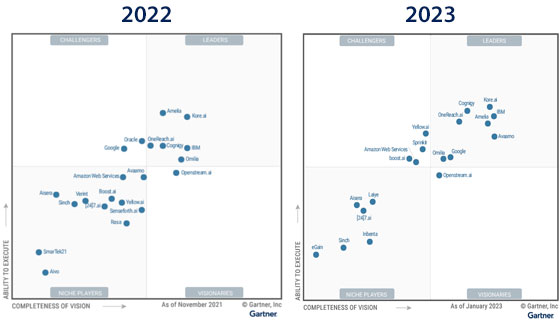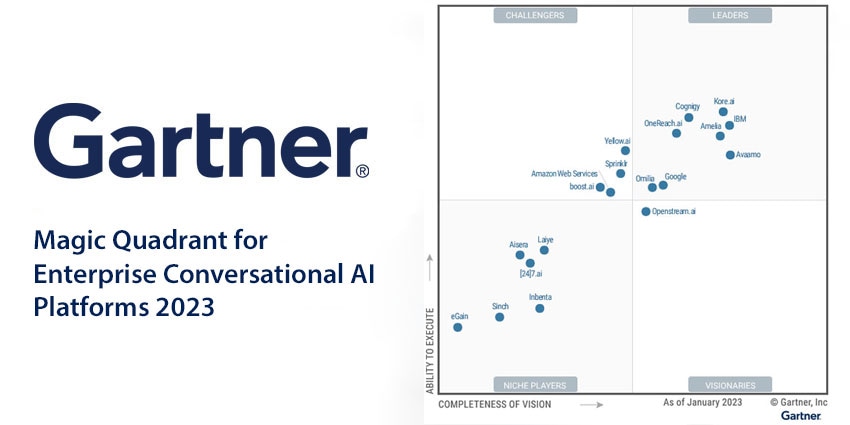
Gartner has unveiled its much-anticipated 2023 Magic Quadrant report for Enterprise Conversational AI Platforms.
The release comes amid surging interest in the market. Much of this stems from the rise in ChatGPT and intrigue into how large language models may transcend the space.
Yet, it is also the continuation of an ongoing trend. In August last year, Gartner predicted that conversational AI will automate six times more agent interactions by 2026 than it did then.
As such, conversational AI vendors are licking their lips, excited by massive growth prospects in customer service and the broader enterprise.
The trouble is, they’ve got rivals - and lots of them.
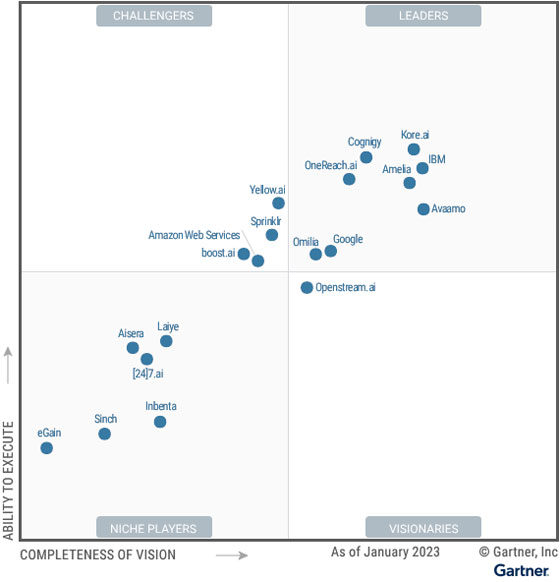
Gartner’s Magic Quadrant aims to break down this competitive landscape, assessing the offerings of 19 prominent global vendors and pinpointing eight market leaders.
The Definition of an Enterprise Conversational AI Platform
An Enterprise Conversational AI Platform allows users to design, orchestrate, and optimize the development of numerous enterprise bot use cases across voice and digital channels.
These use cases typically split into three groups: customer care, employee support, and enterprise NLP resources. The latter involves repurposing the NLP within bots for conversational analytics, document processing, real-time transcription, and more.
According to Gartner, a conversational AI platform supports these applications with both a capability and a tooling layer.
The capability layer includes NLU, dialogue management, channel and back-end integration, access control, and lifecycle management.
Meanwhile, the tooling layer encompasses a no-code environment for designing applications, analytics for understanding dialogue flows, NLU intent tuning, and A/B flow testing.
The sophistication of each element differs significantly from one vendor to another – as do the services they provide across various geographies.
Thankfully, the analysts at Gartner have delved deep into the offerings of many conversational AI providers, dividing them into one of four segments: Leaders, Challengers, Visionaries, and Niche Players. Here, we review them all.
Gartner Magic Quadrant Leaders
Leaders in the Magic Quadrant guide innovation within the conversational AI space, showcasing a sharp vision and proven ability to execute. In doing so, these vendors lead the market in their creativity, platform features, and market understanding. This year’s leaders are:
- Kore.ai
- IBM
- Amelia
- Cognigy
- Avaamo
- OneReach.ai
- Omilia
Kore.ai
Kore.ai leads the market in its ability to execute while falling just shy of Avaamo and IBM in its vision. In achieving these results, Gartner notes that the vendor excels in its market understanding of conversational AI applications that supplement both the customer and employee experience. The market analyst also gives great acclaim to Kore.ai’s extending set of enterprise-ready prebuilt solutions, overall product capabilities, and skilled R&D team.
IBM
IBM Research added 400 speech, NLP, and conversational AI patents to its roster in 2022, taking its total up to 2,700. This exemplifies its thirst for innovation, which Gartner gives the vendor significant credit for. Other notable strengths include IBM's impressive range of external researchers and partners (including MIT), far-reaching global strategy, and the capabilities of the Watson Assistant. These include advanced agent escalation, conversational analytics, and prebuilt flows.
Amelia
NLU is a significant differentiator for Amelia, with its "distinctive multithreaded approach" to AI. This combines deep neural networks with semantic understanding and domain ontologies to enable sophisticated reporting capabilities and next-level bot optimization. While underlining this as Amelia's forte, Gartner applauds the company's product strategy and marketing execution as an excellent growth lever. So too, is its close partnership with CCaaS market leader NICE.
Cognigy
Perhaps most impressive of all the strengths Gartner notes is Cognigy’s continuously impressive customer feedback. The market analyst notes that clients often shine a particularly positive light on its platform’s usability, deployment options, and documentation – alongside the accompanying support services and training. Other plus points from the report include its clear product architecture, industry-specific innovation, and sustainable business model.
Avaamo
Shooting across the Magic Quadrant this year, Avaamo now appears to lead the conversational industry in the completeness of its vision. Such a vision has helped the vendor – considered a niche player in 2022 – innovate and differentiate, with Gartner tipping its cap to Avaamo’s understanding of how to best blend NLP and adjacent technologies. The market analyst also notes the vendor’s voice capabilities and industry-specific strategies – particularly in healthcare – as notable strengths.
OneReach.ai
OneReach.ai develops conversational AI applications that support the holistic "intelligent digital worker", rather than focusing wholeheartedly on contact center automation. It has enjoyed success with such a strategy, and Gartner believes this reflects its exceptional market understanding. The market analyst also pinpoints OneReach.ai's prebuilt connectors to different channels – enabling multimodal virtual assistants – their usability, and customer support as further differentiators.
Google brings together a highly scalable global cloud architecture with some of the strongest AI research facilities in the world. Much of this R&D funnels cutting-edge AI capabilities into its new Contact Center AI (CCAI) Platform – increasing the scope of its conversational AI innovation. As such, it may offer "technology-leading features" for the contact center – according to Gartner. These include agent-assist, post-call summarization, and speech-to-text innovations.
Omilia
Omilia’s most defining strength is likely in its voice capabilities, with significant expertise in building telephony integrations, passive voice biometrics, and out-of-the-box, prebuilt bots. Yet, its architecture – which consists of Omilia Cloud Platform (OCP) miniApps – also garners praise from Gartner. These make it possible to turn tasks and skills into modules that designers can reuse across their other bot-based projects for no additional cost.
Gartner Magic Quadrant Challengers
Challengers in the Magic Quadrant exhibit a track for delivering upon client expectations. With this, they have gained a considerable market presence. However, they often lack the vision to rip up the script and create nuanced uses of conversational AI. This year’s challengers are:
- Yellow.ai
- Sprinklr
- Amazon Web Services (AWS)
- boost.ai
Yellow.ai
Jumping up the Magic Quadrant in 2023, Yellow.ai has seemingly gone to great lengths to prove its ability to execute. Much of this fixates on buyer personas and customer needs. Yet, Yellow.ai's explosive employee growth - doubling the size of its staff last year – has likely lifted its reputation for delivering customer outcomes. With that said, it still lags behind the leaders in the number of patents it holds, which may stifle its future innovation ambitions, according to Gartner.
Sprinklr
Featured for the first time, Sprinklr springs into the challenger segment thanks largely to its contact center expertise. Indeed, Gartner shines a positive light on its outbound communication automation, agent-assist, and agent-augmentation features – each accompanied by "solid" R&D efforts. The analyst suggests these are strong enough for Sprinklr to sustain its innovation objectives. However, most consider Sprinklr a marketing tool, with conversation AI lacking visibility within its portfolio.