
Employees are leveraging more applications than ever before to help them fulfill various tasks.
While all these solutions allow workers to achieve new objectives, digital friction has become a significant employee experience blocker.
As such, brands are increasingly turning to Digital Employee Experience (DEX) management tools to ensure a thriving digital workplace.
Indeed, Gartner predicts that 50 percent of digital workforce leaders will have a DEX strategy and tool in place by 2026, up from 30 percent in 2024.
After sharing this and many other statistics, Gartner offers an in-depth overview of the DEX market, evaluating the offerings of 16 management tool providers and isolating five market leaders.
The Definition of Digital Employee Experience Management Tools
Digital Employee Experience (DEX) management tools monitor how employees engage with the technologies they leverage and their sentiment toward them.
These tools do so in real time, aggregating various data sources - including endpoints, applications, and employee surveys - to offer an overview of how multiple teams leverage their technologies.
In doing so, businesses can isolate unreported IT issues, inform automation projects, gauge new tech adoption, improve IT support, and so on.
Additionally, organizations can run several other initiatives with a DEX management tool. For example, they can remove unused licensed software to reduce costs and security risks by ensuring patching compliance.
Gartner notes that such a solution must offer these three mandatory features to enable such benefits and use cases.
- Data Collection – Features include an Agent for Windows, employee sentiment surveys, and custom integrations with HR, ITSM, and other APIs to import data from different sources.
- Analysis and Insights – Capabilities include a scoring mechanism, usage statistics, root cause analysis, and more.
- Taking Action – Functionalities include self-healing automations, scripts, and employee engagement via workstream UC platforms, like Microsoft Teams, Slack, or Zoom.
Other common features include compliance certifications and various integrations connecting the tool to adjacent technologies, like a business intelligence or data analytics platform.
In the busy DEX management market, many vendors can offer all this.
For its inaugural DEX Magic Quadrant, as shared below, Gartner split 16 providers into four categories: Leaders, Challengers, Visionaries, and Niche Players. Here’s how they performed.
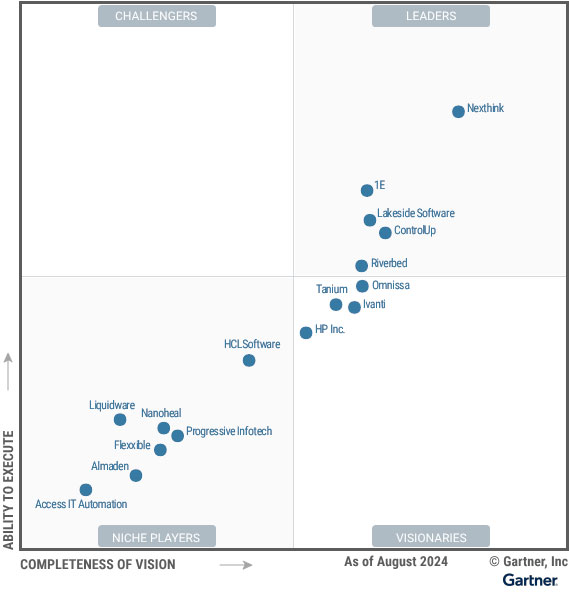
The 2024 Digital Employee Experience Management Tools Magic Quadrant Leaders
Leaders in the Magic Quadrant couple a track record for execution with a forward-thinking vision for how the IT team can continually analyze and enhance the digital employee experience. They also offer a deep platform installed across "most" geographies and sectors. This year’s Leaders are:
- Nexthink
- 1E
- Lakeside Software
- ControlUp
- Riverbed
Nexthink
Nexthink offers DEX management for all “major” virtualization environments, applications, and UC platforms – including Microsoft Teams and Zoom. It also adds new capabilities, flow connectors, and library items with a monthly cadence. That rapid cycle, paired with its “highly extensible and scalable” platform, receives acclaim as Gartner ranks “product” as a core strength for Nexthink. Others include its market execution and understanding, evident in how the vendor has stayed at the market’s forefront since its inception.
1E
After only shifting into the DEX market in recent years, 1E has made up for lost time with its impressive market responsiveness. That is evident in its use-case-specific offerings, such as 1E for Microsoft Intune. Such packs cost less than ordinary bundles and help customers jump from endpoint management to a broad DEX management strategy. Gartner also commends 1E for its "elastic" SaaS architecture, which enables significant scalability, and its bundling sales strategy.
Lakeside Software
Despite its long history in the market, Lakeside Software has kept pace with its evolution, as evident in its SysTrack platform’s capacity for proactive problem resolution functionality. That functionality aligned to target buyers. Recognizing such capabilities, Gartner isolates its innovation cycle as a central strength alongside its ability to drive new growth and scale, extensive partner ecosystem, and sales strategy. The latter involves selling the platform at a price lower than most competitors.
ControlUp
ControlUp primarily differentiates through its product strategy. That includes native remote control for PCs, a low-code workflow orchestration engine for remediations, and data capture intervals of just three seconds. As such, it’s no surprise that Gartner notes “product strategy” as a big plus for ControlUp, alongside its market understanding and business model. With that model, it has accrued significant investment, raising $140MN from four investors during its latest funding round.