
DevOps is a critical cog within an enterprise’s digital transformation strategy.
After all, it accelerates the rate at which solutions pass through the software development cycle.
Moreover, it safeguards the quality of the solution as it undergoes such development.
As such, DevOps brings several benefits, from speed and quality of innovation to business agility. It does so through a series of philosophies, practices, and tools.
A DevOps platform houses these, unifying the work of application developers and IT teams.
The Definition of DevOps Platforms
According to Gartner, a DevOps platform provides “fully integrated capabilities to enable continuous delivery of software using Agile and DevOps practices.”
These capabilities support the six stages of the software development cycle: planning, analysis, design, implementation, testing and integration, and maintenance.
The analyst also states that DevOps platforms reinforce collaboration, ensure the secure development of software, and monitor various delivery metrics.
Moreover, the platforms help lower friction points within complex toolchains, minimize manual handovers, and increase visibility throughout the development cycle.
DevOps platforms support various use cases, with Gartner sharing the following six examples:
- Agile software delivery
- Mobile app delivery
- Edge computing scenarios
- Regulatory requirements
- Cloud-native application delivery
- Platform engineering
Of course, some platforms will better suit particular use cases.
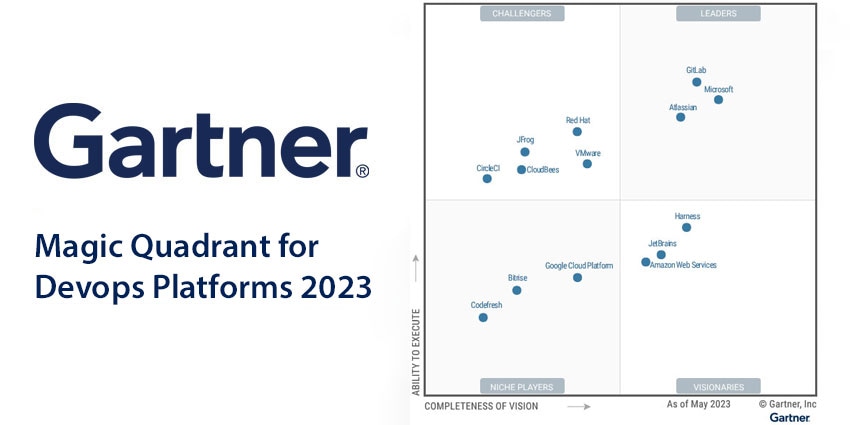
Yet, Gartner has taken a high-level view, splitting 13 vendors into four categories: Leaders, Challengers, Visionaries, and Niche Players – as the quadrant below showcases.

The 2023 DevOps Platforms Magic Quadrant Leaders
Leaders influence the direction of the DevOps space with their thought leadership and services. They back this up with “functionally rich platforms” and a robust capability set throughout the software development lifecycle. As such, these vendors have supported various organizations and use cases. This year’s leaders are:
- GitLab
- Microsoft
- Atlassian
GitLab
GitLab offers complete transparency and traceability across the software delivery pipeline, from base-level code to software apps already in production. That visibility is critical from a security standpoint. Meanwhile, GitLab also builds security into its software development workflows – which Gartner lauds. The market analyst also notes its open-core business model, which allows customers to add capabilities to its core platform, as another significant strength and differentiator.
Microsoft
Microsoft provides two different DevOps platforms: GitHub and Azure DevOps. Yet, customers can procure both with a single license and benefit from several integration points. That may confuse customers. Nonetheless, Microsoft has a thriving developer community that bridges the gap. It also eases the adoption of GitHub workflows and associated solutions. As such, Gartner highlights the community as a core strength alongside Microsoft’s AI-augmented development and cloud development environments.
Atlassian
Atlassian encompasses solutions from Bitbucket, Confluence, Jira Software, Jira Service Management, and Opsgenie. Gartner singles out the combination of Jira Software and Confluence for praise, highlighting how the solutions work well together and enable greater planning and content collaboration. Aside from this, the analyst also sheds a positive light on Atlassian vibrant partner ecosystem – which includes 5,300 apps and integrations – and how the vendor meets the needs of multiple IT and business personas.
The 2023 DevOps Platforms Magic Quadrant Challengers
Challengers can showcase how their solutions have delivered value across particular industries and use cases. That has allowed them to expand their customer base significantly. They have also demonstrated to Gartner their financial strength and commitment to compete at the top of the market. However, they can fall short of leaders in how compelling their roadmap and vision for the future. This year’s challengers are: