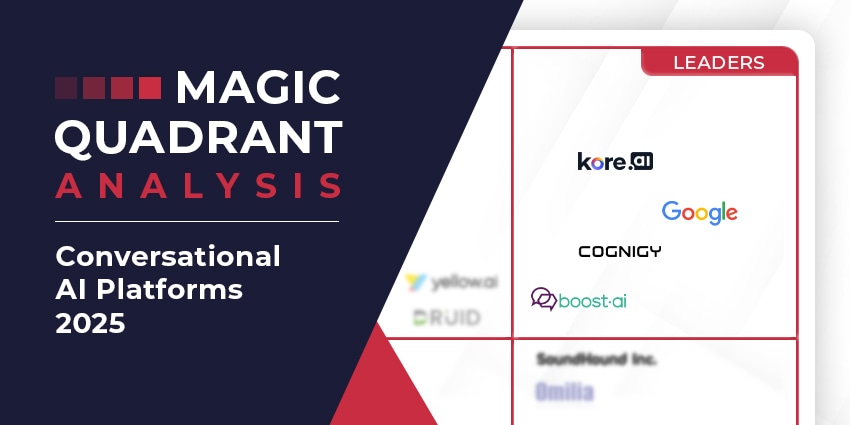
Gartner has dropped its first Magic Quadrant study into the Conversational AI space in over two years.
The report, previously known as the "Gartner Magic Quadrant for Enterprise Conversational AI Platforms", looks very different this time around.
Most notably, many vendors have dropped off. These include OneReach.ai (a former Leader), AWS (a former Challenger), and Openstream.ai (a former Visionary).
Meanwhile, Laiye, Aisera, [24]7.ai, Inbenta, Sinch, and eGain – all previously Niche Players – also no longer feature in the report.
Alongside these slips, the continued omission of Netomi, Uniphore, and Verint is surprising.
However, Gartner did add some key industry players. DRUID AI sprints into the Challenger quadrant. LivePerson and PolyAI enter the mix as Niche Players.
In terms of the Leaders, Google has surged to the top-right of the matrix, while Kore.ai and Cognigy cement their positions in the square. boost.ai enters the Leader quadrant, sliding across from the Challenger group.
IBM, Omilia, and Avaamo have exited the top-right square, earning Challenger, Visionary, and Niche Player spots, respectively.
SoundHound (formerly Amelia) has also dropped into the Visionary square from its Leader spot, while Sprinklr has sunk from a Challenger to the Niche Player group.
That’s a lot of change, compared with most other Magic Quadrant studies, likely underlining the significant impact that the rise of generative and agentic AI has had on the space.
The Definition of a Conversational AI Platform
Conversational AI platforms allow teams to build applications that simulate human interaction across voice and digital channels.
Thanks to industry-wide advancements, the platforms now provide no-code builders, multimodal capabilities, and dedicated conversational intelligence modules as a standard.
While typically deployed to automate customer service conversations, each vendor in this report also supports employee assistance and commerce, sales, and marketing automation use cases.
In doing so, they democratize conversational AI tooling, helping businesses operate more cohesively and efficiently.
That’s the breakdown, although Gartner includes an exhaustive list of mandatory and common features for conversational AI platforms in its report.
From there, the analyst evaluates 13 prominent platform providers, splitting them into four categories: Leaders, Challengers, Visionaries, and Niche Players. Here’s how they performed.
Gartner Magic Quadrant Leaders
Leaders in the Magic Quadrant couple a global base of satisfied customers across many industries with a commitment to continued innovation. They’ve also demonstrated an agile foundation to move with the latest industry trends and changes in customer requirements. This year’s Leaders are:
- Kore.ai
- Cognigy
- boost.ai
Google earns plaudits for its "AI research investment", with Gartner citing its DeepMind initiative, research and development (R&D), streak, and collection of patents.
One such patent is for an on-device conversational application for consumers, allowing them to turn to leverage an AI agent when a business calls them. That beckons the future of machine-to-machine customer service.
However, its AI investment is also evident in its advanced Vertex AI capabilities, which include an emotional awareness feature, real-time video input, and support for "human-like" voices.
Alongside that investment, Gartner also commends the cloud giant for its "geographic presence" and "market responsiveness".
Yet, it doesn’t note how Google is one of only two providers included in this report to own a first-party CCaaS solution. By making "Conversational Agents" available within that, Google opens up a significant opportunity for vendor consolidation.
Kore.ai
Kore.ai wins credit for its "product strength". That covers its complete portfolio, which comprises three agentic AI platforms for customer service, employee support, and business productivity.
Yet, while the analyst lauds its portfolio strength, it doesn’t mention how Kore.ai is often first to market with solutions that go on to become conversational AI platform staples. A recent example is its Knowledge Graph for personalized, detailed, automated customer responses.
That said, Gartner does note Kore.ai’s "business model adaptability" and "employee development programs" as key strengths. The latter has helped the vendor triple its headcount in just four years.
Alongside all this, Kore.ai has boosted its market presence via close partnerships with leading CCaaS vendors, including AWS, Genesys, and Zoom. With Cognigy soon to be acquired by NiCE, it may reap further reward from these collaborations.
Cognigy
At the time of Gartner’s evaluation, NiCE hadn’t yet announced its agreement to acquire Cognigy.
That caused quite the stir, as Cognigy shares a diverse customer base with many of NiCE’s competitors, thanks to years of forging tight partnerships in the contact center space.
While those partnerships may now be up in the air, that customer diversity is a key strength for Cognigy, as it supports an array of use cases, with revenues spanning industries.
Gartner applauds this, alongside Cognigy’s "product capabilities" and "market understanding".
As with Kore.ai, those capabilities are often ahead of their time. Its agent persona-building capability is probably the best recent example of this, something now becoming mainstream.
Finally, while Gartner doesn’t note this, the vendor’s large enterprise presence is notable, particularly across Europe, helping double Cognigy’s revenue from 2023 to 2024.
boost.ai
Surging into the Leader Quadrant, boost.ai impressed Gartner with its "responsiveness to market changes", with the analyst citing its quick development of new enterprise-grade security, collaboration, and persona-building tools as examples.
Gartner also cites "sales strategy" and "customer experience" as core strengths. Indeed, the vendor is well-regarded for its combination of rapid deployments and high-touch support.
Yet, one critical differentiator for boost.ai, which the report neglects to mention, is its price point, which sits well below the market average for conversational AI platforms.
Over time, it has become the budget-friendly option for enterprises. That perception, matched with its robust presence on third-party marketplaces, makes it a highly accessible solution.
Gartner Magic Quadrant Challengers
Challengers in the Magic Quadrant present dependable solutions, backed by a strong operational and financial backbone. However, they typically focus on helping brands make incremental gains, not delivering pioneering innovation or influencing the market’s direction. This year’s Challengers are:
- Yellow.ai
- DRUID AI
- IBM
Yellow.ai
Yellow.ai garners acclaim from Gartner for its "market strategy" and "cross-industry feedback", with the analyst citing high customer ratings for its platform’s "overall usability" and CX.
Its "pricing model" is another core strength, which the analyst describes as clear, predictable, and flexible. That’s increasingly crucial, as while there’s no single-best pricing model for conversational AI, vendors should be able to explain why it aligns with specific customer needs.
Notably, this goes back to another of Yellow.ai’s key strengths: execution. While Gartner didn’t highlight this, the vendor goes deep on different buying personas and their particular requirements. That enables it to translate pricing models and other key platform features for specific buyers.
However, Gartner did list cautions, hinting at why Yellow.ai missed out on the Leader Quadrant. These include "limited" investments in research and achieving global regular certificates.