
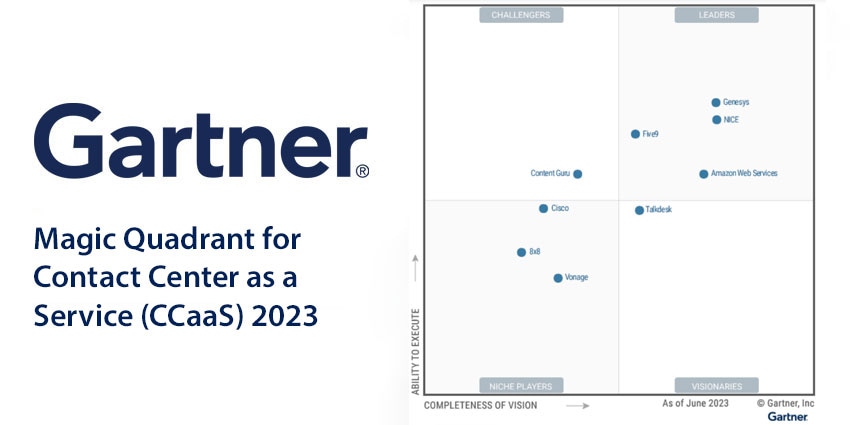
According to Gartner, the CCaaS market continues to expand at a double-digit rate.
Some may argue that the promise of improving agent experiences, better managing "peaky" contact volumes, and utilizing large language models (LLMs) is proving difficult to ignore.
Yet, many more factors are driving this trend. Some of the most notable include the sustained strategic importance of customer experience, new AI and automation opportunities, and the market’s mounting maturity.
Some vendors do an excellent job in pushing that maturity forward, pushing the boundaries of CCaaS, and influencing the direction of the space.
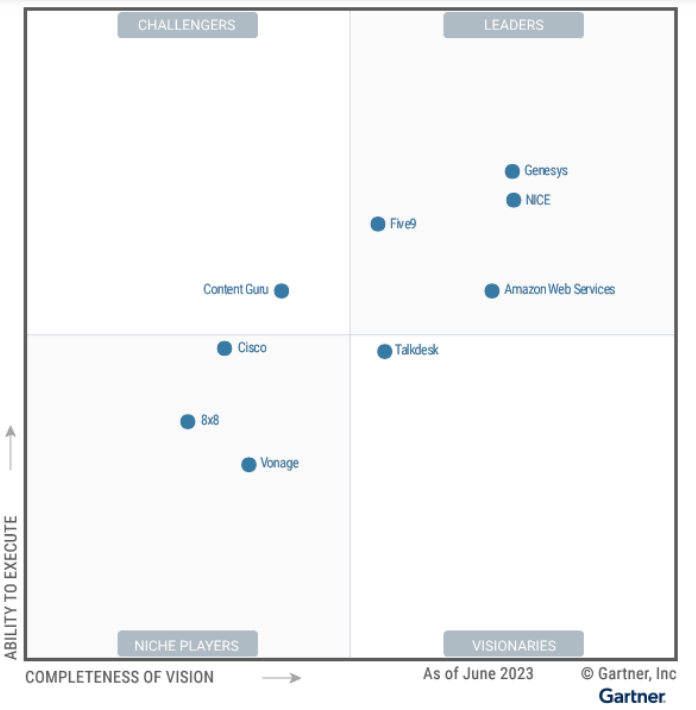
In the 2023 Magic Quadrant for CCaaS, Gartner has investigated nine prominent providers, uncovering four market leaders that do so.
→ THE 2024 Edition: Check out CX Today's coverage of the latest Gartner Magic Quadrant for CCaaS.
The Definition of Contact Center as a Service (CCaaS)
All SaaS applications that enable and support businesses as they engage with customers fall under the term "CCaaS".
Providers in this Magic Quadrant bunch these applications together to build CCaaS platforms, leveraging both native apps and integrations with third-party solutions.
As per Gartner, there are four cornerstones of a CCaaS platform – which the analyst previously labeled as its "pillars of great customer service". These are:
- Contact routing and interactions - These apps pass customers to the best-placed agents – live or virtual - across the optimal engagement channel.
- Resource management – Such tools enhance agent experiences with next-generation workforce optimization (WFO) tooling.
- Process orchestration – These solutions handle complex customer engagements with a degree of personalization.
- Knowledge and insight – Such features uncover new customer, employee, and operational insights that inform next-best actions.
Leading CCaaS vendors will offer native applications across these four fundamental arenas, often with optional integrations to supplementary best-of-breed applications.
These APIs typically come in a marketplace, as each vendor included within the Magic Quadrant study provides.
Such a marketplace also includes integrations to technologies in adjacent markets – such as CRM, UCaaS, ERP, order management, BI, and other platforms.
With all this choice, leading CCaaS vendors allow customers to access more enterprise data and customize service experiences.
However, there is much more to a "leading" vendor than its ecosystem. Further considerations that Gartner accounts for include the overall quality of the product/service, its viability, and sales execution/pricing – alongside many others.
In doing so, Gartner split the nine vendors into four groups: Leaders, Challengers, Visionaries, and Niche Players.
Gartner Magic Quadrant Leaders
Leaders in the Gartner Magic Quadrant impress with the breadth and depth of their solutions, which many multinational organizations leverage within large-scale enterprise environments. In addition, they demonstrate a robust sales and support presence across the globe, enjoy high brand recognition, and have experienced above-average market growth. This year’s leaders are:
- Genesys
- NICE
- Amazon Web Services (AWS)
- Five9
Genesys
Last year, Genesys made a tough decision to move from three CCaaS platforms to one, focusing its innovation on its Cloud CX platform.
However, that did not endanger its leader status. Instead, it seemingly preserved "strong revenue growth." Gartner pinpointed this continued growth as a core strength, allowing Genesys to pump funds into public cloud research and development (R&D) and its continued expansion.
The expansion has furthered the vendor’s operational and channel presence across numerous regions. That makes Genesys a "strong contender" for organizations as they consolidate their contact center – according to Gartner.
Finally, the analyst lauds the processes and solutions Genesys offers its customers to support migrations from legacy environments.
NICE
Within its CXone CCaaS platform, NICE offers Enlighten AI, which feeds from a wealth of anonymized intent and action data gathered by the vendor over many years.
As it does so, Enlighten has become increasingly sophisticated, with Gartner noting how its AI models power impressive conversational guidance and journey orchestration capabilities across CXone.
The analyst also highlighted NICE’s specialist consulting across specific sectors and vision for supporting end-to-end digital journeys as core strengths.
Surprisingly, Gartner did not underline workforce engagement (WEM) or robotic process automation (RPA) as essential differentiators despite the vendor’s expertise and product depth in these arenas.
Amazon Web Services (AWS)
After successive years as a visionary, AWS has broken into the leader quadrant after sustaining its furious speed of CCaaS innovation and differentiating its pricing approach.
Indeed, Gartner refers to the Amazon Connect pricing model as "the most agile in the CCaaS market," ensuring customers only pay for the seats and capabilities they leverage.
Moreover, contact centers can trial new features in a playground environment without long-term commitments, encouraging experimentation and innovation across various channels.
Finally, Gartner notes that AWS has now developed a mighty network of development partners to deliver pre-built solutions as an alternative to those that customers piece together themselves.
Five9
Alongside AWS, Five9 has finally broken into the leader quadrant after several years as a challenger. Gartner suggests that its uptick in enterprise deployments is pivotal to this shift.
After all, the vendor once had a reputation for selling to midsized contact centers. Yet, it has undergone a rapid global expansion and now routinely implements CCaaS solutions across service operations with thousands of agents.
A significant draw for those enterprise customers is Five9’s AI competency, with the vendor showcasing its ability to deliver many use cases across various verticals.
