
Ten years ago, few could have predicted the diverse channel mix that customers use to communicate with brands today.
There are new messaging apps, social media platforms, and even GenAI-powered search. All these channels have created an explosion of touchpoints across the customer journey.
In ten years' time, the channel mix will likely swell further, presenting new opportunities for businesses to keep up with customer preferences, build new journeys, and increase engagement.
An agile foundation is pivotal to prepare for this future, and CPaaS provides it.
As such, researchers expect the market to expand rapidly. Indeed, Gartner predicts that – by 2026 - 90 percent of businesses will leverage CPaaS platforms, up from 30 percent in 2022.
Yet, the CPaaS space is swarming with vendors, making it difficult for buyers to see through the weeds and select the best solution for their business.
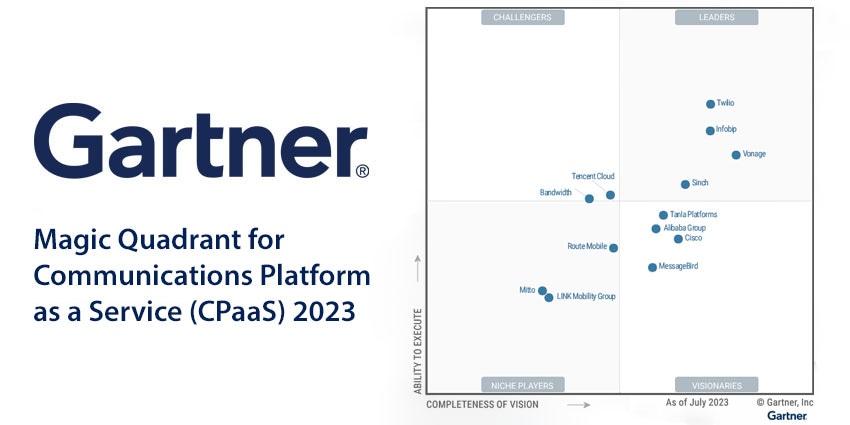
Thankfully, Gartner has evaluated the propositions of 13 leading CPaaS providers to help businesses do so. Through that evaluation, the analyst has isolated four market leaders.
The Definition of Communications Platform as a Service (CPaaS)
A CPaaS platform contains a myriad of APIs, SDKs, and cloud technologies that enable real-time communications by injecting digital channels into customer journeys.
In doing so, it facilitates access to various communication channels. Some of these are evident in Gartner’s minimum core capabilities. These include APIs to:
- Make and accept voice calls
- Route those calls via inward dialing (DID)
- Register phone numbers
- Perform identification and verification (ID&V) tasks
- Send and receive SMS messages
Gartner also stipulates that a provider must enable at least one other messaging app - such as WhatsApp, RCS, Google Business Messages, etc.
Moreover, that vendor must demonstrate rich communication capabilities across the channel – such as voice calling, image sharing, and emoji.
The analyst also expects providers to provide support services for all these core capabilities, including an onboarding program, technical care, and dashboards.
Finally, there are many optional capabilities. These include advanced voice, video, and programable wireless services. The latter includes E-SIMs and IoT-packaged solutions alongside 5G-enabled communications APIs.
Gartner assessed all these capabilities – and more – to split the 13 CPaaS providers into four groups: Leaders, Challengers, Visionaries, and Niche Players. Here’s how each performed.

Gartner Magic Quadrant Leaders
Leaders in the Gartner Magic Quadrant have the most influence on the market's direction. In doing so, they demonstrate a defining vision for how businesses can deploy CCaaS across many use cases, which they back up with a proven ability to execute. Indeed, each can showcase how they deliver consistent business results through references and growth. This year's Leaders include:
- Twilio
- Vonage
- Infobip
- Sinch
Twilio
Twilio CEO Jeff Lawson somewhat pioneered the CPaaS market, and since the vendor has established an expansive CPaaS platform. Gartner recognizes this, giving plaudits to its deep base of programmable communications channels and rich developer ecosystem. That ecosystem includes training programs, code samples, a developer evangelism team, and more. Finally, the analyst pays tribute to the operational experience Twilio offers its customers. That includes quality security certifications, streamlined onboarding, and global customer support.
Vonage (an Ericsson company)
Gartner highlights Vonage’s emphasis on innovation as a core strength – highlighting how it combines CPaaS with its AI studio, multichannel conversation solution, and eCommerce tools. Yet, how it links the technology with Ericsson’s 5G network APIs is perhaps the most fascinating example Gartner gives, as these APIs allow Vonage to differentiate through mobility. Other significant plus points include Vonage’s “attentive” customer support and verticalization strategy. Indeed, the vendor offers solutions across retail, healthcare, finance, and many more sectors.
Infobip
Infobip has a robust private network backbone, with 43 global data centers and 800 direct operator connections, allowing the vendor to offer delivery guarantees. Moreover, the spine supports its impressive international reach. Customers cite this as highly beneficial, alongside the vendor's scaling capacity, flexibility, and responsive service. Finally, Gartner notes Infobip's solution-oriented go-to-market as a strength. That focus – coupled with its professional services - allows the provider to bring CPaaS to a new audience: businesses often daunted by developer-focused initiatives.