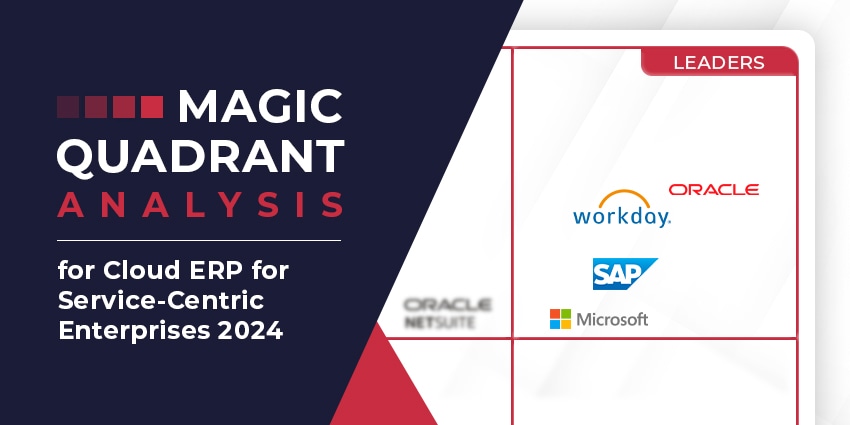
The Cloud ERP for Service-Centric Enterprises 2024 Magic Quadrant is here, with Oracle (Fusion Cloud ERP) in the top-right corner for consecutive years.
However, Oracle is not alone as a Magic Quadrant leader. It's joined by Workday, SAP (S/4HANA Cloud), and - in a change from the 2023 edition - Microsoft (Dynamics 365).
That is the only significant shift in positioning, with no other vendors switching quadrants from last year.
Interestingly, many vendors have multiple products included in the study. Indeed, Oracle (NetSuite) sits in the challenger square. Meanwhile, Microsoft (Business Central) and SAP (Business ByDesign) are niche players.
Sage and Certina also feature as niche players, pegged to the bottom-left of the Magic Quadrant matrix.
Gartner has added no new vendors to its 2024 report.
The Definition of a Cloud ERP for Service-Centric Enterprises
An ERP system is a platform that comprises solutions for managing business-wide processes.
As such, it acts as the central source of truth across various functions, including customer-facing teams, HR, manufacturing, supply chain, procurement, etc.
The ERP systems featured in the Gartner Magic Quadrant are cloud-based, and the analyst evaluates their ability to serve businesses that primarily offer services, not products.
In doing so, these ERP systems offer various financial, human capital management (HCM), and administrative functionalities – alongside integrations, automation tools, and analytics.
Gartner Magic Quadrant Leaders
Leaders in the Magic Quadrant demonstrate a pioneering vision of how the cloud can support and improve service-centric ERP systems and processes. This year’s leaders are:
- Oracle (Fusion Cloud ERP)
- Workday
- SAP (S/4HANA Cloud)
- Microsoft (Dynamics 365)
Oracle (Fusion Cloud ERP)
Gartner commended Oracle for the maturity of its core functions for service-centric enterprises. Among others, these included cloud financial, people, project, and third-party resource management. "Big Red" also earned praise for its robust application and data integration capabilities alongside its embedded AI.
Workday
Workday wins plaudits for its “unified data core” that supports the AI features embedded into its platform. Gartner also praises the platform’s affinity with the broader Workday stack, including its Human Capital Management (HCM), configure-price-quote (CPQ), and financial management system (FMS) solutions.
SAP (S/4HANA Cloud)
Like Workday, SAP earns acclaim for how S/4HANA Cloud fits into its broader portfolio. Additionally, Gartner lauds the global support network that SAP wraps around the platform alongside its embedded AI features. That now includes agentic AI, with the tech giant rapidly building out Joule, its copilot turned AI Agent hub.
Microsoft (Dynamics 365)
Microsoft wins praise for how its Dynamics 365 platform has embedded GenAI with Copilot. Now, with Copilot Studio, the ability for enterprises to build their AI agents for the ERP is massive, as it may allow them to recreate much of their on-premise customizations in the cloud. Gartner also credits Microsoft's Azure and native FMS capabilities.
Gartner Magic Quadrant Challengers
Challengers in the Magic Quadrant have a more significant market presence than Niche Players and Visionaries. Yet, they lack the broader vision of leaders to drive industry innovation forward. This year's challengers are: