From multi-device experiences to integrating Internet of Things (IoT) services, many trends are transforming the ERP space.
Compossibility, collaboration, and hyper-automation... these are just some of the others touching the market and twisting its direction.
Then, there is AI, which is not only moving the ERP innovation needle but also driving the demand for an ERP-suite approach to improve data management.
Indeed, the space is experiencing several waves of disruption, which leading vendors must surf to stay at its forefront.
Some manage this better than others, pushing the market forward while ensuring the expected outcomes for customers.
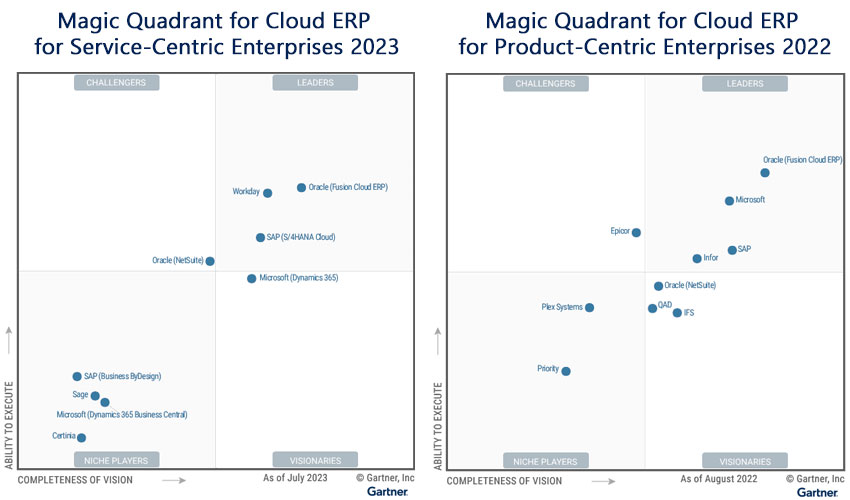
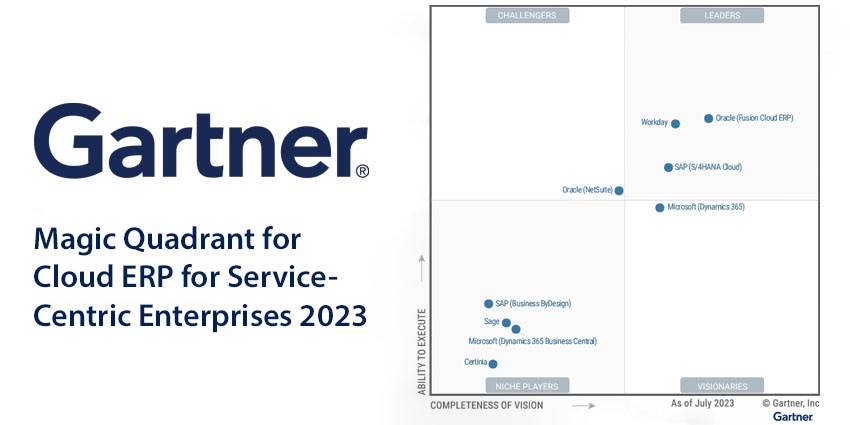
The Gartner Magic Quadrant for Cloud ERP for Service-Centric Enterprises 2023 has evaluated the nine propositions that promise to do so – uncovering four leading offerings in the process.
→ THE 2024 Edition: Check out CX Today’s coverage of the latest Magic Quadrant for Cloud ERP for Service-Centric Enterprises.
The Definition of Cloud ERP for Service-Centric Enterprises
According to Gartner, a service-centric cloud ERP platform provides an integrated solutions suite that includes at least three of the following functionalities:
- A Financial Management System – Such a system includes accounts payable, accounts receivable, general ledger, and more financial planning tools.
- Order-to-Cash – These capabilities range from cash collection functionality to configure, price, and quote (CPQ).
- Source-to-Pay – This category features contract life cycle management, e-purchasing, e-sourcing, and many similar capabilities.
- Human Capital Management – Think of HR tools such as position management, employee lifecycle, and core data management features.
- Other Administrative ERP functionality – Such capabilities cover areas like planning and analysis, service procurement, and project management.
Industries where businesses are likely to choose a service-centric cloud ERP over a more product-centric cloud ERP include healthcare, financial services, and telecommunications, amongst others.
These typically place more emphasis on service than companies in sectors such as manufacturing, deliveries, and servicing of goods.
As such, Gartner placed more emphasis on these particular verticals when conducting its study and pulling together the report.
In doing so, the analyst split the nine cloud ERP offerings into four camps: Leaders, Challengers, Visionaries, and Niche Players.
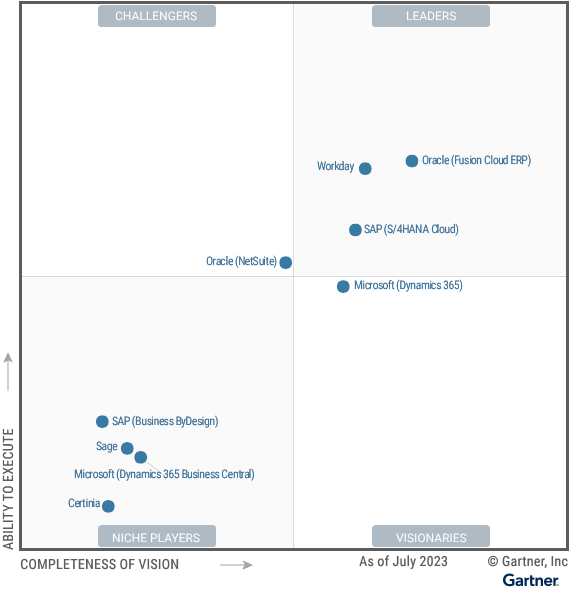
Gartner Magic Quadrant for Cloud ERP for Service-Centric Enterprises 2023
Gartner Magic Quadrant Leaders
Leaders in the Gartner Magic Quadrant demonstrate a "market-defining" vision coupled with a track record of executing that vision through solutions, services, and strategy. In doing so, they’ve established a broad global presence, a proven ability to secure enterprise deals, and trust amongst systems integrators in supporting financial transformation programs. This year’s leaders include:
- Oracle (Fusion Cloud ERP)
- Workday
- SAP (S/4HANA Cloud)
Oracle (Fusion Cloud ERP)
Oracle gains plaudits for the "mature" cloud financial, people, and project management capabilities inside its Fusion Cloud ERP. Alongside its procurement, financial planning, and analysis (xP&A), and order-to-cash features, these prove particularly valuable to the midsize, large, and global enterprises that derive value from the platform. Gartner also highlights robust application and data integration, development analytics, and support for specific industries as significant plus points. Those industries include healthcare, financial services, and government.
Workday
Workday embeds sophisticated xP&A into its ERP to provide planning models for workforce management, budgeting, third-party resources, and project-based planning from one space. Gartner notes this a significant strength, alongside its financial management and "advanced" HR capabilities. The latter includes innovative features for extended workforce management, skills management, and employee sentiment – with mature machine learning powering these.
SAP (S/4HANA Cloud)
SAP (S/4HANA Cloud) helps to consolidate many non-SAP systems from across the globe, including treasury and cash management solutions. In pulling these together, SAP offers a native tie-in with its Analytics Cloud xP&A platform for advanced analytics. Gartner commends this financial management product vision alongside the vendor’s support services and indirect procurement strategy. Also, the analyst notes "enablement of continuous improvement" as a core strength, as SAP’s portfolio paves the way for establishing and observing progressive internal benchmarks.
Gartner Magic Quadrant Challengers
Challengers in the Gartner Magic Quadrant have developed a deep market presence, typically appealing to a specific segment of the addressable market. Moreover, they often report excellent results when working with that faction. Nevertheless, they seemingly lack the broader vision to challenge leaders and compete with them for contracts that cross all shape and size of enterprise. This year’s challenger is:
- Oracle (NetSuite)
Oracle (NetSuite)
Oracle NetSuite covers CRM, HCM, commerce, and many more business software platforms. As such, it has a significant global presence, which the ERP solution exploits with embedded localization features. These cross various languages, regulation conformities, currencies, and more. Gartner underlines this geographic flex as a critical strength, in addition to NetSuite’s professional services automation and preconfigured implementation. Yet, despite the platform’s expansion, the analyst notes that it still misses xP&A capabilities, such as planning models for projects that include third-party workers.