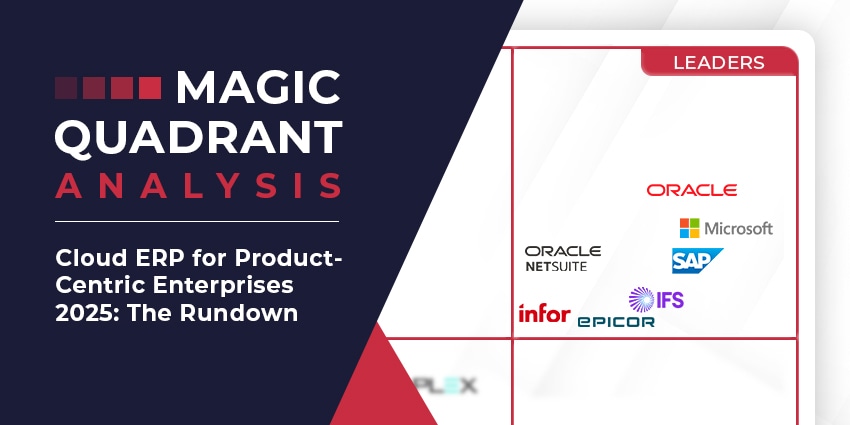
Oracle and Microsoft have emerged as the standout Leaders in the 2025 Gartner Magic Quadrant for Cloud ERP for Product-Centric Enterprises.
The two vendors join a crowded top-right quadrant alongside familiar names such as SAP, IFS, Infor, and Epicor, underscoring a year defined by innovation and acceleration in AI-driven automation.
No vendors were added or dropped from this year’s report, but the positions have shifted dramatically, with this year’s report featuring no Challengers or Visionaries – just Leaders and Niche Players.
Arguably, this is a sign of a market reaching a critical inflection point, as ERP systems evolve from transactional engines to intelligent orchestration platforms.
The Definition of an ERP for Product-Centric Enterprises
A cloud enterprise resource planning (ERP) for product-centric enterprises supports and automates operational activities across manufacturing, distribution, and supply chain sectors.
These systems serve as the backbone of modern product-driven organizations, connecting HR, manufacturing, logistics, and finance, while enabling the scalability and agility that global operations demand.
Vendors in this market deliver not only the infrastructure and core ERP applications but also continuous updates, platform extensions, and the AI-driven intelligence increasingly expected by enterprises.
Gartner Magic Quadrant Leaders
As the name suggests, Magic Quadrant Leaders are the top-performing vendors that demonstrate the strongest vision for how cloud technology and AI can enhance ERP systems, paired with the ability to execute at scale.
This year’s leaders are:
- Oracle (Fusion Cloud ERP)
- Microsoft
- SAP (Cloud ERP)
- IFS
- Oracle (NetSuite)
- Epicor
- Infor
Oracle (Fusion Cloud ERP)
Oracle Fusion Cloud ERP maintains its place at the top of the Leader tree for 2025.
The platform was praised for its breadth of capabilities and its AI Agent Studio, which allows customers to design and orchestrate custom AI agents.
Oracle's strong presence across manufacturing, finance, supply chain, and HCM is underpinned by a unified data model and enhanced Redwood user experience.
Gartner highlights the company's complex corporate capability coverage and agentic AI innovation as key differentiators, while noting that support quality and pricing complexity remain areas for continued improvement.
Microsoft
Microsoft remains a dominant leader through its Dynamics 365 platform, leveraging the power of Copilot-driven AI agents for process automation and supplier communications.
Gartner highlighted Microsoft’s integrated cloud stack – uniting Azure, Power BI, and Copilot Studio – as a defining strength. With its global reach and multi-language support, the platform continues to scale effectively across industries.
However, Gartner advised enterprises to carefully assess customization complexity and industry coverage, particularly for manufacturing-heavy deployments that depend on ISV extensions.
SAP (Cloud ERP)
Formerly known as SAP S/4HANA Cloud Public Edition, SAP Cloud ERP continues to stand tall among Leaders.
In particular, Gartner spotlighted its Joule AI framework, which expands conversational and agentic AI across the suite.
SAP’s broad functionality – from PLM and supply chain to sustainability management – remains a core strength.
Yet, Gartner warned of adoption challenges among large enterprises and portfolio complexity that can make navigating SAP’s ERP lineup difficult.
IFS
IFS’ strong industry depth and an accelerating AI strategy helped the vendor move from Visionary to Leader in 2025.
Its flagship IFS Cloud solution combines enterprise asset management, field service, and manufacturing execution capabilities under a composable, unified platform.
Gartner highlighted IFS’s composability and automation capabilities as standout features, but cautions that ongoing ownership changes and partner support consistency require close evaluation.
Oracle (NetSuite)
Oracle NetSuite moved from Challenger to Leader in 2025, reflecting its continued expansion and ecosystem strength.