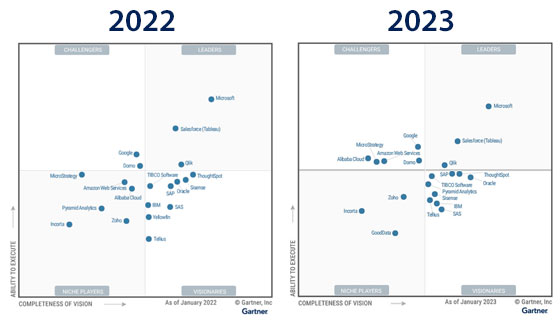
Prominent research firm Gartner has released its much-anticipated 2023 Gartner Magic Quadrant for Analytics and Business Intelligence Platforms.
With enterprises pulling together, sharing insights, and aspiring to become increasingly customer-centric, demand for these platforms is rising.
Indeed, analytics and business intelligence solutions uncover emerging business trends and create a unified view of the customer experience.
As a result, each business unit may sing from the same hymn sheet.
Nevertheless, there are many more components within such solutions. To understand each of these, consider how Gartner defines analytics and business intelligence platforms.
The Definition of Analytics and Business Intelligence Platforms
Analytics and business intelligence (ABI) platforms make it much easier to "model, analyze, explore, share, and manage data" for CX teams – according to Gartner.
As a result, less technical users can uncover and visualize insights, laying the foundations for cross-function collaboration.
AI is playing an increasingly critical role here, spotting trends in data, pulling them together, and automating insight delivery.
Such insights are relevant to the user’s objectives, actions, and workflows.
Yet, this only scratches the surface of an ABI platform’s functionality. The following 12 critical capabilities – as put forward by Gartner – underline this.
- Automated insights
- Analytics catalog
- Data preparation
- Data source connectivity
- Data storytelling
- Data visualization
- Governance
- Natural language query
- Reporting
- Data science integration
- Metrics store
- Collaboration
These features are fundamental differentiators for many of the 20 ABI providers below.
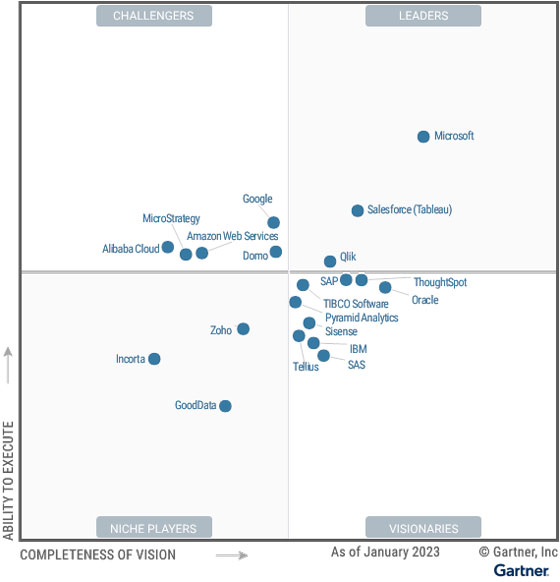
After evaluating each, Gartner separated them into four categories: leaders, challengers, visionaries, and niche players.
The 2023 Analytics and Business Intelligence Platforms Magic Quadrant Leaders
With superior know-how of those core ABI capabilities and a vision to drive client success, leaders deliver a compelling pricing model that "supports proof of value." Alongside this, they pave the way for phased purchases and increased scalability to meet the unique requirements of businesses across numerous industries. This year’s leaders are:
- Microsoft
- Salesforce
- Qlik
Microsoft
In its user adoption, Microsoft "dominates the market." The growth of its Microsoft Power BI cloud service enabled this, with the tech pioneer bundling the solution with other products in its deep portfolio. These include Office 365 and Teams – with the latter allowing enhanced knowledge sharing. Gartner applauds its alignment with these offerings - alongside Azure Synapse - and the value proposition they deliver. The analyst also noted "product ambition" as a core strength – again noting the integration with its broader portfolio - notably Power Apps and Power Automate – as exciting innovation enablers.
Salesforce
With Tableau, Salesforce remains Microsoft’s closest competitor at the forefront of the market. The vendor has built a community of developers around this, which help to ramp up the solution’s adoption. Tagging this approach as "Tableau as a skill", Gartner notes this a significant plus point – in addition to the visual analytics experience incorporated into the system, making it easier to extract meaningful insight. Finally, researchers admired that Tableau had remained cloud-, data source- and application-agnostic despite its Salesforce acquisition, enabling greater composability.
Qlik
Qlik Sense Enterprise SaaS is an ABI platform that includes its Qlik Sense, AutoML, and Application Automation solutions. The latter enables deeper analytics into businesses process with a visual no-code approach. That makes its analytics much more composable than its competitors and is an inherent strength. Gartner notes this, alongside Qlik’s cloud-agnostic approach and comprehensive data & analytics capabilities. Put together after many acquisitions and a laser internal R&D focus, these capabilities support several business personas in gathering and evaluating relevant insights.
The 2023 Analytics and Business Intelligence Platforms Magic Quadrant Challengers
Grabbing the ABI market bull by its horns, challengers provide specific applications proven to continually deliver business value. Nonetheless, some providers seem to trail leaders in the native integrations that bind features within their portfolio. Instead, they may lag in their industry-specific innovation, geographical footprint, and sales channels. This year’s challengers are:
- Domo
- Amazon Web Services (AWS)
- MicroStrategy
- Alibaba Cloud
Google has made significant strides in unifying its BI tools in the past 12 months. Now, it has pieced together the Looker Platform – combining Looker, Data Studio (now known as Looker Studio), and a LookML semantic layer. This layer receives acclaim in the report for allowing businesses to leverage the power of Google Sheets, Microsoft Power BI, and Tableau in coordination with other tools in the Looker platform. Gartner also notes its decision support, workflow features, and further integrations with solutions in the Google Cloud Platform - including Dataproc, Dataprep, and Composer – as cornerstone strengths. Nevertheless, some avoid the platform due to its prevailing developer/data engineer focus.
Domo
Often a platform that businesses with a robust data warehouse foundation select, Domo offers more than 1,000 data and application connectors – all of which are native. To support this, the vendor introduced the "Domo App Framework" to connect these, embed BI into business workflows, and enable what-if analysis in a low-code environment. The example is one example of Domo driving innovation. Gartner praises the vendor for this, alongside its platform’s scalability and multipersona support. Unfortunately, the analyst suggests that its third-party ecosystem is somewhat limited.
Amazon Web Services (AWS)
As it did in the CCaaS magic quadrant, AWS wins praise for the pricing model of its ABI platform Amazon QuickSight, allowing clients to pay-per-use. Moreover, its mature software development kits (SDKs) and APIs enable customers to develop sophisticated embedded analytics use cases. AWS expanded the potential of these further by increasing its investment in its serverless cloud BI service last year to enable complex applications that are less of a burden on the cloud infrastructure. Where AWS lags, however, is in its support services – which include end-user training.
MicroStrategy
MicroStrategy builds organically instead of acquiring code bases. This strategy has given its platform stability and "less buggy code." That platform is also incredibly open, with an emphasis on interoperability that spans multiple clouds and business application stacks. Gartner notes these two elements as significant strengths, alongside MicroStrategy’s reputation for robust reporting and governance – which drives much of its enterprise business. Nevertheless, the analysts believe the vendor trails leaders in its augmented analytics and lack of product differentiation.
Alibaba Cloud
Alibaba impresses with its composable analytics approach. While its Quick BI platform is available as a standalone offering, it fits within the Alibaba LYDaaS portfolio, which provides modular and reusable data and analytics (D&A) capabilities. Gartner admires this approach alongside Alibaba’s digital workplace-oriented analytics and data literacy support programs. Nonetheless, the vendor is very much pegged to the Asia/Pacific region, where competition is growing. The analyst also noted its low market momentum and investment focus as areas of concern.
The 2023 Analytics and Business Intelligence Platforms Magic Quadrant Visionaries
With a differentiated, meticulous vision for the ABI platforms of the future, visionaries can provide deep functionality in specific arenas. Unfortunately, despite their expertise in the space, they often lack the broader portfolio or global presence to deliver a well-rounded ABI platform steadily and at scale. This year’s visionaries are: