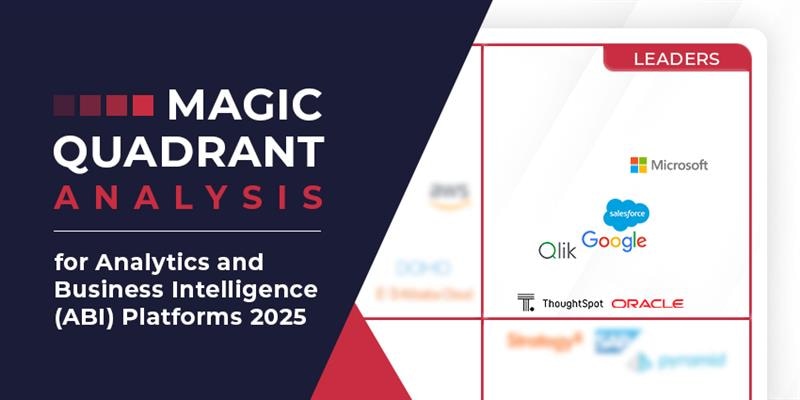
The Gartner Magic Quadrant for Analytics and Business Intelligence (ABI) platforms 2025 looks remarkably similar to the previous year’s edition.
While there are some movers and shakers, continuity is the ultimate winner.
Set against the backdrop of rapid AI advancement, that’s perhaps the biggest takeaway as ABI providers draw a breath and brace for market disruption.
Besides continuity, Alibaba may consider itself the winner, edging closer to the Leader quadrant. Meanwhile, Zoho and GoodData seem set to break free of the Niche Player category soon.
Google and Qlik have compounded their status as Leaders, with Microsoft staying at the market’s forefront.
Sisense is a notable slider, falling further into the Niche Player category despite being on the verge of the top-right quadrant just two years ago.
Sigma is the only new entrant in this year’s comprehensive report, with Omni possibly the most prominent BI provider not to feature in the report.
A Definition for Analytics and Business Intelligence (ABI) Platforms
Analytics and Business Intelligence platforms allow businesses to connect data streams and build models, dashboards, and visualizations around that data.
From there, brands can glean and share insights, spot pain points, and predict trends to enhance business operations.
Yet, as AI matures, the ABI space will shift. Users will soon want to ask questions in plain English and get a dashboard that didn’t exist five minutes previously, a dashboard where even the parameters weren’t defined in advance.
In this sense, the walls of traditional analytics platforms are disappearing.
Some ABI platform providers are more ready for this future than others. As such, vision is more critical than ever, as Gartner weighed its 20 participating vendors.
The analyst also assessed each participant's ability to execute before sorting them into four groups: Leaders, Challengers, Visionaries, and Niche Players. Here’s how they performed.
Gartner Magic Quadrant Leaders
Leaders in the Magic Quadrant demonstrate a "solid" understanding of critical product capabilities, proof of value, and a roadmap to cement their market leadership. They can also offer advanced analytics without necessitating extensive consultation and IT expertise. This year’s Leaders are:
- Microsoft
- Salesforce (Tableau)
- Qlik
- Oracle
- ThoughtSpot
Microsoft
Microsoft again leads the Magic Quadrant with its Power BI solution, with Gartner commending its "dominant" market presence.
The analyst also lauds Copilot for Power BI and how it boosts productivity within data and analytics (D&A) workflows, alongside the platform's integration with Microsoft Fabric. That integration places the ABI platform at the heart of a deep D&A ecosystem.
Another strength not noted by Gartner is its Microsoft 365 integration, which helps democratize insight across the organization. Again, this underlines Power BI’s appeal to enterprises that have invested heavily in the Microsoft platform.
Salesforce (Tableau)
Salesforce wins plaudits for its data preparation tooling and automated insights, which aid users in analyzing data "more effectively". The launch of Tableau Next should extend these capabilities.
Additionally, Gartner pinpoints flexibility, scalability, and a "strong user community" as core strengths, with users considered active partners in developing Tableau’s roadmap. The burgeoning community also ensures customers have access to a high availability of talent.
Beyond the Magic Quadrant analysis, observers typically hold Tableau in high regard for its data visualization capability, embedded BI, and generative AI (GenAI) functionality.
Google excels in its platform governance and administration, controlling access to analytics content and allowing users to identify data sources via an API.
Gartner underscores this and applauds Google Looker's "robust" open architecture, semantic layer, and "simplified" pricing model. The latter allows customers to upgrade as their modeling and analytics strategies evolve, making costs more predictable.
Surprisingly, Gartner doesn’t mention how the search giant’s significant investment in integrating Looker with BigQuery, Workspace, and Gemini bolsters its proposition.
Also noteworthy is how Google supports on-premise and cross-cloud deployments of Looker, unlike its fellow hyperscalers, namely AWS and Microsoft.
Qlik
Qlik demonstrates a track record for "renewed customer success", with Gartner pointing toward its comparatively high customer satisfaction and retention ratings.
The analyst also trumpets Qlik's "associative model differentiation" and cloud- and application-agnostic approach. That approach appeals to buyers with multi-cloud deployments covering a broad spectrum of enterprise apps.
Gartner doesn’t, however, highlight how Qlik has proven ahead of the curve in anticipating the commodification of BI platforms, making timely enhancements to its D&A workflow automation.
Oracle
The Oracle Analytics Cloud integrates closely with the tech giant's Fusion Data Intelligence. That allows it to offer pre-packaged data analytics, integrations, and models for its horizontal apps, from finance to CRM.
Gartner praises this business application integration, alongside Oracle's "market-leading" data preparation capability and AI enhancements. Many of those AI enhancements gear toward distributing automated insights and bolstering data storytelling.
While Oracle doesn't push its offering outside its internal ecosystem, the Analytics Cloud is one of the most comprehensive solutions on the market and a robust option for those already utilizing its CRM and ERP solutions.
ThoughtSpot
ThoughtSpot autonomously spots anomalies in a dashboard, visualizes them, and gives users the tools to analyze them. That's an excellent example of the "automated insights and natural language query capabilities" that Gartner isolates as a core strength.
The ability to embed ThoughtSpot's BI functionality into apps and have analytics trigger actions within them is also a powerful capability bookmarked by Gartner. Meanwhile, the analyst also praises its "increasing market interest".
Other strengths that Gartner didn't spotlight include its broad cloud deployment options and full-stack data, analytics, and AI platform.
Gartner Magic Quadrant Challengers
Challengers in the Magic Quadrant enjoy strong market positioning, aided by a track record for delivering positive results across specific ABI use cases. However, they may trail leaders in coordinating products, innovation depth, and CX. This year’s Challengers are:
- Amazon Web Services (AWS)
- Alibaba Cloud
- Domo
Amazon Web Services (AWS)
AWS draws praise for its "transparent pricing", which starts at just $3 per user per month. Meanwhile, the report also commends its serverless architecture, which enhances scalability, and its integrated global cloud service.
The cloud juggernaut also has strengths in its augmented BI, serving up single-click machine learning models to non-technical users. Its natural language query and generation capabilities are also robust.
While Gartner didn’t note these strengths, it did highlight prospective cautions. Chief among these are its "confined deployment options", as the solution sits best on the AWS cloud.
Alibaba Cloud
Alibaba Cloud is leaning into BI agents that build dashboards, analyze data, interpret data, make predictions, and diagnose issues. Such "AI and agentic enhancements" earn plaudits from Gartner.
Additionally, the analyst lauds its Quick BI platform’s accessibility, "flexible pricing", and specialized features for Chinese users, including big screen visualizations and specialized workbooks for creating complex reports.
However, the report portrays its support services beyond the Asia/Pacific market, its integrations with non-Alibaba Cloud products, and its global community as limited.
Domo
Domo excels in its "data connection and preparation capabilities", with advanced features to manage pipelines and 1,000+ connectors to prominent data systems. Gartner recognizes this while crediting Domo's AI agent strategy and ability to embed BI features into various third-party apps and portals.