
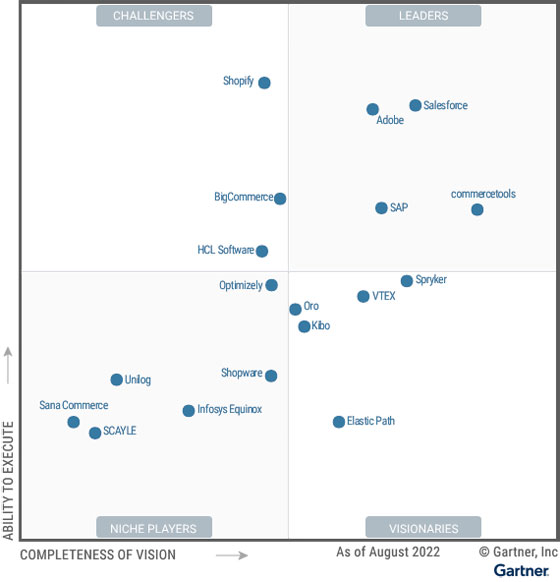
Gartner has released its long-awaited 2022 Magic Quadrant study that assesses many of the most mainstream digital commerce platforms.
Demand for such platforms surged in 2021 as enterprises endeavored to keep pace with digital disruption. Indeed, the market grew by a record 22 percent, per the market analyst.
However, many providers are striving to seize a more significant market share. As such, companies have many solutions to choose between.
Thankfully, Gartner isolates the strengths and cautions of 18 industry-leading platforms. In this year’s report, it identifies four market leaders.
The Definition of Digital Commerce Platforms
According to Gartner, a digital commerce platform is the core technology that allows online consumers to buy products and services autonomously through interactive self-service.
The platform supports customers too by informing buying decisions while harnessing data and algorithms to present complete orders for payment.
To quality for this Magic Quadrant, vendors must also enable interactive commerce experiences through empowering clients with a "storefront, product catalog navigation, product pages, shopping cart, check-out and customer account."
Vendors can offer such capabilities either natively or through APIs.
Each of the following 18 vendors does precisely that, with Gartner splitting them into four categories: Leaders, Challengers, Visionaries, and Niche Players. Here, we review them all.
Gartner Magic Quadrant Leaders
Leaders in the Magic Quadrant offer platforms that impress in depth and breadth. They also offer solutions that cross multiple industries and use cases, each being easy to scale. Moreover, these vendors provide many integrations to native and/or third-party enterprise systems, demonstrate an impressive global footprint, and an exciting go-forward vision. This year’s leaders are:
- Salesforce
- Adobe
- commercetools
- SAP
Salesforce
Salesforce offers "Shared Lightening" services that add depth to its commerce platforms, allowing companies to efficiently utilize numerous offerings, including product recommendations and a native payments integration. Such an example hints at its impressive innovation streak, as demonstrated by its new Composable Storefront solution. Gartner notes its array of industry offerings and multisite functionality as further strengths.
Adobe
As Gartner puts it: "Adobe Commerce is rich in functionality" across both the B2C and B2C worlds. It also offers a page builder that goes hand in hand with the Adobe PWA Studio. As a result, companies can create imaginative, differentiated commerce experiences. Alongside this, the platform’s use of AI is eye-catching and enables cross-channel personalization that supports personalized discounts and dynamic recommendations.
commercetools
While it is perhaps the least recognizable name in the leader list, commercetools demonstrates the most impressive vision of all vendors within the Magic Quadrant. Moreover, it backs this up with innovative solutions already driving value across multiple sectors. Its "microservices, API-first, cloud-native, headless" (MACH) architectural approach underpins this, which receives much acclaim within the report.
SAP
Achieving market leader status for the eighth year in a row, the SAP Commerce Cloud continues to drive the right results for clients. Much of this hinges on its lauded content management application, which Gartner claims is "more complete" than most of its competitors. The analyst also highlights its decoupled storefront editor, autoscaling capacity, and enterprise support as especially noteworthy plus points.
Gartner Magic Quadrant Challengers
Challengers in the Magic Quadrant typically focus on high-growth sectors, targeting specific markets and significantly investing in technology that meets the needs of their target clientele. While such an approach often means that their platforms trail leaders in comprehensiveness, these vendors offer a robust feature set with a track record of success. This year’s challengers are:
- Shopify
- BigCommerce
- HCL Software
Shopify
From 2020 to 2021, Shopify’s revenue increased by 48 percent. Such market share growth is the fastest of any vendor in the Magic Quadrant. Gartner credits this to its expansion beyond core commerce, bulking up its portfolio with Shopify Payments, POS, Shipping, and more. The vendor also supports complex use cases and offers a broad ecosystem. Yet, its B2B digital commerce offerings "remain untested."
BigCommerce
Gartner Peer Insights reviewers are positive about many aspects of the BigCommerce platform, especially its service and support capacity. Gartner also notes this as a particular strength, alongside its application ecosystem and the flexibility of its cloud-native platform. Unfortunately, the vendor lacks the geographical reach of market leaders, which seemingly inhibits its ability to acquire large enterprise customers.
HCL Software
Large companies with complex technologies often turn to HCL Software as the vendor provides out-of-the-box sophisticated multisite capabilities. Pricing and support are other plus points, while Gartner claims that its NLP-powered product discovery tool is among the strongest in the space. However, complex administration UIs and a lack of composability are perhaps preventing HCL from entering the leader quadrant.
Gartner Magic Quadrant Visionaries
Visionaries in the Magic Quadrant are some of the most innovative vendors in the space. As such, they win business through disruptive technologies, creative pricing plans, and identifying niche points within the market. With a strategy of this ilk, visionaries can win new customers quickly. However, they lack the resources and partner networks of leaders. This year’s visionaries are:
- Spryker
- VTEX
- Oro
- Kibo
- Elastic Path
Spryker
Spryker is one of the most forward-thinking vendors in digital commerce. Its completeness of vision is lauded by Garter and is maybe most evident in its architecture, which features over 40 independent modules. These enable a high degree of customization. Its extensibility is another considerable strength. However, for now, Spryker lacks out-of-the-box functionality as it is sometimes a struggle to build new workflows.