
Last week, Gartner released its 2023 Magic Quadrant for CCaaS study.
The report is a meticulous piece of market research. Yet, the quadrant matrix steals the show, and some businesses take it at face value and use the grid to inform their vendor shortlists.
No matter if that business is a large enterprise or a burgeoning SMB expanding beyond the confines of a UC or CRM platform – the matrix provides a North Star guide.
However, the requirements for these businesses will swing significantly.
Recognizing this, Gartner also releases a Critical Capabilities study, where the analyst adjusts its weightings to give each vendor a score across different use cases.
In this report, Gartner has done so across five use cases while listing "key findings", "recommendations", and – of course – "critical capabilities" to support various CCaaS buyers.
How Did Each Vendor Perform?
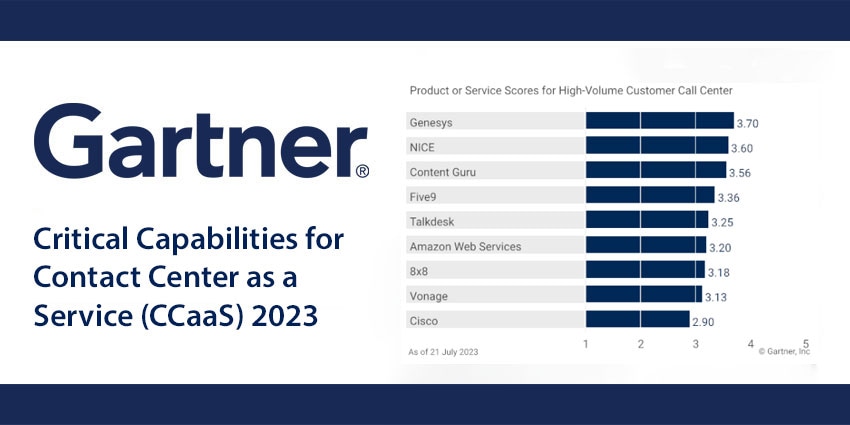
Across each of the following use cases, Gartner ranked vendors on a scale of one to five. Here’s how they performed.
#1 Use Case: High-Volume Customer Call Center
- Genesys – 3.70
- NICE – 3.60
- Content Guru – 3.56
- Five9 – 3.36
- Talkdesk – 3.25
- Amazon Web Services (AWS) – 3.20
- 8x8 – 3.18
- Vonage - 3.13
- Cisco – 2.90
#2 Use Case: Customer Engagement Center
- Genesys – 3.89
- NICE – 3.72
- Amazon Web Services (AWS) – 3.48
- Five9 – 3.28
- Talkdesk – 3.27
- Content Guru – 3.06
- 8x8 – 2.85
- Vonage - 2.53
- Cisco – 2.28
#3 Use Case: Digital Customer Service Center
- NICE – 3.69
- Genesys – 3.67
- Amazon Web Services (AWS) – 3.15
- Talkdesk – 3.03
- Content Guru – 3.00
- Five9 – 2.95
- 8x8 – 2.86
- Cisco – 2.50
- Vonage - 2.48
#4 Use Case: Agile Contact Center
- Amazon Web Services (AWS) – 3.72
- Genesys – 3.65
- NICE – 3.34
- Talkdesk – 3.03
- Five9 – 3.01
- 8x8 – 2.92
- Content Guru – 2.88
- Vonage - 2.55
- Cisco – 2.35
#5 Use Case: Global Contact Center
- Genesys – 3.74
- Amazon Web Services (AWS) – 3.56
- NICE – 3.09
- Five9 – 3.07
- Content Guru – 2.88
- 8x8 – 2.83
- Talkdesk – 2.70
- Vonage - 2.54
- Cisco – 2.51
Gartner’s Key Findings Into the CCaaS Space
Within its market overview, Gartner summarizes four essential findings from its lengthy analysis of the CCaaS space.
1. A Heightened Demand for Journey Orchestration Tools
The analyst notes how organizations increasingly seek orchestration tools from their CCaaS suites. These allow businesses to design new journeys across platforms and channels, whether or not they are bot- or human-assisted.
Perhaps this plays a part in why Genesys and NICE scored so well across each use case, with their Pointillist and Enlighten Journey Orchestration solutions, respectively.
2. Organizations Are Consolidating CCI Instances
Gartner highlights how businesses are leveraging the scalability and multi-region features from their CCaaS provider to consolidate "hundreds" of contact center infrastructure (CCI) instances.
That trend underlines how contact centers increasingly connect their data streams and perhaps emphasizes why Gartner lists "Data Center Design" as its first "critical capability".
Recently, Five9 acquired Aceyus to bolster this crucial cornerstone of its CCaaS offering.
3. Businesses Place Emphasis on Workforce Engagement Management
The analyst suggests the "importance" of agent experience necessitates tighter integrations between CCaaS and workforce engagement management (WEM) solutions.
In this arena, Five9, Genesys, and NICE, in particular, differentiate themselves with mature offerings. Other vendors rely on integrations with the likes of Verint and Calabrio to close the gap.
4. Third-Party Applications Become a Differentiator
Enterprise SaaS environments are swelling, increasing the opportunity for tight integrations that enable new capabilities.
Gartner recognizes the increasing interoperability within partners’ software and notes how new applications should be available for trial and purchase within a CCaaS provider’s marketplace.
That may even include apps from CCaaS competitors. For instance, Genesys is now available within the AWS marketplace.
Gartner’s Recommendations for CCaaS Buyers
Wishing to equip service leaders with more insight to inform their CCaaS platform selection process, Gartner underlined the following four recommendations.
1. Ask for "Referenceable Transition Frameworks"
The analyst suggests quizzing prospective vendors on their "referenceable, transition frameworks, methodologies, and commercial options" for CCaaS migrations.
Within the Magic Quadrant report, Genesys received recognition for its processes and tools that aim to ease this transition.
2. Prioritize Solutions with a Depth of Native Capabilities
By prioritizing solutions with deep capabilities across CCaaS subsets – such as routing and WEM – contact centers can lower their total cost of ownership.
Yet, be cautious when considering this Gartner recommendation. Just because a vendor offers various WEM tools – for example – doesn’t mean it’ll meet the team’s complete requirements.
A leading European supermarket chain fell victim to this. It selected a vendor from the study, as it had "quality management (QM)". But, when the QM team got their hands on it, they soon realized that it only met 15 percent of their needs. Ouch!
3. Seek Out Flexible Pricing Models
Throughout a CCaaS contract, a business’s # engagement strategy could change numerous times.
To plan for such eventualities, the analyst suggests giving increased consideration to pricing models, which accommodate probable shifts towards increased digital engagement and self-service.
Interestingly, AWS gained plaudits in the Magic Quadrant report for its usage-based pricing model. Such models are often more agile than traditional license-based systems.
4. Favor Credit-Based Contracts
Credit-based contracts allow businesses to pick and choose components of a CCaaS offering instead of the whole feature set.
Gartner argues that service leaders should select providers – and their partners – that offer "meaningful" service credit-based contracts, which flex across the deal’s duration.
The 13 Critical Capabilities for CCaaS
Despite CCaaS vendors weathering a storm of emerging AI, digital engagement, and tech convergence trends, Gartner’s critical capabilities for CCaaS stay the same as in 2022. They are:
1. Data Center Design
A robust data center architecture lays the foundations for a scalable and resilient CCaaS platform.
Moreover, it enables high availability, swift data recovery configurations, and the ability to stretch the platform to meet “peaky” demand.
2. Telephony-Centric Offer
Competitive voice carrier services are critical for customers to manage costs while maintaining a high-quality audio experience.
According to Gartner, a CCaaS vendor should put forward reference customers that cope with sky-high call volumes to emphasize their ability to deliver such an experience.
In addition, the analyst refers to bring your own telco (BYOT) as an “important feature”, allowing customers to shop for the best rates and cater to companies with complex telecom plans.
3. Digital-Centric Offer
Gartner believes CCaaS vendors should offer orchestration tools for consistent, persistent, and seamless contact center experiences. These should cross digital channels, including those driven by conversational AI.
Alongside these solutions, the analyst suggests that leading providers offer guidance to become more digitally-centric – considering people, process, and tech considerations.
4. Marketplace
As Gartner’s fourth “key finding” suggests: third-party applications are becoming a differentiator. As such, provider marketplaces are coming increasingly to the fore.
Tight integrations with technologies in adjacent fields are essential here. Salesforce for CRM, Microsoft Teams for UCaaS, and ServiceNow for ITSM are excellent examples.
Nonetheless, Gartner also highlights that “leading” providers will offer solutions developed by their communities alongside trial-and-buy options for numerous applications.
5. Developer Environment
Perhaps the most prominent example of this is AWS’s DevOps Playground for Amazon Connect users. It allows users to customize their platform and trial integrations in a test environment.
Such “safe spaces” enable a new level of composability, allowing IT teams to kickstart test-learn-optimize-embed workflows that accelerate and safeguard contact center innovation.
6. Workforce Engagement Management
CCaaS is slowly engulfing the WEM market. Principally, this includes workforce management (WFM) and QM solutions.
Nevertheless, this has swelled to include voice of the employee (VoE), gamification, learning management, and onboarding solutions.
Increasing their WEM capabilities across this product set should be a core focus for CCaaS providers, according to Gartner. It will ensure they rely too heavily on partners.
Yet, marketplace integrations with third-party integrations to specialist providers are essential.
7. Virtual Customer Assistant
As the contact center channel mix expands, the requirement for multimodal conversational AI applications inflates too.
Recognizing this, Gartner suggests contact centers should offer in-house conversational interfaces while acting as the orchestrator for various leading conversational AI platforms.
8. Customer Administration Portal
Ideally, such a portal allows users to create, customize, and manage contact center reports in real-time. These may oversee queues, routing, admin, and much more.
Data visualization tools are essential here to make critical insights more accessible.