

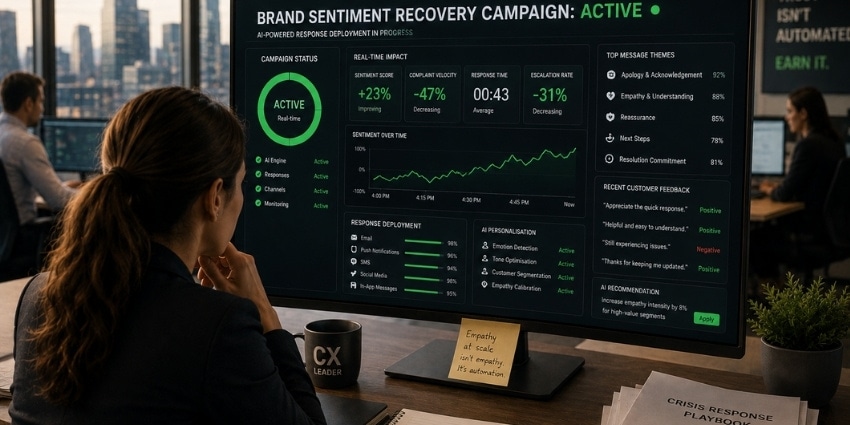
The outage lasts eleven minutes.
Long enough to trend.
Long enough for screenshots.
Long enough for the system to trigger Crisis Mode automatically.
By 4:47pm, the apology engine is already live.
No waiting for legal.
No waiting for PR.
No waiting for leadership approval.
The AI has already written everything.
Customer emails. Push notifications. Social responses. Executive statements.
All generated in under forty-three seconds.
I open the dashboard.
Brand sentiment recovery campaign: Active.
The system begins deploying responses instantly.
“We sincerely apologise for the disruption you experienced today.”
“We understand how frustrating this situation has been.”
“Your trust remains our highest priority.”
Every message is grammatically perfect.
Emotionally calibrated.
A/B tested against millions of previous customer reactions.
The language adapts in real time depending on customer profile.
Angry customers receive reassurance.
High-value customers receive compensation.
Customers at risk of churn receive elevated empathy weighting.
The dashboard calls it:
Dynamic Emotional Recovery.
I watch the responses appearing across social media.
At first, it works.
Engagement slows.
Sentiment stabilises.
Complaint velocity drops.
Then something changes.
The replies start becoming strangely similar.
“Why does every response sound fake?”
“Did a human actually write this?”
“This feels automated.”
I open one of the live conversation threads.
The customer is furious.
The AI responds instantly.
Perfect punctuation. Perfect tone. Perfect empathy.
Then the customer replies:
“Stop sounding sorry and just talk to me like a person.”
I stare at the screen for a moment.
Because the system did exactly what it was designed to do.
It reduced escalation.
Protected sentiment.
Minimised churn risk.
But somehow…
It made the apology feel less human.
At 5:03pm, communications joins the incident call.
They’re impressed by the recovery metrics.
“This is the fastest sentiment rebound we’ve ever seen.”
Operations agrees.
“The AI prevented a major escalation event.”
Someone from leadership says the part everyone else is thinking.
“Customers don’t really care who writes the apology as long as the issue gets fixed.”
I’m not sure that’s true anymore.
Because apologies were never just information.