

If you've spent the last two years watching AI pilots promise transformation but struggle to scale, you're not alone. The difference between a promising proof of concept and genuine enterprise impact often comes down to three things: data quality, operational integration, and the courage to deploy in high-stakes environments.
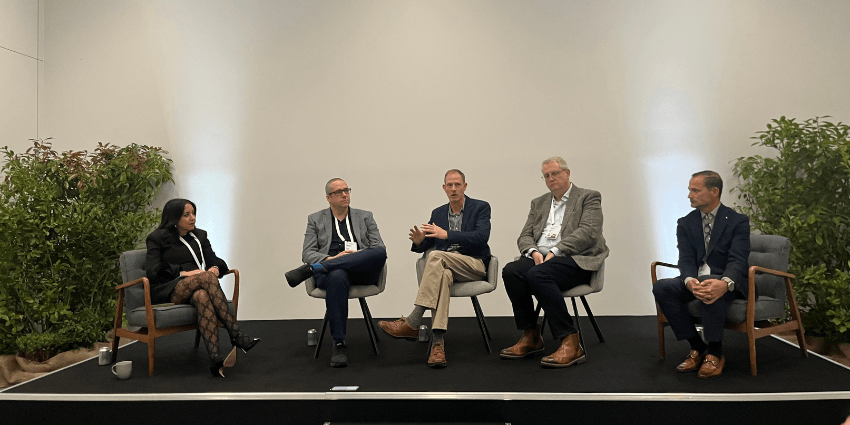
At Salesforce's Agentforce World Tour 2025 in London, that courage was on full display. Zahra Bahrololoumi CBE, CEO of Salesforce UKI, hosted a panel featuring leaders who've moved decisively beyond experimentation.
"We've gone from pilot to scale," Bahrololoumi said, noting that 70% of Salesforce's top 10 global deals now include significant Agentforce and Data Cloud components.
"The proportion of Agentforce and Data Cloud being so central to those transformations is very typical of what we're seeing across the UK."
Bobby the Virtual Police Assistant: AI in Public Safety's Most Sensitive Moments
One of the leaders on the panel was Chief Superintendent Simon Dodds from Hampshire & Isle of Wight Constabulary and Thames Valley Police introduced Bobby, the UK's first AI-powered policing digital worker, live for just eight days but already handling critical cases.
Hampshire and Thames Valley forces handle approximately 5,000 contacts daily, with 2,000 to 2,400 being 999 emergency calls. Bobby handles non-emergency inquiries about lost property, bail conditions, or neighbor disputes, freeing human operators for critical calls.
However, it was the contextualization capabilities that really impressed the audience.
"We had a young child use Bobby, and they just put in 'mum and dad are arguing, what do I do?' And it recognized the use of mum and dad as being childish, and was able to put that through to an operator," Dodds explained. "Within 10 minutes, we had a car on scene."
In another case, a mother sought advice about a neighbor who repeatedly appeared when her daughter was in the garden. Bobby recognized language patterns suggesting vulnerability, stalking, and harassment, and escalated to a human operator immediately.
Despite these impressive examples, Dodds also highlighted that Bobby also has intentional limitations:
"There's no way for Bobby to access any of our crime databases, and the data Bobby has is just the knowledge articles that our staff themselves would use."
When asked about accountability, Dodds acknowledged the risk: "Our human operators will make mistakes, so Bobby might make some mistakes. That's why we've got to make sure that we stay on top of the learning."
Pandora's Gemma: Bridging the Gap Between In-Store Magic and Online Shopping
Ricky Wilson, SVP of Channels, Customers, and Colleague Technology at Pandora, described how the jewelry brand is using Agentforce to replicate the personalized in-store experience online.
Pandora deployed Gemma to handle after-sales inquiries during peak demand and to bring conversational commerce to online shoppers.
Wilson explained how "the Net Promoter Score of those customers interacting with Gemma is 10.5 points higher, and that all comes down to customers actually just wanting something answered or something solved."
The more ambitious goal is replicating the in-store consultation experience. "In store, we have this incredible experience where you can actually be guided by one of our members of staff to help bring your story to life, the reason that you're buying this item," Wilson explained. "What we're trying to do is bridge that gap."
Customers who interact with Gemma view more products, spend more time browsing, and ultimately spend more. One breakthrough highlighted during the keynote was the ability to complete purchases within a conversation, eliminating the need to navigate to separate checkout processes.
LIV Golf's Agent Caddy: Transforming Fan Engagement and Broadcast Storytelling
Nick Connor, SVP of Technology at LIV Golf, outlined how the global golf league is deploying Agentforce across three dimensions: speed, scalability, and engagement.
"Speed is about being able to use Agentforce on top of our data to ask questions and get the answers that are needed to make decisions quickly," Connor said.
For broadcasts, this means commentators can query statistics in real-time instead of waiting for colleagues to respond via Slack. "That's really critical to how consumers and fans are getting the stories told."
He also detailed how scalability extends across marketing, operations, and player support: