
the voice of customer experience technology
Front page
News17 Jun 2026 · 3 min read

Forget Skynet: What Airbus’s AI Defense Tech Means For Enterprise CX

Airbus has introduced a military AI agent mesh with 90 micro-agents. Discover how Jonathan Debure's strategy signals the future of CX automation.

Airbus AI Agent Mesh

Airbus has introduced an 'AI agent mesh' featuring 90 specialized micro-agents designed to automate battlefield decision-making and intelligence gathering for military commanders.

The defense contractor is moving away from monolithic artificial intelligence models to orchestrate a network of specialized agents that collaborate to solve complex tactical problems, marking a significant transition from traditional chatbots to agentic workflows.

The United States Department of Defense has experimented with artificial intelligence for decades. While projects like Maven previously processed drone footage to flag targets for human review, companies are now aggressively marketing artificial intelligence platforms for battlefield decision-making.

Airbus is introducing a modular architecture that breaks complex goals into smaller tasks, dynamically assigning them to specialized agents that communicate to execute the mission.

From an execution standpoint, Jonathan Debure, Head of Strategy and Technical Intelligence at Airbus Defence and Space outlined the goal:

"Modularity is the magic word. Rather than one system trying to do everything, we break down a complex task into smaller elements that can be handled by a specialized AI agent. By bringing multiple agents together, we can then automate incredibly complex operational sequences."

Resolution Superiority Replaces Complex Interfaces

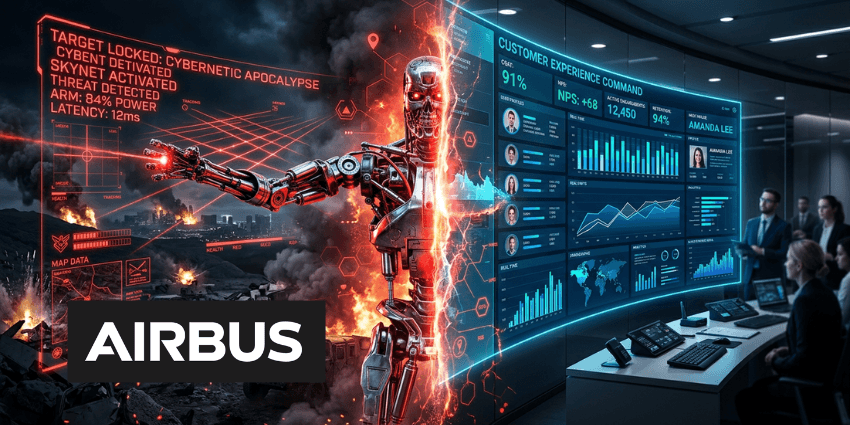
This military technology serves as a crystal ball for customer experience leaders. And the exact architectural shifts achieving 'decision superiority' on the battlefield will be coming to the contact center.

Brands will soon use these frameworks to achieve 'resolution superiority' in their own operations. But the future of customer service is not one giant support bot.

It will be an orchestrated mesh of micro-agents working together. While a triage agent communicates with a billing agent, it will also negotiate with a retention agent.

These micro-agents will pull data from sentiment analysis tools to resolve complex issues instantly. And this collaboration will handle multi-step customer problems that currently require human escalation in over 80% of cases. Asked what changes now, Debure emphasized:

"Commanders won't need to be experts in the underlying simulation software or the battle management system. They simply enter a task in their own words, and the agents collaborate behind the scenes across various platforms to deliver a result."

Furthermore, commanders and customer service representatives will no longer need to navigate complex software interfaces. Human agents will simply prompt the system using natural language.

The artificial intelligence mesh will then execute the necessary clicks across backend systems like Salesforce and legacy billing platforms. And this eliminates the need for agents to click through multiple tabs to process a refund or apply a loyalty credit.

Traceability Builds Trust In Artificial Intelligence Automation

In warfare, the side that processes information and acts fastest wins the engagement. But in customer experience, brand loyalty will belong to companies that instantly synthesize a customer's entire history.

These brands will offer hyper-personalized resolutions before competitors even load a profile. Airbus also heavily emphasizes traceability to prevent hallucinations in high-stakes scenarios.

As customer experience platforms hand more autonomy to artificial intelligence, brands will demand the exact same explainability. And systems must provide an audit trail detailing exactly why an agent made a specific decision.

Human supervisors need this transparency to trust the system when it issues refunds or changes policies. While the agentic era of artificial intelligence was once just a theoretical concept, it is now actively deploying in the most complex environments on earth.

As someone who has watched the customer experience industry wrestle with clunky chatbots, I find this shift incredibly promising. When artificial intelligence and personalization converge through modular agents, leaders will redefine what it means to connect with customers.

The technology cutting through the chaos of the battlefield today will build the seamless, empathetic customer journeys of tomorrow.


Join the conversation: Join our LinkedIn community (40,000+ members): https://www.linkedin.com/groups/1951190/ Get the weekly rundown: Subscribe to our newsletter: http://cxtoday.com/sign-up

rate this story
helps rank stories across uc today
The discussion0 takes · attributed & checked

Does this reflect your experience?

opening the room…
Read nextordered by techtelligence · every pick explained
matches this topic

Can Crescendo’s AI Agents Really Run the Whole CX Operation?

28 Aug 2026
matches this topicSalesforce’s Outcome-Based Pricing: Strategic Masterstroke or Defensive Scramble Against AI Seat Compression?27 Aug 2026matches this topicVerint Warns AI Value Needs Better Data3 Sept 2026