

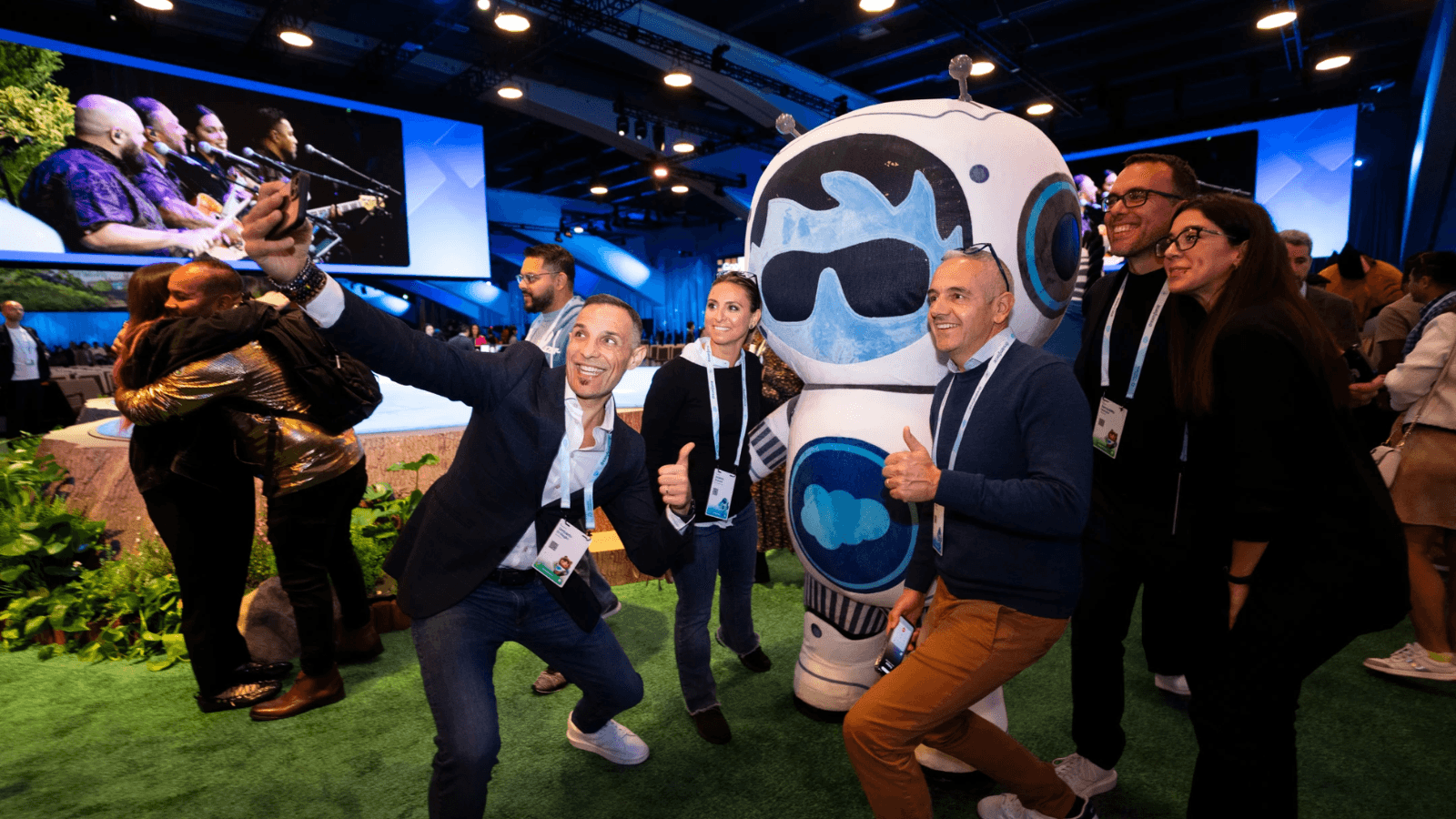
Dreamforce 2026 is Salesforce’s chance to prove that Agentforce can improve real customer service journeys.
Every technology vendor now promises more personal customer service through AI. Yet, for many customers, the reality still means repeating an account number to a chatbot, moving to an adviser who cannot see the previous conversation, and being called by their first name while trying to solve the same issue for the third time.
At Dreamforce 2026, Salesforce must show it can offer something better.
From September 15-17 in San Francisco, Salesforce will put its Agentic Enterprise strategy in front of customers, partners, and a very large audience of people who have heard the AI pitch before. The company wants AI agents, CRM data, service workflows, commerce, marketing, and human employees to work as one connected system.
For CX leaders, that is either the beginning of a more intelligent service operation or a very expensive new way to expose old data problems.
Both outcomes are possible.
The question at Dreamforce is not whether an AI agent can hold a conversation. We are past being impressed by that. The question is whether it can resolve a billing issue, identify a vulnerable customer, process a return, understand an entitlement, preserve context across channels, and know when to get out of the way and bring in a capable human.
That is why CX leaders should pay attention.
The Dreamforce CX Reality Check
Salesforce will have plenty of AI demos. CX leaders should look for something harder: proof that an AI agent can use reliable customer context, complete an approved task, improve the customer journey, and hand over gracefully when a person is needed.
In This Guide
- Salesforce Is Selling an Agentic Customer Experience. Does It Hold Up?
- Containment Is Not the Same as Resolution
- The Customer Does Not Care Which System Owns Their Data
- The Most Important AI Feature May Be Knowing When to Stop
- Your Service Team Will Notice the Difference Before Your Customers Do
- Who Should Actually Go to Dreamforce?
- Fine, But What Is Actually Happening at Dreamforce?
- How CX Leaders Should Prepare for Dreamforce
- Questions CX Leaders Should Ask at Dreamforce
- What to Do When the Full Agenda Is Released
- Reader Perspectives on Dreamforce 2026
- Official Dreamforce Resources
- Dreamforce 2026 FAQs
- Follow Dreamforce 2026 With CX Today
Salesforce Is Selling an Agentic Customer Experience. Does It Hold Up?
Salesforce’s pitch is broader than a customer service chatbot. Agentforce is positioned as an AI layer that can work across CRM records, customer data, knowledge, workflows, commerce, and connected applications.
In theory, that means a customer can get an answer, complete a task, receive a relevant recommendation, or be routed to the right employee without the usual game of digital pass-the-parcel.
In theory is doing some heavy lifting here.
Customer experience teams already know the difference between a well-designed digital journey and a disconnected one. The hard work is rarely the interface. It is the data underneath it: duplicate profiles, missing order information, poorly maintained knowledge, unclear ownership, conflicting policies, and integrations that behave beautifully in a demo but not necessarily at 8am on a Monday when a service queue is full.
Dreamforce is useful because it puts Salesforce’s product vision next to the customer deployments that are supposed to prove it. The event gives CX leaders a chance to ask what was connected, what had to be cleaned up, what the AI can actually do without a person, and what happens when the AI gets it wrong.
There is a very big difference between an AI agent that can answer “Where is my order?” and one that can handle an exception without making a customer explain their entire life story twice.
Salesforce is bringing the Agentic Enterprise message to Dreamforce at a moment when CX leaders are under pressure to improve both customer outcomes and operational efficiency. The company’s strategy connects Agentforce with Service Cloud, Data 360, Customer 360, MuleSoft, Tableau, Slack, commerce tools, and its broader CRM platform.
The strategic promise is straightforward: give AI agents the customer context, knowledge, workflow access, and guardrails required to do useful work. The real-world question is much less straightforward: can an organisation safely connect all of that without creating another expensive layer of complexity?
What CX Leaders Should Investigate
Prioritise production customer stories that explain the data work, integrations, knowledge management, governance, human oversight, implementation effort, costs, and measurable outcomes behind an AI deployment.
Is It a Win Just Because the Customer Didn’t Reach an Agent?
Containment is not resolution.
A customer who gives up, abandons a journey, or returns later through a more expensive channel may never have reached a human adviser. That does not mean the experience worked. It means the contact-centre dashboard may have looked better than the customer journey actually was.
Many AI service projects are initially measured by the number of interactions handled without a person. That is understandable. Contact volumes cost money, service teams are stretched, and repetitive enquiries are a reasonable place to look for automation.
But CX leaders should be more demanding than the average AI business case.
Ask how a deployment has affected first-contact resolution, repeat contacts, complaint volumes, escalation quality, abandonment, customer effort, customer satisfaction, and resolution time. Ask whether the organisation has measured what happened after the chatbot conversation ended. Ask how customers behave when the agent cannot complete the request.
The right outcome is not the fewest possible human conversations. It is the lowest-friction route to a reliable resolution.
At Dreamforce, look for customer examples that provide more than an automation percentage. A credible deployment should show which journeys were automated, what customers could complete, what happened when the AI was uncertain, how the business measured quality, and whether the experience improved for the people using it.
Cost to serve matters. Of course it does. But an AI strategy that saves money by making customers work harder is not efficiency. It is a delayed cost.
The Customer Does Not Care Which System Owns Their Data
Customers do not think in CRM records, commerce platforms, knowledge bases, contact-centre queues, or service desks.
They think: “I bought this. It has not arrived. I need someone to fix it.”
Salesforce’s Data 360 strategy means that an AI agent cannot offer a genuinely useful experience if it has only part of the story. A service agent needs the right account information, interaction history, product or order details, entitlement, consent status, and approved knowledge at the point of need.
That sounds obvious, but it is exactly where many AI projects become uncomfortable.
Before asking what an agent can do, CX leaders should ask whether the organisation has a dependable view of the customer in the first place. If the answer is “not really,” an AI agent will not solve that. It will make the gap more visible, faster.
Dreamforce should help attendees investigate how Salesforce connects service data, CRM records, commerce information, marketing interactions, loyalty data, knowledge, and third-party systems. The useful conversations will be about identity resolution, permissions, consent, data quality, freshness, retention, data residency, lineage, and ownership.
Because the real CX challenge is not collecting more data. It is making the right information available, safely and appropriately, at the exact moment a customer needs help.
Personalisation Is Not a First Name in a Chat Window
Customers may welcome a faster, more informed interaction. They are less likely to welcome an AI experience that appears to know too much, makes a wrong assumption, blocks access to a person, or cannot explain why it took an action.
Personalisation only feels useful when it removes friction. Knowing that a customer has an open delivery issue and should not be offered a new product is useful. Making a customer repeat that issue because one system cannot see another is not.
CX leaders should use Dreamforce to examine how Salesforce applies consent, permissions, and customer context across AI-led journeys. The strongest approach will not be the one that knows the most about a customer. It will be the one that uses customer information responsibly and makes the interaction easier.
The Most Important AI Feature May Be Knowing When to Stop
There are customer moments that should not be automated into a dead end: vulnerability, bereavement, fraud, high-value retention, a complex complaint, an urgent service failure, or simply a customer who has already tried everything else.
The handover is not a failure of automation. It is part of good service design.
At Dreamforce, CX leaders should look closely at how Agentforce supports human escalation. Can the AI recognise uncertainty? Can it identify a high-risk interaction? Does it transfer the full conversation context? Does the adviser receive a useful summary, the information used, and a clear record of what has already been attempted?
Can a customer reach a person when the situation calls for one?
Because if the handover starts with “Can you explain the issue again?”, the technology has failed the customer even if it technically worked.
Governance Is a Customer Experience Issue
Governance is often treated as a technical or compliance conversation. It is also a CX conversation.
An AI agent with access to customer data and the ability to trigger workflows needs boundaries. CX leaders need to know which systems the agent can access, what actions it can take, when a person must review an action, how activity is recorded, how errors are detected, and how a customer is protected if the technology makes the wrong call.
For regulated industries, those questions are particularly urgent. But they matter everywhere. A mistaken response about a refund, payment, subscription, delivery, account status, or customer entitlement can quickly become a trust problem.
Dreamforce should provide an opportunity to ask Salesforce and its customers how permissions, auditability, monitoring, testing, policy controls, human approval, and escalation rules work in practice rather than on a slide.
Who Should Actually Go to Dreamforce?
Not everyone needs a flight to San Francisco. But Dreamforce is worth serious consideration if you own a customer experience problem that Salesforce says its agentic strategy can solve.
Go if You Own Customer Service or Contact Centre Performance
You need to know whether AI can improve resolution, adviser productivity, self-service, quality, and cost to serve without creating more customer effort or a queue of messy escalations.
Prioritise sessions and conversations that explain real service journeys, customer outcomes, employee workflows, knowledge management, and the metrics used to assess success.
Go if You Are Responsible for Digital Customer Journeys
You are trying to reduce friction across web, messaging, mobile, customer portals, and assisted service. Dreamforce is a chance to assess whether Salesforce can keep a customer’s context intact as they move between those journeys.
The practical question is whether a customer can complete something meaningful without abandoning the journey, entering the same information repeatedly, or being pushed into a channel they did not choose.
Go if Your Customer Data Is Not as Connected as Everyone Pretends It Is
Agentic AI has made customer data a boardroom issue. If identity, consent, service history, commerce data, and knowledge are fragmented, the real value of Dreamforce may be in understanding what has to be fixed before an AI deployment becomes credible.
Data, CRM, and customer-journey leaders should focus on Data 360, Service Cloud, integration, governance, identity, knowledge, and the role of third-party systems in the architecture.
Go if You Need to Put Guardrails Around AI Before It Reaches Customers
Security, compliance, data, governance, and IT leaders should be in the room. An AI agent with customer data and the ability to trigger workflows is not a small experiment. It needs access controls, monitoring, auditability, testing, escalation rules, and clear accountability.
Go if You Lead Commerce, Loyalty, or Revenue-Critical Journeys
Service interactions do not stop being commercial interactions simply because a customer has a problem. Returns, deliveries, subscriptions, account changes, loyalty status, renewals, and payment issues can shape retention just as much as a marketing campaign.
Commerce and loyalty leaders should investigate how Salesforce connects customer service, commerce, CRM, and AI-led journeys without treating a frustrated customer as just another conversion opportunity.
Go if You Support Customers as a Salesforce Partner
Consultancies, systems integrators, managed-service providers, and technology partners should attend to understand where Salesforce is directing product investment and where customers will need support.
The opportunity will extend beyond implementation. Organisations moving AI agents into production will need help with CX strategy, journey design, data readiness, knowledge management, integrations, governance, workforce enablement, quality assurance, and ongoing optimisation.