
The Data Lake is a centralised repository for structured and unstructured data. Combined with auto-tracking it can take your website experience to the next level!
What does agriculture have in common with data and digital analytics? For the past 20 years, the way we track digital data has been likened to meticulously managed farms. Every data point was similar to a carefully sown seed, cultured and preserved for future use. Despite being effective, this precision-focused model has its drawbacks, the main ones being it's inflexible and requires significant resources to maintain.
Auto-tracking addresses these hurdles by effortlessly gathering all data points without needing to specify each one. This means an abundance of raw format data is assembled, offering remarkable flexibility for defining them retrospectively. For instance, recording all clicks on your web pages enables you to distinguish between “add to cart” clicks and “menu item” clicks based on the data attributes of each click. This ensures data quality, allowing for retrospective analysis without the concern of implementation issues or changes.
One might assume that acquiring more data prolongs the tracking implementation time. While this might hold true for traditional individual data point tracking, auto-tracking simplifies analytics implementation and bolsters data quality. For data to be employed in replaying sessions with perfect fidelity, it must record events down to the millisecond, mirroring real-time as much as possible.
Digital Analytics: The Power of Data Lake
So what is the data lake exactly? Simply put, a data lake acts as a centralised repository allowing storage of all your structured and unstructured data at any scale. You can store your data as-is, without any preliminary structuring, and execute different types of analytics—from dashboards and visualisations to big data processing, real-time analytics, and machine learning. These are all deployed in businesses to steer data and insights-based decision-making.
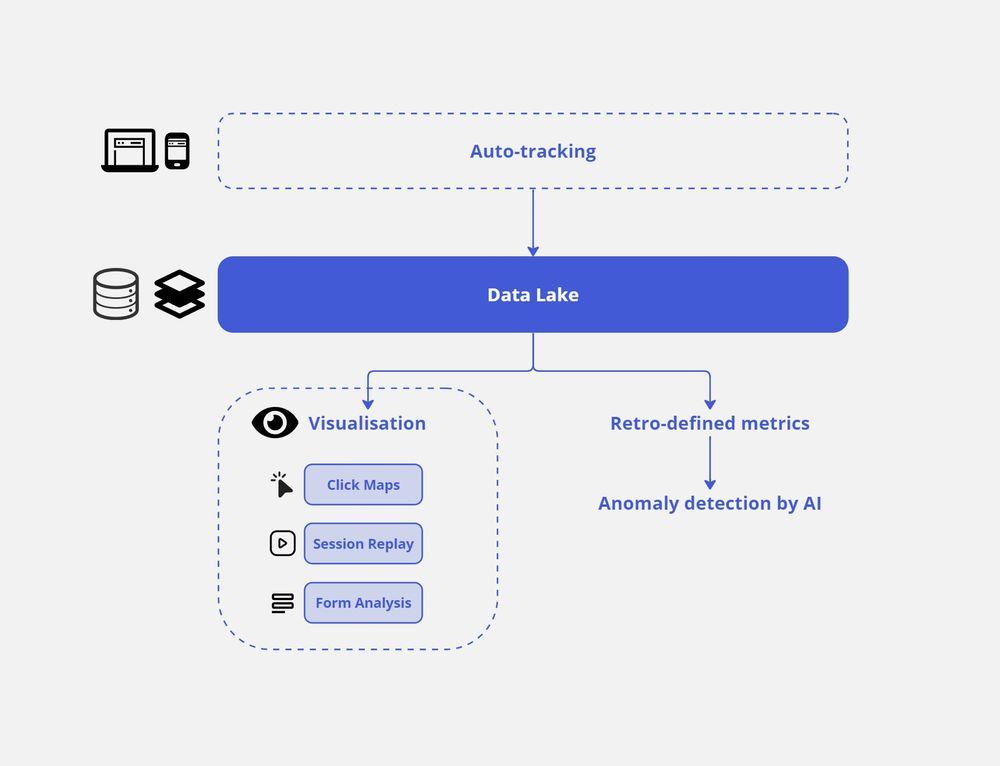
The architecture diagram above demonstrates how you can utilise auto-tracking and the data lake to visualise your website performance.
In the realm of digital customer experience analytics, digital interfaces like web browsers can be uniformly tracked, making it an ideal use case for integrating auto-tracking and data lake concepts. This captures all raw data while simultaneously enjoying flexibility and assured data quality. It seems you can indeed have your cake and eat it too!
A data lake acts as a centralised repository allowing storage of all your structured and unstructured data at any scale.
With auto-tracking, there's no concern about missing key button click data in your next release. This advantage enables business operators to swiftly make data-driven decisions and gain a competitive edge (particularly in the agile-demanding post-COVID environment).
Auto-Tracking & Data Lake: Pros and Cons
In summary, here are the benefits of merging auto-tracking with a data lake for digital analytics:
Flexibility
High data quality
Quick implementation process
Low maintenance effort
But what are the potential pitfalls? One downside might be the escalated operational expenses due to processing a larger data volume. However, these costs are offset by a decrease in maintenance costs and increased flexibility in data collection and use. Having all data in its raw, unprocessed state accelerates the build-measure-learn cycle, allowing businesses to focus on learning and making rapid, data-backed decisions.