Digital transformation and the rapid rise of emerging technology platforms is altering an organisation's ability to communicate with its customers. Coupled with a changing landscape of consumer demand for easier and more effective transactions with businesses, a drive is behind the new face of customer contact centres.
Principal analyst at the Altimeter Group, and an award-winning author, prominent blogger/writer, Brian Solis has published a report entitled 'Contact Center 2.0: The Rise of Collaborative Contact Centers'. The report, which was commissioned by RingCentral examines how digital transformation is making contact centres unified, collaborative, and intelligent. We have examined the report and now bring you a summary of its most interesting findings.
The Background
It is first important to establish the background of the contact centre. The model, which is still in use across industry today, was initially formulated and first used in the 1950s and 1960s with the same philosophies and premises that are still used today. The technology in existence then restricted the capability of these centres to providing basic routing between customers and the business serving them. As the technology available through the past few decades has evolved, the premise on which these contact centres have been built has not and the basic philosophy, in many cases remains the same as it did 50 years ago.
Changing Customer Demands
Customer expectations and requirements have changed dramatically in the last five years and have shifted to be almost unrecognisable from two decades ago. With the rise of social media channels, and a more connected global world, where a customer is so much more well informed, the presumption they have about customer service or customer experience (CX) has drastically changed.
"Every day, customers are introduced to new, user-centred services that condition them to expect more immediate, convenient, and personalised experiences. This is the foundation for Contact Centre 2.0."
The report explains that the changing customer demands need to be reflected in the infrastructure of businesses looking to service them. This is one of the main drivers for digital transformation within the contact centre but Brian's findings suggest businesses may not be fully understanding how they can best align their transformation strategies with customer demand.
"We’ve found that only 35% of companies investing in CX and digital transformation had mapped the customer journey within the last year - This means that roadmaps are developed and investments in CX are made without understanding customers."
In a connected world, customers demand "Immediacy, convenience, and personalisation". Answers can be found online in seconds to a vast array of questions, that in the past would have required research time. A journey, which historically would have required planning, can now be completed ad-hoc with satellite navigation or even an Uber. If a customer wants a specific food, they can use a variety of services for almost immediate delivery, right to their door. These expectational changes must now be reflected in the provision of CX within the contact centre, as more often than not the current experience is not as efficient.
Customers vs Cost
Brian explains that the development of contact centres has been fundamentally flawed. "If we were to examine the evolution of contact centres, we would see them as the ultimate experiment in iteration vs innovation and as perceived cost centres rather than investments in future performance and enhanced customer experiences."
Organisations focusing on contact centres from a cost perspective have missed the fundamental premise and opportunity that this customer exposure can enable.
"It’s time to close the chapter on Contact Centre 1.0. It’s time to make customer engagement experiential, intuitive, and collaborative for a modern customer in modern times."
Digital Transformation is Critical
Brian has worked in previous studies to define digital transformation, which is a critical exercise to properly understand its relevance.
“The realignment of, or investment in, new technology, business models, and processes to drive value for customers and employees and more effectively compete in an ever-changing digital economy.”
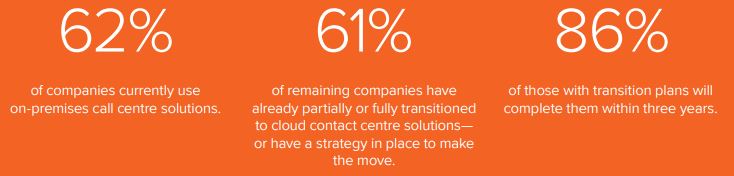
The report stipulates that digital transformation is the underlying evolution from contact centre 1.0 to 2.0. As well as commissioning the report, leading provider of global enterprise cloud communications and collaboration solutions, RingCentral, alongside CITE Research conducted a study. The study focused on employees working alongside, or planning to work alongside, contact centre solutions. The results showed that businesses are at least some way down the path of digital transformation, with 70% of companies already having an official digital transformation strategy in place. The main focusses for these strategies were "digital technology integration (71%) and CX (also 71%)." These results correlate with previous research that Brian has formulated.