Databricks CustomerLake is Databricks' new Agentic CDP, built inside the lakehouse rather than as a bolt-on, betting that banks would rather govern and understand their data once than maintain a separate CDP copy of a customer record they already own.
Every bank has a customer record. Most have too many versions sitting in different systems. That's not just frustrating; it's a dangerous environment for any regulated company.
That's why Databricks' Data Intelligence Platform enters the industry at an interesting moment for the CDP market, and CustomerLake, its newest and most CX-specific application, is the sharpest current test of whether the platform underneath it can actually back up the claim of better data management.
Instead of forcing banks to continue chasing a single customer view through dedicated CDPs stacked on top of a data warehouse, Databricks is arguing that's backward: govern and understand the data properly first, inside the platform banks already run their core analytics on, and the customer view falls out of that rather than needing its own separate system.
In the customer data space for finance, this isn't an architecture argument anymore. It's a control argument. If zero copy customer data can cut duplication without weakening activation, and if customer data governance can travel with every profile, audience, and AI recommendation, Databricks has a serious banking CX story.
Related Articles
- Customer Data Management: The Complete CX Guide
- Single Customer View: Where CRM Falls Short
- Databricks CustomerLake: Inside the AI-Native CDP
TL;DR: Is CustomerLake Ready for Banking CX?
- The pitch is architectural, not just a feature list: CustomerLake avoids the usual CDP copy problem by keeping profiles and activation close to governed data, not a separate replica.
- Financial services now has a second, sharper proof point: Clearlake Capital just partnered with Databricks and West Monroe to run AI-enabled investing across deal origination, due diligence, and portfolio operations.
- Platform-wide evidence backs the real-time claim: Databricks' Lakebase scaled a workforce agent to 130,000 consultants at DXC, cutting task time by 94%.
- The gap: CustomerLake is still in Private Preview, and public, named banking outcomes for the product specifically are still thin.
What Is the Databricks Data Intelligence Platform?
The Databricks Data Intelligence Platform is Databricks’ lakehouse for running data engineering, warehousing, analytics, governance, and AI against the same data estate. It uses Delta Lake for storage, Unity Catalog for permissions and lineage, and Mosaic AI for model and agent development.
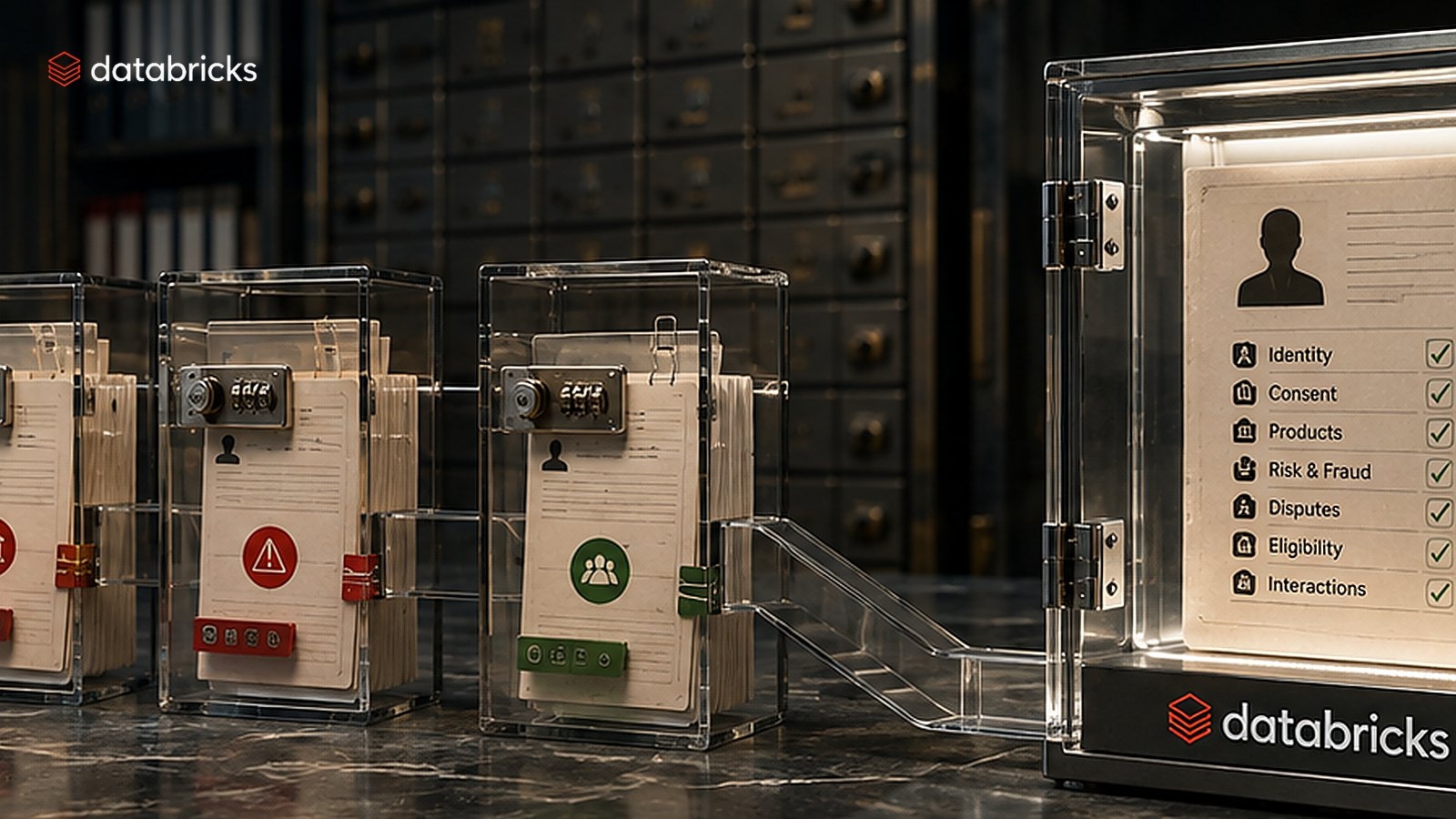
For regulated companies like banks, the intelligence platform offers the architecture. Payment data, product holdings, fraud alerts, CRM records, and risk attributes can stay connected in one secure system, without forcing the team to build different versions of the customer.
Customer Lake sits on top of that foundation, applying the platform capabilities to identity resolution, customer profiles, audiences, and activation.
What Is DatabricksIQ?
DatabricksIQ is the layer that gives the platform context about the data inside it. It reads metadata, lineage, queries, usage history, table relationships, and company terminology to work out how different assets relate.
That context appears in Genie, where users can question data in plain English, and Genie Code, where technical teams can generate code, fix pipeline errors, and build dashboards. It also improves search inside Unity Catalog and helps Databricks tune workloads around the way the environment is actually being used.
In finance, DatabricksIQ can connect terms such as disputed payment, available balance, vulnerability flag, and product eligibility to the tables and rules behind them. It still relies on the bank defining those terms properly in the first place.
What Is Databricks CustomerLake?
Databricks CustomerLake is Databricks’ new Agentic CDP, launched in June 2026 and built inside the Databricks lakehouse. It launched at a time when the CDP market was already being pulled toward AI agents, composable data stacks, and cleaner governance, and Databricks has walked straight into that fight with a very pointed claim: customer profiles don’t need to live in another copied database to become useful.
The AI-native product brings Customer 360 profiles, identity resolution, audience building, campaign automation, activation, and personalization into Databricks. It's still in Private Preview, so buyers shouldn't treat it as battle-tested CDP replacement material yet. Launch customers include HP, Circle K, AB InBev, and Getnet by Santander.
CustomerLake isn't another marketing dashboard with a fresh coat of paint. Profile Agents, Campaign Agents, Agentic Identity Resolution, the Real-Time Profile API, Genie, Lakeflow, and Unity Catalog all come in the same package. Databricks wants teams to build profiles, shape audiences, activate records, bring in data, question it, and govern it without bouncing between platforms.
Learn more about customer data management use cases in 2026 here.
Why Is Financial Services the Strongest Vertical Test for CustomerLake?
Databricks isn’t focusing exclusively on finance here, but financial services is the harshest place to test CustomerLake because banking data has consequences baked into it. A retail brand gets a segment wrong, and someone gets an odd offer. A bank can trigger a complaint, expose sensitive information, or recommend a product the customer should never have seen.
The customer record also has to reconcile product holdings, transactions, risk signals, complaints, consent, vulnerability, and eligibility. Each attribute can change what the bank is allowed to say or do, which makes stale context far more dangerous than a weak marketing segment.
Databricks' April 14th, 2026, Financial Services Outlook reports that around 94% of financial services firms are piloting or using generative AI across customer functions, fraud, and risk workflows. That means the standard for the data underneath those systems is rising.
Every copied profile gives consent, eligibility, and risk context another chance to drift. Regulators won't care which system missed the update. They'll still expect the bank to explain the decision.
CX Awards 2026 Are Open
See which CRM, data, and customer intelligence platforms are shortlisted across every category this year.
Can Databricks Replace a Dedicated CDP for Banks?
For some banks, yes. For most, CustomerLake changes where the CDP job happens before it removes the dedicated product altogether.
CustomerLake can take on a lot of CDP work, from Customer 360 and identity matching to audiences, activation, campaign automation, personalization, and real-time profile access. Its best case is a bank where Databricks already holds the important customer, payments, risk, product, and service context. The less data copied out, the fewer arguments later.
In a Databricks-heavy estate, CustomerLake may replace the existing CDP. Elsewhere, it is more likely to sit underneath one, supplying governed profiles while the incumbent handles the campaign tools marketers already know.
Many companies are already moving away from pulling every record into one database, and toward connected data linked through shared identifiers. CustomerLake fits that architectural shift, even though the operating model will differ from bank to bank.
Salesforce Data Cloud, Adobe Real-Time CDP, and Twilio Segment still have an advantage where day-to-day marketing work gets messy. They offer more packaged consent workflows, activation templates, channel connectors, and tools built for people who don't spend their days inside a data platform. When quarterly targets are looming, speed and usability can beat a cleaner technical design.
The decision buyers can't sidestep is whether Databricks becomes the customer-data command center or remains the governed data source beneath another engagement system.