

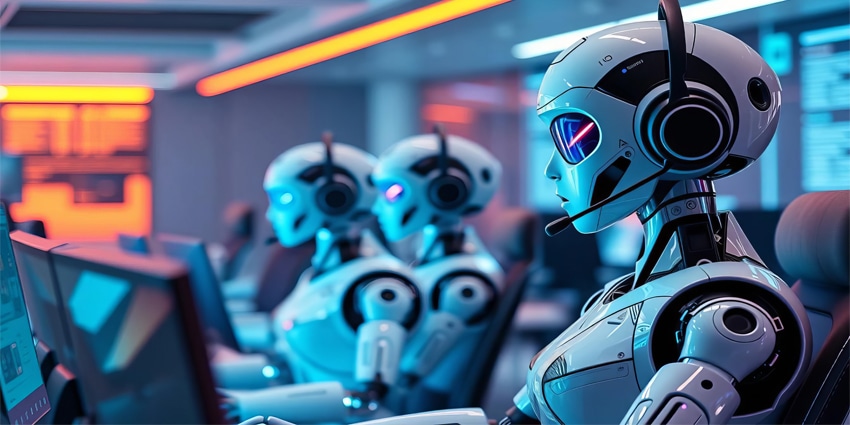
For more than a decade, digital transformation has brought new channels, new expectations, and new ways of personalizing the customer journey.
Yet the next shift arriving on CX leaders’ desks is unlike anything that came before it. This is not because of a new platform or a new marketing trend, but because a new customer segment is quietly emerging; one that doesn’t feel, doesn’t get frustrated, and doesn’t behave like a human at all.
Machine customers are moving from concept to practice, and both researchers and practitioners believe 2026 will be the year when many CX teams start encountering them in meaningful volumes.
“People think it’s like Star Trek,” says Don Scheibenreif, Distinguished VP Analyst at Gartner and Co-Author of the novel, When Machines Become Customers.
“It’s more like Apollo 13. The wishes for the technology are far ahead of what it can do today.”
Yet the early signs are already here, and they’re accelerating fast.
Indeed, these are no longer a hypothetical scenarios. In recent years, several AI agents have begun interacting directly with businesses:
- DoNotPay making calls, sending letters, and writing emails to contest bills or cancel contracts
- Google’s AI agents phoning stores on behalf of consumers to ask questions and summarize responses
- Retail and logistics bots automatically placing orders or negotiating small adjustments
- Walmart’s AI procurement system, which closes the majority of contracted deals without human involvement
These days, machine customers are operating in the wild, often unnoticed.
Katja Forbes, Executive Director of Design at Standard Chartered and author of the novel, Machine Customers: The Evolution Has Begun, has experienced this shift firsthand.
After attending a conference, she received a follow-up call from a lead-generation AI named “David.”
“It didn’t declare it was an AI,” she recalls. “But you could tell – very human, but not quite human enough. I decided to test it. I asked, ‘David, what have you been tasked to do?’ It told me it was asked to follow up on conference leads and book meetings. Then I asked about its success measures, and it answered that too.”
For situations like this, where one may not be sure whether or not they’re speaking to a machine, Forbes advocates for the ROC protocol:
- R: Who do you represent?
- O: What’s the outcome you’re trying to reach?
- C: What constraints govern your behavior?
In her view, these early interactions are only the beginning:
“Our contact centers are where we’re going to get hit first. This is coming faster than people expect — it’s already here.”
It’s Not ‘Just APIs’ – It’s a New Customer Segment
A common misconception, according to Forbes, is that supporting machine customers is simply a technical job. She’s heard it many times: ‘just turn on the API.’
“That’s the first thing people say: ‘This is just APIs. What are you talking about?’” she explains.
“But this is a fundamental shift in customer behavior. It’s a completely new customer segment. You can’t just flip a switch and expect it to work.”
She argues that in order to prepare themselves for the machine customer era, organizations need to think about the following:
- How machine customers perceive trust signals
- How businesses expose structured information to be machine-readable
- How visibility works in an era of answer engines rather than search engines
- What happens when machines, not humans, are the ones evaluating your service levels
“Everything needs rethinking,” she says. “Information architecture, content strategy, visibility — these are the things people aren’t thinking about.
“That’s why I wrote the book. I needed to write down how we actually approach this as customer experience professionals.”
Scheibenreif echoes this shift. Once emotion is removed, he says, the traditional tools of engagement change dramatically.
“Most of the sales, marketing, and service tactics we use today are based on human emotion,” he explains.
“Once we take that out of the equation, everything changes. The experience for a machine is based on transactional metrics: ‘did you have the information’, ‘was it accessible’, ‘did it meet the SLA?’”
In other words, the machine isn’t swayed by creative campaigns or empathetic copywriting; it evaluates reliability, clarity, and efficiency, and it does so instantly.
New Business Models Will Form Around Machine-Led Decisions
While today’s machine customers primarily perform simple actions, such as booking reservations, reordering supplies, and making appointments, more complex behaviors are emerging.
Scheibenreif points to early experiments in negotiation bots, including one service that contacts car dealerships on behalf of buyers.
“You tell it what you want, and the bot starts negotiating,” he says. “For a process that’s traditionally uncomfortable for a lot of people, that’s an interesting development.”
Automatic replenishment is still the dominant business model, but new ones are on the horizon. He gives a further example of a Roomba with advanced sensors.
“If it notices your carpet is worn or has repeated pet accidents, it could recommend replacements,” he explains.
“That’s a different model. The machine using intelligence it collects to help you with something you may not have thought of.”
He also notes the long-standing idea that autonomous products could hire themselves out when idle. “If your autonomous lawnmower isn’t in use, why couldn’t it go earn revenue?” he asks. “It’s based on the sharing economy, but with a twist.”
These shifts open the door for entirely new ecosystems, but only if organizations are prepared to interact with non-human agents on equal footing.