

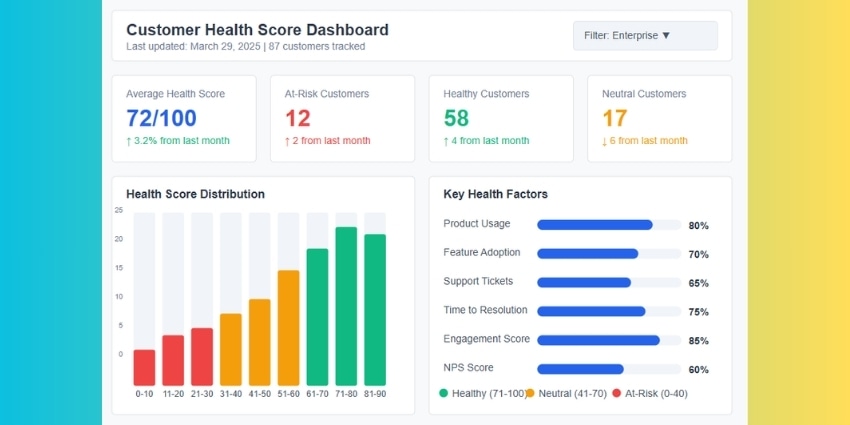
As someone who's analyzed countless customer relationships over the years, I've seen thriving partnerships suddenly deteriorate without warning. If you're responsible for nurturing customer relationships, you know that sinking feeling when a seemingly happy customer announces they're leaving. That's why I'm passionate about the Customer Health Score – it's the early warning system every CX professional needs.
Why Traditional Metrics Aren't Enough
We've all been there – staring at positive satisfaction scores while customers quietly disengage. Traditional metrics like CSAT and NPS are valuable snapshots, but they're just that – moments in time that don't always reveal the complete picture of your customer relationships.
Customer Health Scores dive deeper by examining the actual behaviors and engagement patterns that signal long-term relationship strength. This more nuanced approach helps you understand not just if customers are satisfied today, but if they're likely to stay, leave, or become advocates tomorrow.
Building Your Customer Health Score Framework
A powerful Customer Health Score examines multiple dimensions of the customer relationship:
Usage Patterns: Look beyond simple login frequency. Which features are customers using? Are they adopting new capabilities? Has usage increased, plateaued, or declined? A customer who consistently explores your product's full potential is typically healthier than one who uses the same limited features.
Support Interactions: While high ticket volume might seem negative, context matters. Are they struggling with basic functions or pushing boundaries with advanced features? Are resolution times improving as they gain expertise? These nuances tell a story about relationship trajectory.
Engagement Signals: Consider how customers interact across channels. Do they attend your webinars? Open your emails? Participate in your community? Each positive engagement strengthens the relationship.
Business Outcomes: Ultimately, are customers achieving their desired outcomes with your product or service? A health score must reflect whether your solution is delivering tangible value.
Implementing Your Health Score System
Rather than prescribing a one-size-fits-all approach, I recommend this process for building a health score that reflects your unique customer relationships:
- Identify Your Leading Indicators: Analyze your successful long-term customers and those who've churned. What behavioral patterns differentiated them 3-6 months before renewal? These differences become your key health indicators.
- Weight Factors Appropriately: Not all signals carry equal importance. Work with customer-facing teams to determine which factors most strongly predict retention or churn in your business.
- Create Scoring Tiers: Develop a simple system – perhaps green/yellow/red or numeric scores – that makes health status immediately clear to everyone in your organization.
- Connect Scores to Actions: The most effective health score systems trigger specific interventions. A yellow score might prompt increased check-ins, while red scores could activate executive outreach or success team intervention.
- Refine Through Learning: Your initial health score model will improve with time. Regularly revisit which factors accurately predicted outcomes and adjust accordingly.
Turning Insights into Action
The real power of a Customer Health Score isn't in the number itself – it's in how you respond to it. Here's how to make your health score actionable:
Proactive Interventions: When scores begin trending downward, don't wait for customers to raise concerns. Reach out proactively with specific support based on the factors driving the decline.