Tech innovation is accelerating like never before, and 2025 is the year many brands will embark upon transformational projects to reimagine their customer experiences.
In doing so, they’ll revamp their tech ecosystems, working with tech providers offering everything from CRM and CDP platforms to CCaaS and WEM solutions.
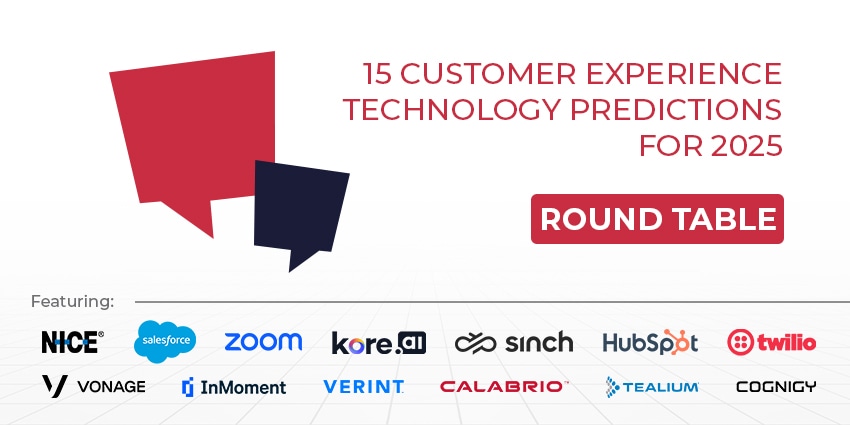
Recognizing this, CX Today reached out to some of the most recognizable tech players from across the CX stack, who will hand-hold global organizations through their transformations.
An expert from each tech giant gave a top tech prediction for their primary subset of CX. Here’s what they had to say.
CRM
Salesforce is the leader in CRM technology, with HubSpot providing its closest competition in the midmarket space. Unsurprisingly, AI dominated both their predictions for 2025.
1. Agentic AI Takes the Mantle from Generative AI
In November 2022, 72 years after Alan Turning published the paper on 'Computing Machinery and Intelligence', came the rise of generative AI. Next, 2025 will see the ascendance of agents.
Indeed, agentic AI will take center stage as humans learn to work alongside AI agents to deliver exceptional customer experiences and build limitless digital workforces.
As it does so, agentic AI will offer a new level of value realization for companies, which has yet to be achieved with generative AI at scale.
For companies looking to transform their CRM and engage with their customers in a new way, starting this journey will require a strong data foundation grounded in trust and clear controls for accessing and auditing data, processes, and systems.

The modern AI-powered CRM platform will require a flexible architecture because the rate of innovation is unprecedented.
With this pace of change, balancing flexibility and guardrails with speed of execution and accuracy of the AI results will be a defining point for any organization.
- Paul O'Sullivan, CTO at Salesforce UKI
2. Customer Success Teams Will Work with AI, Reimagining CX Processes
There are two significant areas of opportunity for customer success teams in 2025. These are:
- Speeding up time to value with AI.
- Moving from onboarding to "everboarding" to meet customer expectations.
Time to value used to be limited by what customer success reps could accomplish in a day. Now, they can rebuild their processes, so humans and AI work together, helping customers get faster results and resolutions.

When it comes to onboarding, customers used to expect a long, complex implementation to get up and running. But that’s not the case anymore.
Instead, customer success teams should focus on "everboarding": an ongoing process that's more than just implementation and can help enable greater adoption and usage of their product.
- Jon Dick, SVP of Customer Success at HubSpot
Customer Data Platform (CDP)
Many CX platforms now place data layers over their solutions. Yet, CDPs reach across all of them, unifying that data, putting it to work, and bolstering CX-wide AI implementations. Tealium is a market leader whose prediction focuses on strengthening that data backbone.
3. Brands Develop a Vendor-Neutral Data Layer to Power Their CX Initiatives
As composable tech architecture trends mature, real-time personalization and AI activation remain key challenges that cannot be solved with cloud data warehouses (CDWs) alone.
While some organizations initially attempted to build their composable stack directly on cloud data warehouses, they're increasingly discovering the limitations of this approach.
Many now adopt an architectural strategy that combines the depth of CDWs with a vendor-neutral data layer managed in the CDP to enhance efficiency and performance and reduce cost.
Such a centralized data layer approach is gaining traction as brands realize that keeping pace with customer expectations requires real-time processing capabilities that traditional CDW-based architectures cannot deliver.

The industry's direction is clear as CDWs shift toward real-time capabilities in partnership with CDPs.
However, true AI-driven customer experience decisions require both robust infrastructure and a carefully planned architectural approach centered around an agile, vendor-neutral data layer.
- Matt Parisi, Director of Product Marketing at Tealium
CCaaS
NICE features as a leader in almost every analyst report into the CCaaS space. Meanwhile, Zoom has perhaps made the biggest splash of the many new market entrants. Again, AI features heavily, as both brands make big predictions below.
4. Businesses Embrace Fully Automated Customer Service
By 2025, many will embrace the idea that the future of customer service is fully automated, turning contact centers from traditional cost centers into profit centers.
With advancements in AI, automation will handle most customer interactions, efficiently resolving issues, offering proactive support, and even driving upsell opportunities.

Businesses will not only benefit from reduced operational costs but will also unlock new revenue streams through personalized AI-driven engagements.
The shift will be transformative, with AI enhancing both customer satisfaction and the bottom line as contact centers evolve into critical revenue-generating hubs.
- Barry Cooper, President of the CX Division at NICE
5. Customer Satisfaction Rebounds from Its Record Lows
Customer satisfaction (CSAT) will rebound from its all-time lows, largely driven by AI investments and adoption.
AI-first contact centers will enhance agent performance with real-time assistance and automate routine tasks, enabling human agents to tackle complex issues more effectively.
Meanwhile, predictive analytics, sentiment analysis, and intelligent routing will create hyper-personalized experiences that anticipate customer needs, leading to higher satisfaction and loyalty.
On that note, proactive outreach will evolve from a "nice-to-have" to a baseline expectation in CX.

Leveraging AI, companies will anticipate customer needs, provide preemptive solutions, and deliver tailored communications.
From guiding customers through onboarding to suggesting relevant upgrades, this proactive approach will cater to the desire for hyper-personalized, anticipatory service, enhancing satisfaction and reducing churn across every touchpoint.
- Amy Roberge, Head of Zoom Contact Center
Conversational AI
Over the past five years, Cognigy and Kore.ai have raced to the conversational AI market’s forefront, competing with IBM and Google on most enterprise shortlists. Now, as agentic AI looms, these brands pinpoint how their markets will change in 2025.
6. AI Agents Form a Digital Labor Force
The rise of AI-first, agentic solutions will drive fundamental strategy shifts in customer service.
While challenges like attrition and labor shortages persist, their impact will diminish as AI takes on more tasks, improving scalability.
Customers will find it easier to speak with Tier 2-level human support, though even rarer to talk with a human for Tier-1-level support.

Yet, the market’s rapid evolution also presents a growing challenge: many solutions appear similar in demos, making it harder to assess true enterprise readiness. Vendors without proven capabilities risk overpromising, leaving businesses to learn the hard way.
As such, organizations must look beyond surface-level offerings to identify partners capable of delivering real, scalable value.
- Alan Ranger, VP of Marketing at Cognigy
7. Customers and Employees Get Personal Assistants
By 2025, AI agents will significantly reshape consumer shopping behavior, particularly for events and experiences such as booking holidays or preparing for gatherings like birthdays or game nights.
AI-driven personal assistants will handle everything from curating personalized shopping lists for specific events to managing complex travel itineraries based on user preferences, budget, and availability.

These agents will integrate seamlessly with retailers and service providers, offering dynamic recommendations based on real-time data, including weather, location, and user feedback.
Shoppers will rely on AI to anticipate needs, suggest tailored products or services, and even automate purchases, making the entire process more intuitive, efficient, and personalized.
- Gopi Polavarapu, Chief Solutions Officer at Kore.ai
Voice of the Customer (VoC)
InMoment led the charge across the VoC market when GenAI burst onto the scene. Now, as tech advancements accelerate further, the provider shares not one but two predictions as to what might come next.
8. Everyone Gets a Digital Twin
The concept of digital twins - virtual replicas of customers built from vast amounts of data - will become a cornerstone of customer experience strategy.
Data-rich, these digital twins will allow organizations to simulate, predict, and optimize customer experiences in ways that were previously thought impossible.
These models mirror real customers' behaviors, preferences, and needs, enabling companies to personalize interactions and predict future actions with remarkable precision.
In practical terms, they will allow businesses to test and refine CX designs before launching them in the real world, offering a risk-free environment to experiment with new strategies.
Enterprises will use these digital replicas to anticipate how different customer segments will react to a new product feature or marketing campaign.