“Single customer view” has become a strikingly popular phrase for anyone selling enterprise software. CRM vendors promise it. So do CDP providers, data cloud suppliers, and increasingly the companies looking after your warehouse. You could spend a fortune comparing them and still end up with agents who can’t tell whether a refund has cleared.
Customer data management (CDM) is the work of keeping customer information accurate, connected, secure, and available where it’s needed: deciding which records to trust, sorting out duplicate identities, and getting information to the people using it. A CDP might help enormously. So might fixing an integration you’ve been working around for three years. As always, AI has raised the stakes, as Carlie Idoine, VP Analyst at Gartner, put it,
“AI needs to be tightly aligned with data, analytics and governance.”
Despite this, Salesforce’s 2026 survey of 3,450 commerce professionals found that only 27% said their customer data was fully unified across sales, service, marketing, and commerce.
It’s time to fix the customer data problem in the contact center once and for all.
Key Takeaways
-
A disappointing CRM doesn’t automatically justify buying a CDP. Find out what’s failing first.
-
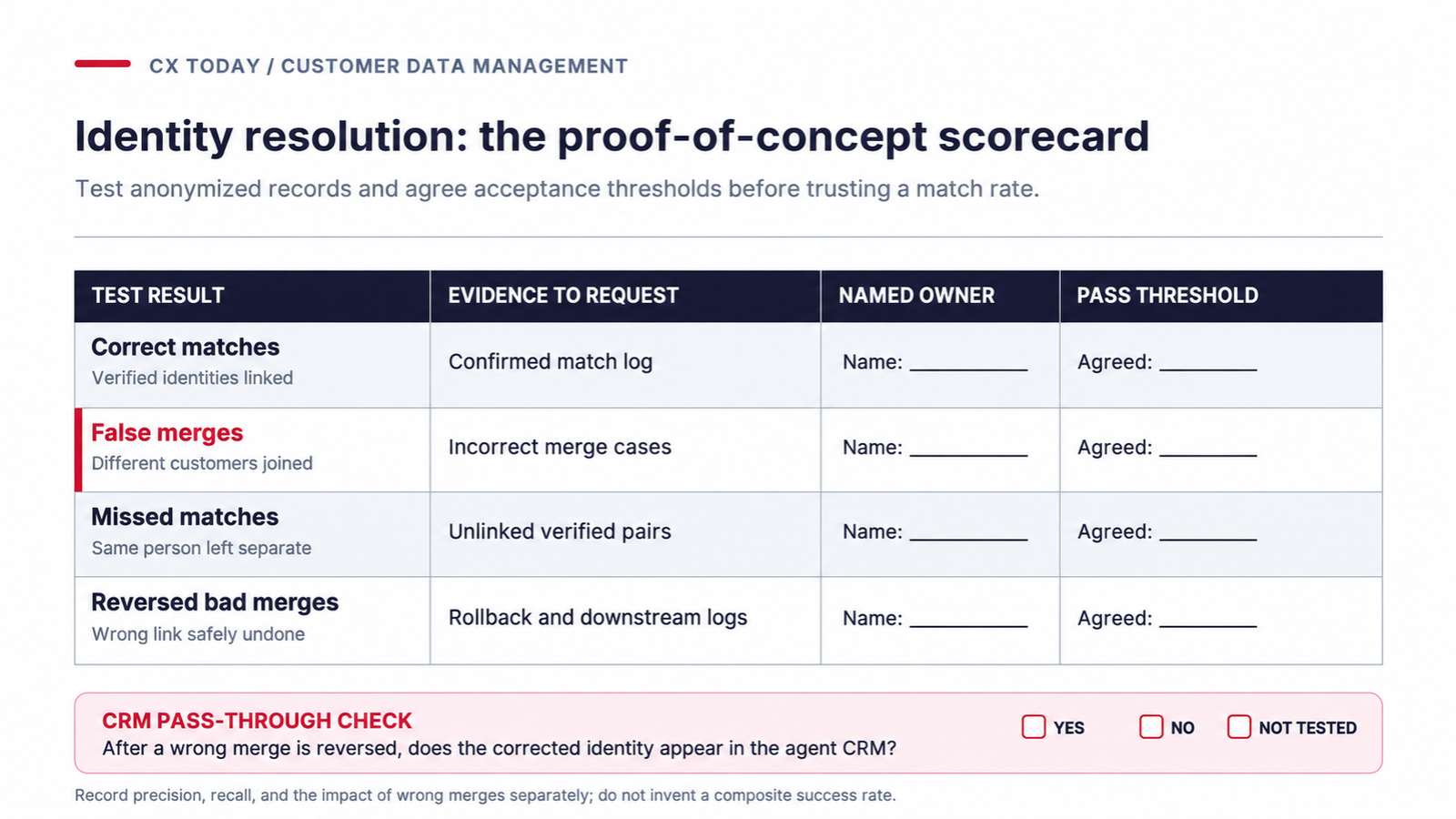
CDPs can connect customer identities, although incorrect matching can create problems worse than the duplicates they replace.
-
Data warehouses and composable CDPs deserve serious consideration before you agree to another separate customer database.
-
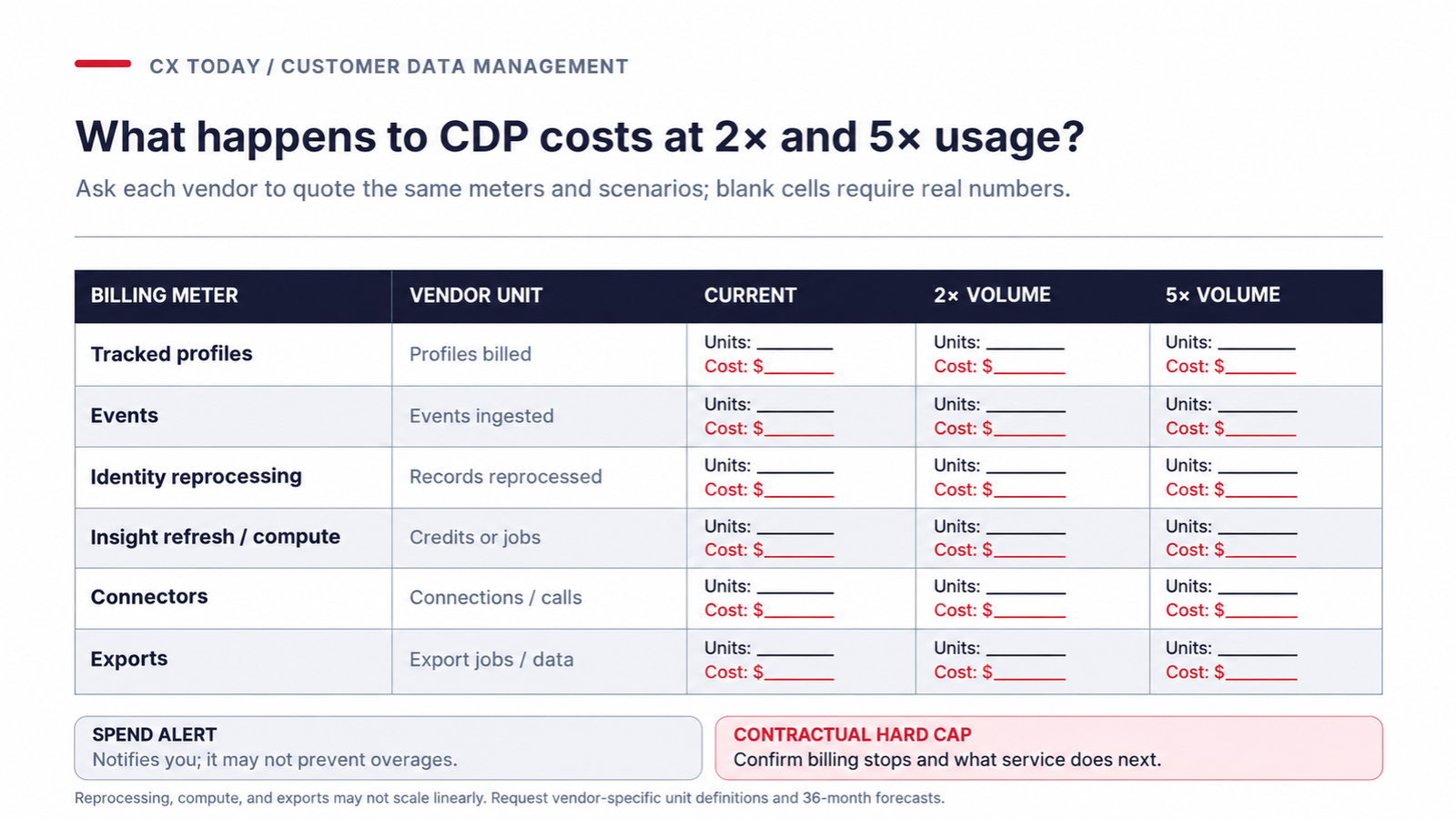
“Data cloud” tells you remarkably little about the capabilities included in a contract. Make suppliers show you what’s actually available.
-
Check identity accuracy, data freshness, and consumption charges using your own workloads. Vendor demonstrations rarely expose the expensive surprises.
If an agent can’t find a customer’s refund, buying a CDP is an absurdly expensive answer. If millions of records genuinely need stitching together across channels, it could be money well spent.
CRM, CDP, Data Warehouse and Data Cloud: What Does Each Do?
A data warehouse can hold more about a customer than anyone in the business, while the agent taking their call knows next to nothing about them. Neither system is failing; they were built for different jobs. The issue is that companies expect one product to handle everything, which isn’t surprising when vendors keep using the same language for different capabilities. It’s also why customer context has become CRM’s next competitive battleground, especially now AI agents need those records mid-interaction.
|
Technology |
What I’d actually use it for |
What I’d question |
|---|---|---|
|
CRM |
Managing customer relationships, cases, sales activity, and service workflows |
Can employees access information held outside the CRM? |
|
CDP |
Recognizing customers across channels and making connected profiles available for use |
How does it handle uncertain matches? |
|
Data warehouse |
Bringing large datasets together for analysis, reporting, and increasingly customer activation |
How much additional work is needed to get that data into operational systems? |
|
Data cloud |
Depends on the vendor. Most bring together some mix of customer identity, data storage, and activation tools. |
What’s included in the price, and what’ll require another product? |
Some of the capabilities you’re shopping for may already be sitting in your existing technology. Databricks, for instance, describes using Hightouch for activation while customer information stays in its lakehouse, a sensible starting point for businesses already invested in a warehouse.
The CDP Institute’s 2026 research also gives buyers reason to challenge the “everything under one roof” pitch. Of five major platforms examined, none documented behavioral collection, identity resolution, and consent/data-rights management together as generally available first-party capabilities.
How Does Customer Data Management Work?
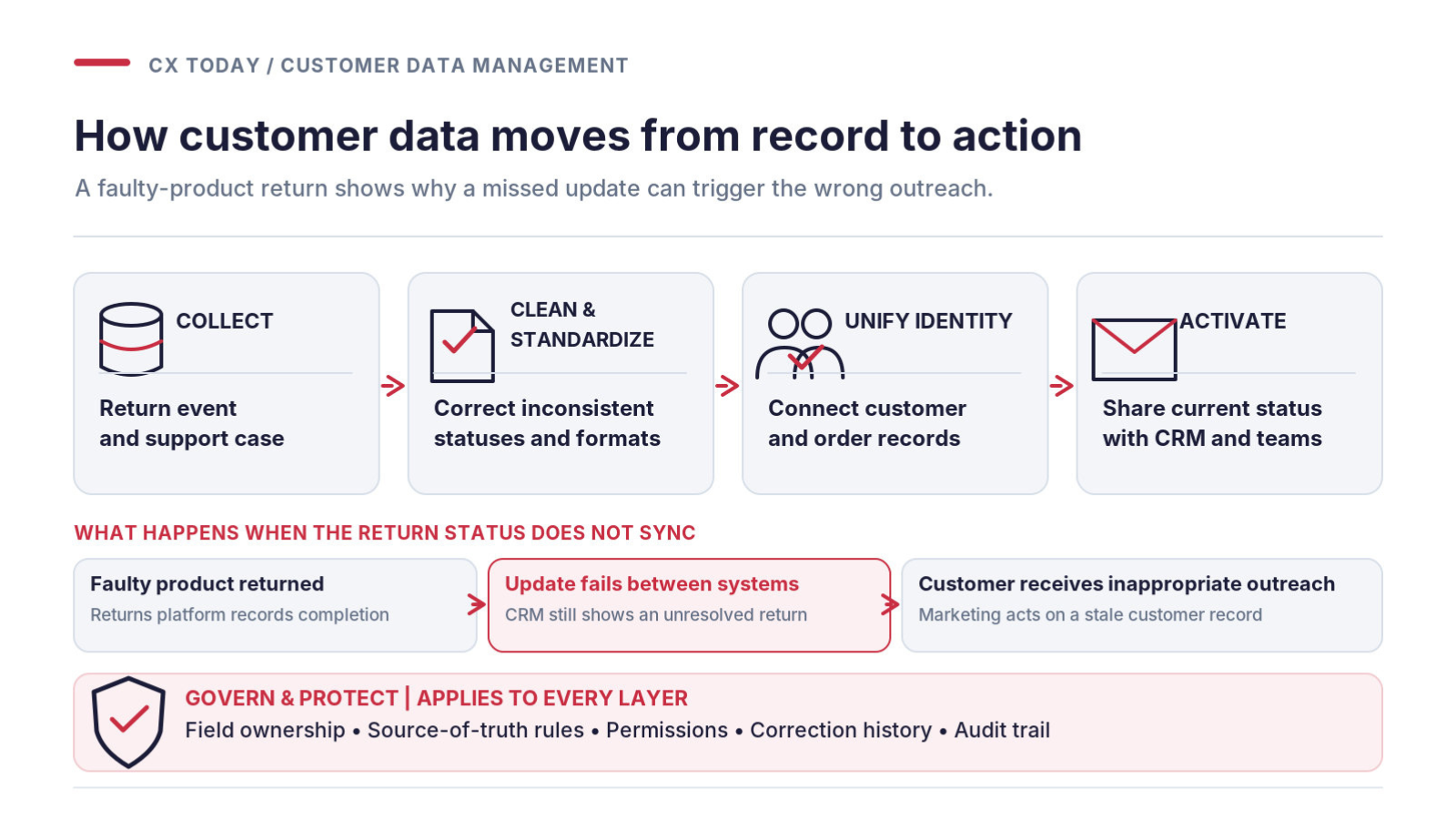
A customer changes their phone number in the banking app. Six months later, the fraud team is still sending verification codes to the old one. Both systems have accurate records of what they were told. Nobody’s made sure the newer information takes precedence.
That’s the sort of problem customer data management (CDM) is supposed to catch. There are five parts to the process, and it’s definitely worth paying attention to what happens in between them:
-
Collect first-party data: Everything customers have told you or generated, from purchases and support requests to website activity and account preferences.
-
Standardize and clean data: Check what records mean before combining them. One system’s “inactive” could be another’s “temporarily suspended,” and that causes a surprising amount of trouble.
-
Unify customer identity: Three email addresses might belong to one customer; one phone number might belong to a whole household. Matching rules need to handle both, especially where money is involved.
-
Activate data across teams and tools: Service agents should see what marketing and sales already know, where they’re permitted to, which means CRM and contact center software talking to the other systems through pipelines that don’t need constant rescuing.
-
Govern and protect customer data: Someone needs the authority to settle disputes between records, with corrections tracked and the original source traceable. If bad data has affected someone’s account, “we don’t know where that came from” is a dreadful answer.
Also, borrow one rule from master data management: agree which system has authority over each customer field. The returns platform should be able to correct a return status without an older CRM record reversing it overnight.
CRM, CDP or Data Cloud: Which Do You Actually Need?
It’s usually worth exploring a few cheaper options before putting another customer data platform on the shopping list. Particularly if you’re already paying for a CRM and a warehouse that nobody seems to be using properly.
|
What’s going wrong? |
Where I’d look first |
What I’d want to see |
|---|---|---|
|
Agents can’t find orders or previous conversations |
CRM configuration and integrations |
A complete customer history without copying records between systems |
|
One customer appears under several identities |
CDP identity resolution |
Accurate matches on your own data, including false-merge figures |
|
Customer data sits unused in Snowflake or Databricks |
Warehouse activation or a composable CDP |
A working audience or service workflow using that data |
|
Teams disagree about which records are correct |
Data ownership and governance |
Agreed rules for correcting conflicting information |
When Is Your CRM the Problem?
Sit with an agent for an hour and count how often they leave the CRM for information it should already display. Then check 50 closed cases: are orders and billing details linked, or pasted into the notes? Those findings can save an unnecessary purchase, because single customer view projects fail despite plenty of CRM investment. If you’re actually replacing the sales CRM, our 2026 Gartner Magic Quadrant rundown covers that separate decision.
When Is a CDP Worth Paying For?
When fragmented identities are genuinely preventing recognition or cross-channel activation, beyond what your CRM’s identity features can do. Be ready for it, though: Alium Research’s 2026 buyer interviews describe an enterprise software company that suspended its CDP project because its data wasn’t ready. If nobody owns duplicates, conflicting fields, or preferences, assign that first. A new CDP inherits the arguments your existing systems are already having.
Could You Keep Your Existing Architecture?
Quite possibly. Pets at Home uses separate Salesforce environments because different parts of its business need different things; there’s no advantage in forcing everything into one platform for the sake of it. Give the supplier a journey that’s regularly causing trouble and a sample of your records. Can they recreate the problem and sort it out without an engineer holding everyone’s hand? If your existing technology can handle the fix, ripping everything out is a peculiar way to spend the budget.