
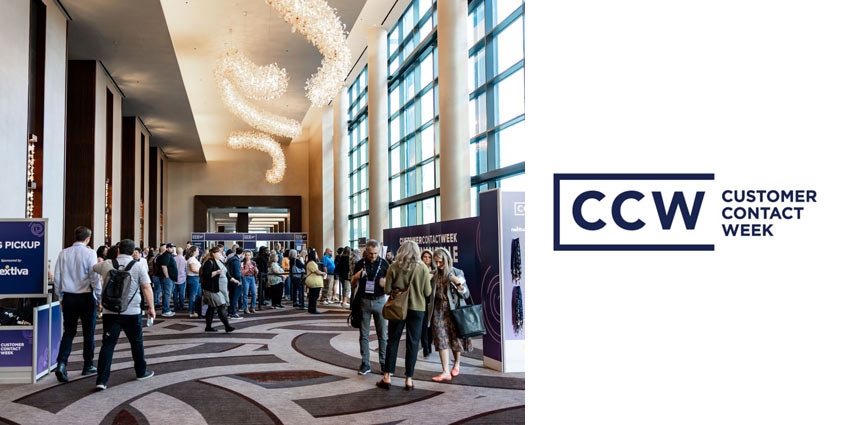
At massive CX events like Customer Contact Week 2024, attendees enjoy the opportunity to learn from keynotes, demos, and live peer case studies.
Yet, the best learnings often stem from the on-the-fly conversations with customer experience leaders, casually sharing impactful lessons that have helped shake up their CX operations.
During day one of CCW, the CX Today team engaged in many of these discussions and stopped by several scheduled sessions.
In doing so, we narrowed down all our learnings into the following five fascinating pieces of advice for contact center leaders, touching on everything from channel to workforce management.
1. Don’t Good Cop, Bad Cop Your Contact Center Channels
Customers often default to the phone, sensing that it offers them the best shot of getting their own way. Unwittingly, contact centers can reinforce these perceptions.
"A key reason customers escalate is to achieve better experiences," noted Brooke Lynch, Divisional Director of Digital at the Customer Management Practice. "Don’t encourage this by giving "special compensation" to people who argue over the phone."
To avoid this, delivering a consistent experience across channels is crucial. Yet, that's tricky to do with the explosion of digital communications.
For this reason, some brands are considering: which channel is best suited to each customer intent?
From there, they’re crafting the best possible experience on that channel – blending modalities, AI, and a human touch – and, via a front-end virtual agent, routing customers to that experience.
So, while contact centers are meeting customers on their channel of choice, they’re not necessarily keeping them there. Instead, they’re signposting and guiding them to the best possible solution.
As a result, more customers are likely to refrain from defaulting to the phone.
Sometimes they’ll escalate to voice, and that should remain an option. Yet, if the case has no irregularities, agents should feel confident in staying strong and navigating the customer through the pre-set experience.
2. Consider Slant Schedules & "Flex" Outsourcing
Typically, a contact center experiences a higher influx of calls at the beginning of the week than at the end of it.
As such, they hire more part-timers and/or pull harder on the outsourcing lever at the start of the week – adding complexity to workforce operations.
That’s why more contact centers are weighing up the merits of slant schedules. Here, an employee still works a 40-hour week. However, instead of doing the full eight hours each day, they’ll do ten hours on Monday, nine hours on Tuesday, and so on until they reach six hours on Friday.
Not only could such a shift pattern simplify scheduling, outsourcing, and recruiting processes, but agents often prefer this shift pattern as their workload lightens through the week.
Caleb Scott, a WFM Manager at CHHJ, discussed the potential merits of the system alongside how his team is better managing peaks in contact volumes.
That's a critical focus as peak management is a significant challenge across the collections industry, like many other spaces. After all, when an unexpected incident crops up – like a severe non-forecasted weather emergency – forecasts go out the window.
Yet, by choosing to work with an outsourcer with a "flex" option to offer emergency support – which doesn't come at a premium – CHHJ has a much-strengthened ability to smooth over peak periods and ensure consistent customer service.
3. Develop a Flywheel for Contact Center Innovation
The cloud offers the possibility for continuous performance optimization. That's a significant shift in mentality for contact center leaders and IT teams that have always leveraged on-premise systems.