
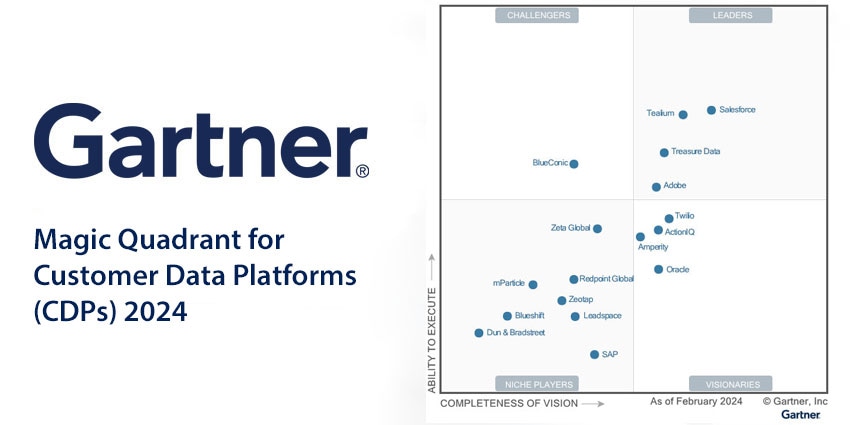
Data problems "plague" customer service, sales, and marketing teams – alongside other CX functions – according to Gartner.
As such, businesses aim to centralize data collection from various sources – and that’s where customer data platforms (CDPs) enter the fray.
Increasingly, brands are turning to these platforms, and – as a result – Gartner has launched its first-ever CDP Magic Quadrant.
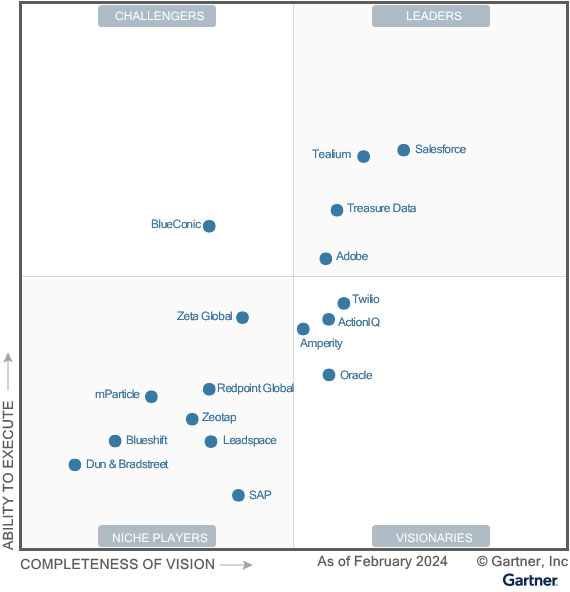
To do so, the research firm has evaluated 17 prominent CDP providers, isolating four market leaders.
The Definition of Customer Data Platforms
Customer data platforms connect with other systems to establish a unified customer database.
Such other systems include CRM, CCaaS, social media, conversational intelligence, the company website, and third-party databases – to name just a few possibilities.
Yet, beyond that, a CDP must consolidate profiles at the individual customer level and activate the data within those profiles. These are core capabilities.
Then, there are other features that Gartner notes CDPs "should" provide. Those include customer segmentation, integrations, data model management, privacy, and analytics reporting.
However, those at the forefront of the market go further. For instance, leaders may release other features from consent and preference management to data science workbenches and clean rooms.
While assessing all these capabilities, Gartner evaluated each of the 17 vendors in the Magic Quadrant on their deployment histories and vision.
In doing so, the analyst segmented each CDP provider into four groupings: Leaders, Challengers, Visionaries, and Niche Players.
Gartner Magic Quadrant Leaders
Leaders in the Magic Quadrant showcase a track record for satisfying enterprise requirements across critical CDP use cases and industries. Yet, they also go beyond the "table stakes" capabilities, embracing a longer-term view of the market demonstrated via potentially disruptive roadmaps. This year’s leaders are:
- Salesforce
- Tealium
- Treasure Data
- Adobe
Salesforce
The Salesforce Data Cloud connects the vendor’s CRM apps, including its Sales, Service, and Marketing Clouds, analyzing and activating data across the Salesforce ecosystem. Its partner network helps to pull data from many third-party solutions into that ecosystem, catering to the needs of businesses of all shapes and sizes. Gartner recognizes these strengths alongside Salesforce’s innovation cycle, citing its predictive and generative AI extensibility for engagement and activation.
Tealium
Tealium first brought a verticalized offering for Pharma to the CDP market. Since then, it has built a cross-sector, leading CDP. However, Tealium has maintained its nous in handling complex data and regulatory systems. Gartner recognizes this, lauding the vendor for identifying "specific regulatory and vertical combinations" that would benefit from a sector-specific innovation. Moreover, the analyst tips its cap to Tealium’s partner ecosystem of global collaborators and market neutrality, with 1,300 out-of-the-box connectors.
Treasure Data
While it may appear a marketing CDP, its add-ons for sales, service, and B2B demand-gen have helped Treasure Data deliver a fully-fledged, leading platform. In addition, the vendor enables cross-CRM customer profiles that connect the customer experience, allowing businesses to action various data sources for nonmarketing use cases. Gartner highlights this as a plus point, alongside its capability to track open web advertising and AI framework that enables predictive segmentation, next-best-offer, and channel recommendations.
Adobe
The Adobe Experience Platform (AEP) offers a CDP in its UI, making it easy to navigate and interoperable with other Adobe solutions – such as Adobe Target, which allows businesses to run A/B tests. There are also plenty of helpful resources and tutorials to help enterprises leverage these capabilities. That cohesive interface is a notable strength, in addition to its "multipronged" partnership strategy and full-funnel vision that combines first-, second-, and third-party data within customer profiles.
Gartner Magic Quadrant Challengers
Challengers in the Magic Quadrant have a reputation for "strong" product functionality and execution. Moreover, they stay focused on meeting client expectations. However, they may lag behind leaders in their "visionary pace" and exposure to large enterprises. This year’s challengers are: