

Contact center AI adoption is accelerating. Investment is up, vendor capabilities are maturing, and the business case for automation and agent assist has never been clearer. And yet deployment failures remain stubbornly common.
A common weakness is starting to emerge in contact center AI deployments: the agents handling the hardest escalations are often the least prepared for them, and the calls that matter most are rarely the routine ones.
As Ping Wu, CEO of Cresta says:
"the hardest conversations an agent has are the ones that move the business: the sales call, the retention save, the upsell in a service call."
Too often, they are also the conversations agents have had the fewest chances to practice before going live.
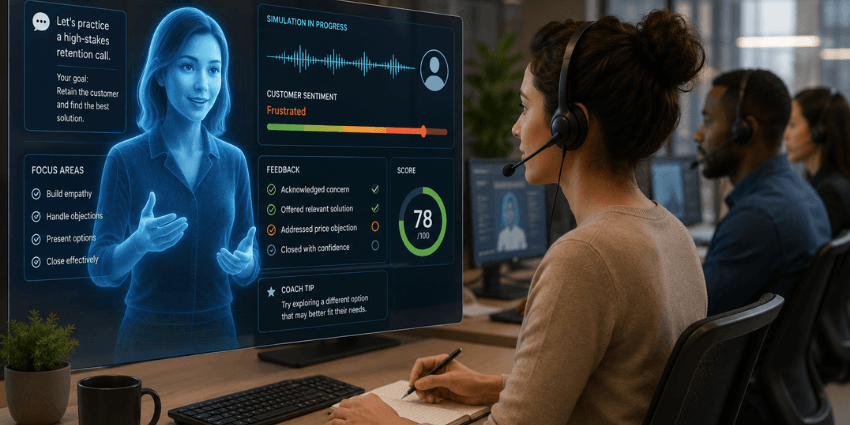
It is a problem that vendors are beginning to take seriously. Cresta, which launched its Cresta Training Simulator today, made the agent readiness gap its central argument.
Keep Reading
- Cresta’s CMO on the Unified AI Workforce
- How ODEON Cinemas is Redefining Empathetic Guest Service With Zendesk
- KPMG’s Dan Balisteri on Over-Personalisation
Why Is AI Upskilling Such a Persistent Problem in the Contact Center?
AI upskilling is particularly difficult in the contact center, because the consequences of being underprepared are immediate and customer-facing. An agent who struggles creates a bad customer experience, live, on a recorded call, with no opportunity to recover quietly.
The scale of the challenge is significant. Salesforce’s latest State of Service report found that 79% of service professionals are investing in agentic AI, underscoring how quickly AI is moving into frontline service operations. But training is not keeping pace. Zendesk reports that while 72% of CX leaders say they have provided adequate training for generative AI tools, 55% of agents say they have not received any training.
In the contact center, that gap matters most on the hardest calls, where agents are expected to handle complexity, emotion, and commercial pressure in real time.
The problem is not willingness, its infrastructure. The traditional tools available for contact center agent training - scripted role-plays, static eLearning modules, supervisor-led sessions - were not designed for continuous, personalized upskilling at scale. They were designed for initial onboarding. The pace of change in modern contact center environments has long since outgrown them.
Is the Industry Starting to Respond? Cresta Is Making Moves
As AI takes on more routine interactions, the value of the human agent shifts toward the hardest, highest-stakes conversations. Cresta’s launch of Training Simulator is significant because it argues those moments need a new kind of preparation: continuous, data-driven practice grounded in real conversation data and live quality criteria.