According to Gartner, 90 percent of businesses will leverage CPaaS platforms by 2026. In 2022, the figure stood at just 30 percent.
That represents an extraordinary uplift for the market. But what is driving it?
The integration of generative AI (GenAI), expansion of developer tools, and heightened focus on personalized engagement. These are all possible examples.
Yet, we wanted to dig deeper. So, for this month’s roundtable, we rounded up a panel of eight industry experts to lead us through some of the most disruptive market trends. They are:
- Mauro Carobene, Head of Customer Interactions Suite at Tata Communications
- Anthony Bartolo, Chief Operating Officer at Bandwidth
- Ivan Ostojić, Chief Business Officer at Infobip
- Anna Jäger, Vice President Marketing EMEA at Sinch
- Seth Gilpin, Director of Product Marketing at Telesign
- David Casem, CEO of Telnyx
- Carina Kern, Principal Product Marketing Manager EMEA at Twilio
- Vikram Khandpur, SVP, CPaaS Products and Developer Experience at Vonage
In addition to market trends, our panelists discuss how the tech is enabling industry-specific CX innovation below - alongside some of the differentiators to look out for within CPaaS platforms.
CPaaS Market Trends
Rich Conversational Channels
Ostojić: Infobip just revealed its 2024 Messaging Trends Report, and, as part of this report, we highlighted how many complete customer journeys are taking place on rich conversational channels.
Customers can now seamlessly progress through the various stages of purchase within a single conversational thread on a chat app or rich communications services (RCS), for instance.
Another essential trend to spotlight is the emergence of GenAI as a key tool to enable better conversational experiences since it can replicate human conversation by recognizing individual words, context, and intent.
The CPaaS industry is well positioned to capitalize on GenAI appliances since GenAI has a natural fit in different channels and enables next-level communications between businesses and consumers.
AI Everywhere
Carobene: AI is revolutionizing customer engagement within CPaaS ecosystems in several key ways:
- Hyper-Personalization/Individualization: Leveraging AI, businesses can predict customer needs, curate content tailored to individual preferences, and facilitate brand interactions at the customer’s convenience and on their preferred communication channel.
- Contextual Engagement: Bots provide timely and relevant responses to customer queries, ensuring first contact resolution (FCR) and swift service delivery.
- Real-Time Insights: CPaaS platforms, augmented with AI, often provide analytics capabilities - such as sentiment analysis during live interactions and actionable recommendations - to improve customer satisfaction scores.
- Channel Orchestration: AI empowers organizations to create a comprehensive view of customer conversations, ensuring consistent communication across channels and touchpoints.
Heightened Interoperability
Bartolo: There’s an old saying that the only sure things in life are death and taxes. If you’re an enterprise CIO, you can add “integrations” to the list.
CIOs want the best solutions for UC, CC, AI, and fraud prevention – but they want interoperability so they’re not locked into a single vendor. And they can’t risk breaking something on their way to the cloud. CPaaS adoption will accelerate as vendors show they can solve this integration challenge.
At Bandwidth, we believe we have an elegant solution with our new Maestro platform.
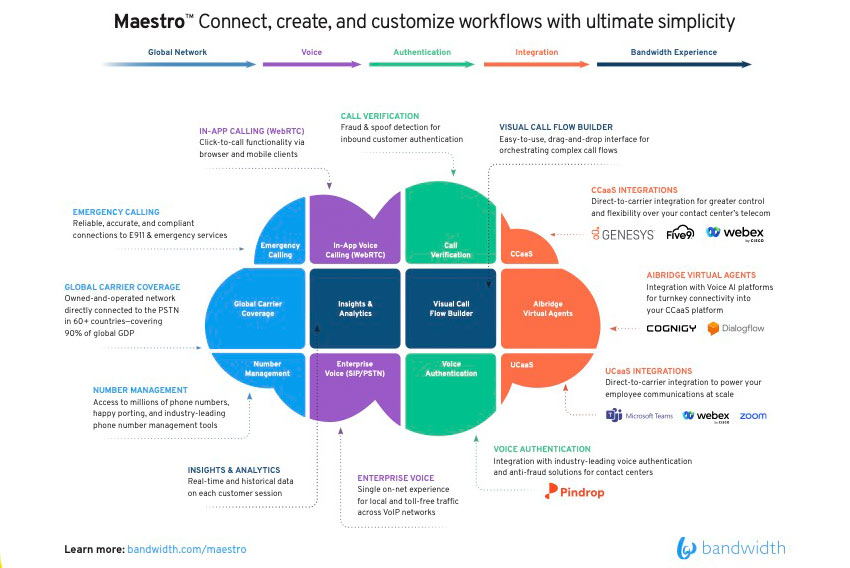
The most important integrations are available out of the box with Maestro. This speeds up time to value and reduces development time from months to hours while giving future flexibility to switch between solutions.
By solving the integration headache, CIOs are free to focus on delighting their customers with a better CX. Come to think of it, maybe there are only two sure things in life after all!
Next-Level Accessibility
Jäger: Generative AI will likely enable access to CPaaS APIs for more businesses in 2024.
Until today, there’s been a barrier for smaller companies to benefit from the cost advantage and reach of CPaaS.
AI will allow these companies to create customized software to solve their unique challenges at a lower cost. This opens up new sales markets for CPaaS players.
Channel Mix Changes
Gilpin: Over the next five years, OTT channels - like WhatsApp, Viber, and RCS - will become a staple of business communication.
From rising costs and SMS vulnerabilities to OTT end-user adoption and feature-rich experiences – there’s a growing need for businesses to build new channels into their CPaaS stacks.
In many markets outside the United States, like Latin America and Southeast Asia, WhatsApp is ubiquitous, and - when Apple integrates RCS into iOS later this year - there will be an overnight doubling of device penetration and coverage.
CPaaS APIs that offer unified, multichannel delivery will become the new standard as businesses rapidly adopt and scale.
Real-Time Communications
Casem: The growth of the CPaaS market is largely fueled by evolving connectivity requirements that necessitate high-performance, low-latency solutions for real-time AI applications. These include voice bots, chat apps, and instantaneous language translation.
The integration of advanced GPU architecture with cutting-edge large language models (LLMs) for rapid data inference and interaction exemplifies how the CPaaS market is shifting toward supporting more complex, AI-enabled communication services.
As it does so, CPaaS providers meet the growing demand for intelligent, real-time applications across various sectors.
Customer Data Platform (CDP) Integrations
Kern: Leading CPaaS vendors are integrating capabilities such as CDPs to provide greater levels of context and personalization to everyday customer interactions.
Integrating AI to bring data insights - offered by a CDP - to service and sales reps at the right moment of a conversation is also transforming the CPaaS market.
These trends allow businesses to become more context-aware, precise, and personalized with their customer engagement strategies.
CPaaS in Conversational Commerce
Khandpur: Conversational commerce technologies streamline customer interactions directly within channels such as websites, social media platforms, or messaging applications.
By utilizing CX technologies like virtual agents and assistants, companies can address product queries and offer recommendations tailored to customers' preferences and shopping habits.
CPaaS allows companies to maintain access to valuable insights such as customer intent, geographical location, and social engagement, empowering them with deeper insights into customer needs and enhancing CX.
Industries Embracing CPaaS
Financial Services
Jäger: We surveyed 3,000 FinServ consumers worldwide to determine their real needs:
- 73 percent prioritize secure communication
- 95 percent seek seamless messaging to voice call transitions
- 89 percent desire useful advice
CPaaS seamlessly meets these needs.
For instance, Triodos Bank has streamlined its operations by implementing One Time Password (OTP) functionality using Sinch’s CPaaS.
Nets, a payment processor, now relies on CPaaS for robust two-way communication with a high level of security.
Similarly, FirstBank successfully leverages CPaaS to provide personalized SMS notifications.
The focus is on meeting customers on their terms, at the right time, and across an expanding array of channels - without all the technical heavy lifting.
Bartolo: The financial services space is one of the top industries adopting CPaaS.
Automated voice, text messaging, and emergency calling in the cloud are the fastest ways to build a better CX.
CPaaS also unlocks many additional benefits, like reducing operating costs, leveraging AI technologies, and simplifying and de-risking digital transformation company-wide.
Yet, agnostic of industry vertical, we’re seeing a consistent theme among enterprises actively embracing CPaaS: a focus on Customer Experience.
Here are some other factors:
- Business History: They've been around for a while (e.g., Banking, Financial Services, Insurance), and have significant on-premises or homegrown capabilities that need modernization.
- Regulated: Regulated industries have extra hurdles to clear in order to shift to the cloud (e.g., Healthcare and privacy of Personal Identifying Information, or PII).
- Inorganic Growth: Mergers and acquisitions lead to a mixed-and-matched tech stack.
- Multinational: Operating in multiple regions is complicated and requires software automation to help maintain business continuity.
Kern: CPaaS helps businesses deliver personalized communications at scale, with applications across many industries.
One example is within financial services, where a host of fintech brands are taking advantage of the power of CPaaS to provide a frictionless digital user experience.
Retail and eCommerce
Gilpin: Retailers are pioneering over-the-top (OTT) channels like WhatsApp and Viber to mobilize the shopping experience.
By embracing what’s possible through OTT channels, businesses can offer customers a seamless journey – browsing, purchasing, and engaging with customer support, all within a single messaging app.
Such an approach allows for personalized interactions, where businesses can send tailored multimedia content, promotions, and product recommendations that engage customers in ways that would never be possible using SMS.
The integration of chatbots and AI offers instant and automated support. These features not only enhance customer experience but also drive bottom-line and customer lifetime value.
Retail and eCommerce's embrace of CPaaS illustrates a commitment to leveraging innovation to meet the evolving needs of the digital consumer.
Healthcare
Casem: The need for reliable, real-time communication is crucial in healthcare for telemedicine consultations, patient monitoring, emergency response, and seamless collaboration among healthcare professionals.
CPaaS platforms offer healthcare providers the tools to build custom communication solutions that integrate voice, video, messaging, and AI capabilities into their systems.
These powerful integrated tools enable remote patient consultations, real-time health data exchange, appointment scheduling, and personalized patient engagement through automated reminders and notifications.