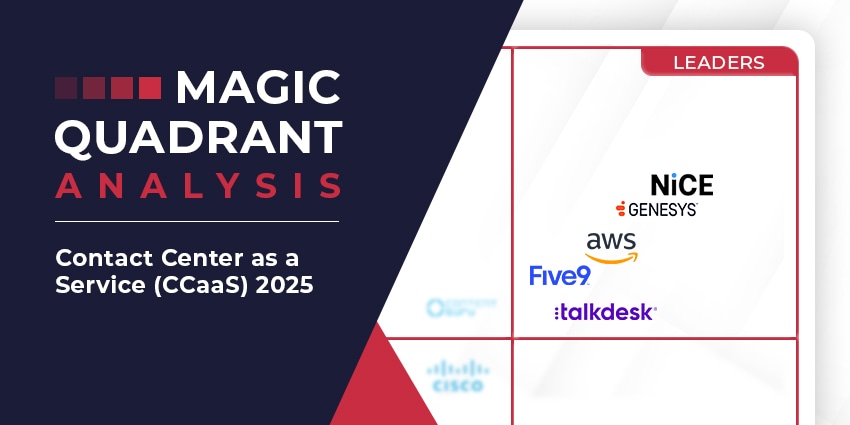
The Magic Quadrant for CCaaS is back, and once again, NiCE and Genesys lead the way.
AWS, Five9, and Talkdesk join them in the Leader square, with the latter bouncing back after placing as a Visionary last year.
Content Guru also rises up the pile. It has shifted from the Niche Player quadrant and is now a Challenger. Meanwhile, Cisco moves in the opposite direction.
8x8 has dropped out of the evaluation, yet Zoom enters and takes its place as a Niche Player.
Alongside 8x8, Google, Microsoft, and Sprinklr are prominent CCaaS providers that don’t feature in the Magic Quadrant matrix.
The Definition of Contact Center as a Service (CCaaS)
All cloud applications that enable customer support teams to manage multichannel conversations fall under the term "Contact Center as a Service (CCaaS)".
The providers included in the Magic Quadrant assemble those apps, both native and third-party, on CCaaS platforms, enabling service experiences led by both humans and AI.
Yet, it’s not all about facilitating conversations. CCaaS platforms will also offer solutions for analytics and reporting, agent assistance, and workforce engagement management (WEM).
While Gartner's definition is more comprehensive, that's ultimately what each vendor in the report offers.
The analyst evaluates them on such capabilities, alongside pricing models, support services, integrations, verified customer feedback (stripped from Gartner Peer Insights), and more.
In doing so, the research firm splits nine of the most prominent industry players into four groups: Leaders, Challengers, Visionaries, and Niche Players. Here’s how they performed.
Gartner Magic Quadrant Leaders
Leaders sit in the top right-hand square of the Magic Quadrant, scoring above average in their "ability to execute" and "completeness of vision". This year’s Leaders are:
- NiCE
- Genesys
- Amazon Web Services (AWS)
- Five9
- Talkdesk
NiCE
NiCE has secured several major enterprise CCaaS deals this calendar year, including two nine-figure mega-contracts.
Key to these deals are its advanced global support services, which Gartner lauds, alongside the vendor’s "technical account manager support".
Additionally, the analyst pinpointed "advanced AI and analytical capabilities" as a strength. However, it didn’t note how NiCE’s burgeoning enterprise partnerships, with the likes of AWS, ServiceNow, and Snowflake, aid that AI strategy and set the stage for end-to-end, automated resolution flows.
Also, Gartner fails to mention NiCE’s workforce engagement management (WEM) heritage, which continues to be a significant differentiator, especially with the top two third-party alternatives – Verint and Calabrio – set to merge. However, in fairness, confirmation of this merger seemingly came through after the research firm completed its evaluation.
Genesys
Genesys excels in big enterprise deployments, especially from its own on-premise install base, offering tried-and-tested playbooks, process maps, and solutions to make migrations easier.
Gartner recognizes these strengths, alongside its "adaptability and innovation", highlighting Genesys’s rapid delivery of new, differentiated features.
Somewhat remarkably, however, Gartner doesn’t mention Genesys’s leading role in converging CCaaS and CRM solutions, despite noting this as a key market trend.
Its recent $1.5BN investment from Salesforce and ServiceNow seemingly rubberstamps Genesys’s strategy here, with the two CRM vendors taking learnings from their collaboration with the CCaaS revenue leader and applying those industry-wide.
As that trend kicks into gear, Genesys will continue to play a leading role in converging the customer support stack.
Amazon Web Services (AWS)
Gartner notes that Amazon Connect clients often report their satisfaction with building "functionally rich AI capabilities", leveraging the broader AWS portfolio.
As this suggests, AWS uses its size well and enables differentiated innovation.
AWS also wins praise for its "customizable solutions", which seems to reinforce perceptions that Amazon Connect is a platform for the builders.
Yet, the perceptions are outdated. For instance, its major platform re-architecture, announced in March 2025, embedded first-party AI capabilities across its platform, enabling customers to deploy native AI in "just a few clicks".
As such, Amazon Connect is now more of a solution for businesses that want an "oven-ready" platform, as well as those looking to build. Unfortunately, whether intended or not, this report somewhat reinforces those antiquated notions.
Elsewhere, Gartner praises AWS’s "ability to scale". Yet, surprisingly, omits its pricing model, which advances on consumption-based pricing. Indeed, it includes a single price for all AI features, lowers costs for AI testing, and ensures customers don’t need to pay for unused seats. That's often a big deal-winner for AWS.
Five9
Five9 has endured some negative press in 2025 with multiple rounds of layoffs. However, its CCaaS revenue growth held firm, rising at a double-digit rate.
Gartner credits strengths in its "support services" and "broad market fit", with Five9 growing far beyond its North American roots and delivering successful enterprise implementations worldwide.
Many of those implementations have a "high attach rate for AI Agent functionality", per Gartner, with Five9 quick out of the gates in releasing AI agent functionality.
That speed reflects deeper strengths in contact automation, with it being the only CCaaS vendor to make it onto CX Today’s top conversational AI providers to watch list in 2025.
Talkdesk
After a two-year absence, Talkdesk is back in the Leader's quadrant. Its "industry-specific solutions" are a big reason why, as it not only customizes its products to the sector, but pre-packages specialized integrations and workflows to accelerate migrations and innovation.
The solutions have expanded Talkdesk’s market, as Gartner emphasizes. Yet, another key solution that the CCaaS provider released helped here: Talkdesk Embedded.