

A Cisco report has called into question the security credentials of DeepSeek’s large language model (LLM).
Conducted in collaboration with AI security researchers from the University of Pennsylvania, the study uncovered "critical safety flaws" in DeepSeek’s R1 offering.
For any readers who may have been hiding under a rock for the past two weeks, DeepSeek R1 is an open-source, generative AI (GenAI) chatbot, similar to OpenAI’s ChatGPT.
However, whereas the likes of OpenAI are pouring billions of dollars into their GenAI chatbots, DeepSeek is offering comparable results at a fraction of the cost.
Unsurprisingly, the cost disparity between DeepSeek and other major US firms has rocked the AI space.
But is there a hidden cost to deploying DeepSeek’s solution?
In Short, yes.
The Cisco report claims that DeepSeek’s cost-efficient training methods – such as reinforcement learning, chain-of-thought self-evaluation, and distillation – may have weakened its safety measures.
Indeed, as the Executive Summary of the research stated:
Compared to other frontier models, DeepSeek R1 lacks robust guardrails, making it highly susceptible to algorithmic jailbreaking and potential misuse.
The Research Process
To assess DeepSeek R1’s safety and security credentials, the researchers used algorithmic jailbreaking.
In doing so, they utilized 50 random prompts from the HarmBench dataset to measure the tool’s responses to six types of harmful behaviors, including cybercrime, misinformation, illegal activities, and general harm.
The study described the results of these tests as "alarming", stating:
DeepSeek R1 exhibited a 100 percent attack success rate, meaning it failed to block a single harmful prompt.
"This contrasts starkly with other leading models, which demonstrated at least partial resistance."
Attack success rate is a standard metric that is widely used in evaluating jailbreak scenarios.
The same method was used on several of DeepSeek’s most popular rivals, including OpenAI, Meta, and Gemini.
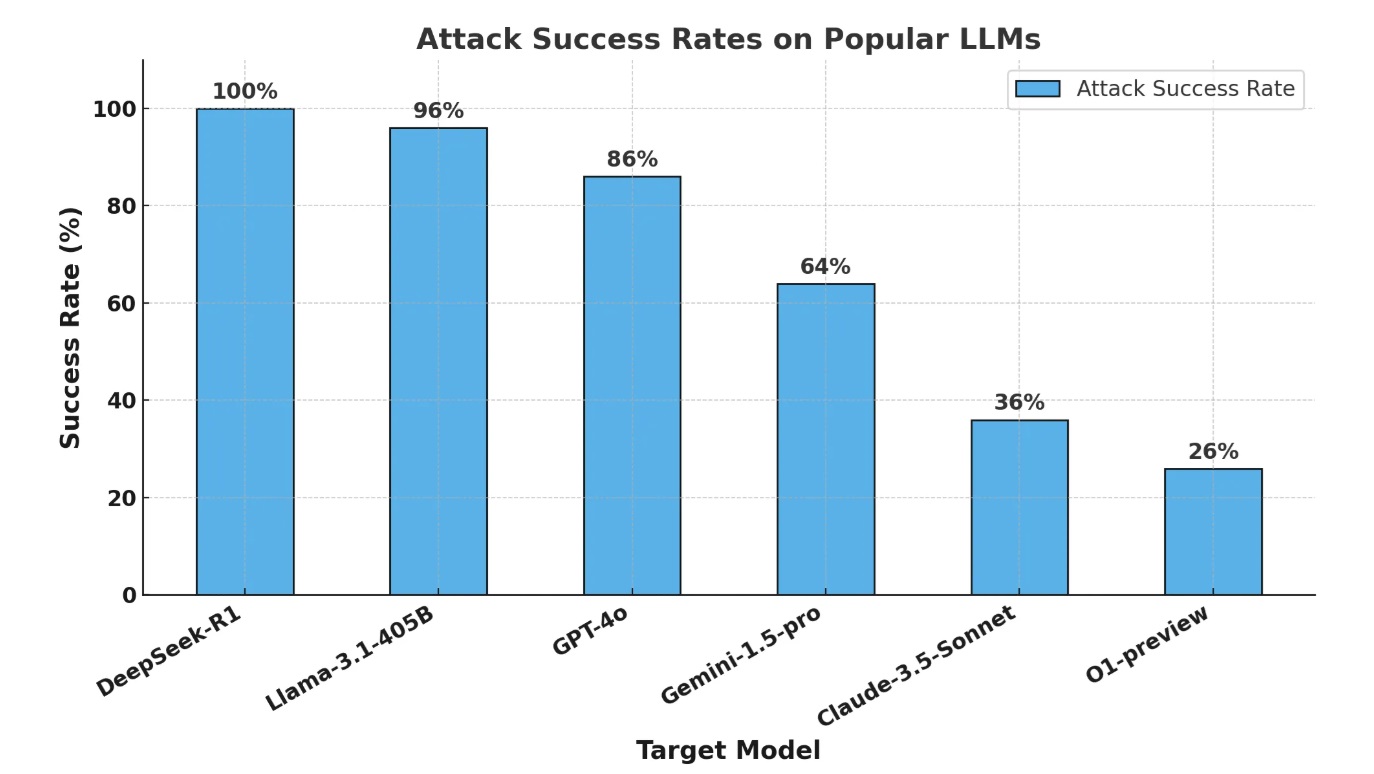
As seen in the above graph, while DeepSeek did not perform considerably worse than Meta’s Llama solution and OpenAI’s GPT-40 tool, it trailed other prominent rivals by quite some distance.
Indeed, the gap between DeepSeek and the preview of OpenAI’s new 01 reasoning model is particularly stark – providing the US tech firm a significant point of difference in the fight for AI supremacy.
But what does all of this mean for the customer experience space?