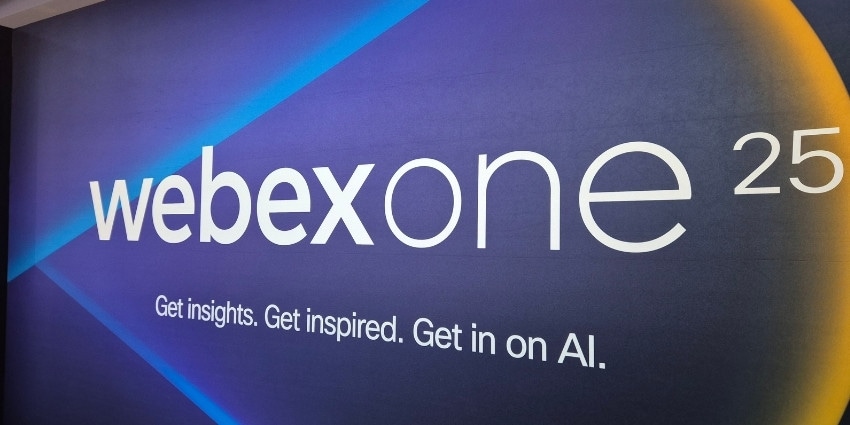
San Diego, CA — At WebexOne 2025 this week, Cisco unveiled a series of major enhancements to its customer experience portfolio, pushing deeper into AI-powered quality management, agent assistance, and cross-industry integrations.
The announcements underscore Cisco’s strategy to position Webex Contact Center as a platform where AI agents and human agents work side by side — with supervisors given the tools to oversee both.
“AI is the key to delivering amazing customer experiences at scale”
Said Jeetu Patel, President and Chief Product Officer at Cisco. “As AI and human agents increasingly collaborate, businesses need platforms designed to deliver quality experiences while moving faster than ever.”
More WebexOne 2025 Coverage
- Smarter Conversations, Healthier Outcomes: Valeris’ Webex Contact Center Story
- Why the Future of AI in CX Depends on Leaders Who Can Say ‘No’
- No More Boxes: Webex’s Open Approach to Customer Experience Integration
- Ryan Reynolds at WebexOne 2025: Hollywood, Business, and CX with a Side of Sarcasm
- Connected Intelligence and the End of the Drudge Work, Says Nate Brown
AI Quality Management: Coaching Humans and Machines
Launching in early 2026, Webex AI Quality Management (QM) gives supervisors a unified view across their workforce — whether it’s people or AI agents.
Unlike traditional tools that focus on compliance, Cisco says AI QM will deliver:
- AI-assisted scoring and real-time insights
- Personalised coaching for human agents
- Performance optimisation recommendations for AI agents
The aim: a single platform where leaders can identify successes, reduce AI adoption risks, and continuously raise customer experience standards.
From Deployment to Impact: AI Agents at Work
Webex AI Agent and Cisco AI Assistant are now generally available for both cloud and on-premises customers, with beta support for 50+ languages arriving later this year.
Key highlights include:
- Autonomous resolutions: Customers can fulfil intent through self-service, with Webex AI Agents connecting securely to third-party systems. Multi-agent collaboration via MCP and A2A protocols is planned for 2026.
- Smarter human assistance: Cisco AI Assistant supports live agents with transcription, suggested responses, and wrap-up summaries.
Customers are already reporting tangible results:
- CarShield has automated 66% of pre-call screenings and cut claim onboarding times by 90%.
- BancFirst has modernised customer interactions through Webex integrations across departments.
- Columbia Bank has used Topic Analytics to uncover call trends, with 20% of general questions identified as loan-related and routed more efficiently.
Multi-agent collaboration via MCP (Model Context Protocol) and A2A (Agent-to-Agent) protocols may sound technical, but it’s one of the biggest shifts in how AI will operate inside the enterprise. Rather than working in isolation, AI agents from different vendors and platforms will be able to talk to each other, share context, and coordinate tasks securely.
For CX leaders, this means a Webex AI Agent could pull data from a Salesforce Agent, trigger an AWS Lex workflow, and even coordinate with a third-party service bot — all in real time and without human handoffs. Cisco is taking a leadership stance here by embedding multi-agent orchestration powered by AGNTCY, ensuring that these cross-agent interactions remain secure, verified, and under enterprise control.
The significance is simple: instead of buying one “super AI,” businesses can plug into an ecosystem of specialised agents that work together — accelerating automation while keeping the contact centre agile.