

This week, over 40,000 people gathered for one of retail's largest annual events, the National Retail Federation (NRF) conference.
At the event a theme that became evident is that retailers are being asked to deliver more “human” service in physical locations, at the exact moment when labor is harder to hire, train, and retain.
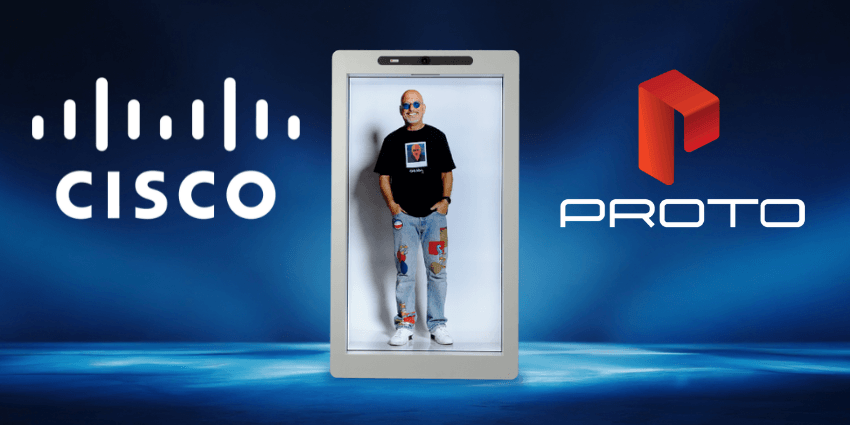
That tension is why a recent demo from Cisco and Proto Hologram at the event is worth a closer look. At Cisco’s booth, the companies showcased an AI-powered hologram chatbot called Kailey, positioned as a step beyond holograms as theatre, and toward holograms as a practical front line for retail customer experience.
David Nussbaum, Founder at Proto Hologram explained how Kailey works:
“Kailey runs on a small language model deployed at the edge using Cisco’s Unified Edge platform, enabling natural, voice-based conversations without relying on the cloud.”
Nussbaum went on to describe Kailey as a real person scanned live at the conference, then “brought to life” as an interactive hologram using Proto technology.
The experience is designed for natural, voice-based conversations. In the demo, customers could ask questions conversationally, get product and platform support instantly, and interact with a more human-style interface than a screen-based chatbot.
Critically, Proto Hologram frames the underlying architecture as edge-first, with the small language model deployed locally using Cisco’s Unified Edge platform, rather than relying on cloud connectivity.
Why Edge AI Matters for Retail CX, Beyond the Wow Factor
Retailers have experimented with kiosks, digital signage, QR journeys, and chatbots for years. The failure mode is familiar. Customers either do not notice them, or they notice them once and then abandon them when the answers are slow, irrelevant, or inconsistent with reality in the store.
An edge-deployed model changes a few practical considerations. Latency is the obvious one. If a customer is standing in an aisle asking a question, the interaction needs to feel immediate.
Resilience is another. Stores do not always have perfect connectivity. An experience that “does not rely on the cloud” can reduce the impact of network instability on customer service moments.
There is also governance. CX leaders will want clarity on how product and support knowledge is curated, updated, and controlled across locations. A compelling interface amplifies both accuracy and inaccuracy, so the operating model matters as much as the demo.