

Since the close of 2021, revenue growth across the CCaaS space has slumped quarter after quarter – according to newly released Gartner research.
Indeed, across the proceeding six quarters, total year-over-year (YoY) revenue growth in the space dropped by a total of approximately ten percent.
The following graph – made public by CX analyst Nicolas de Kouchkovsky – highlights this trend.
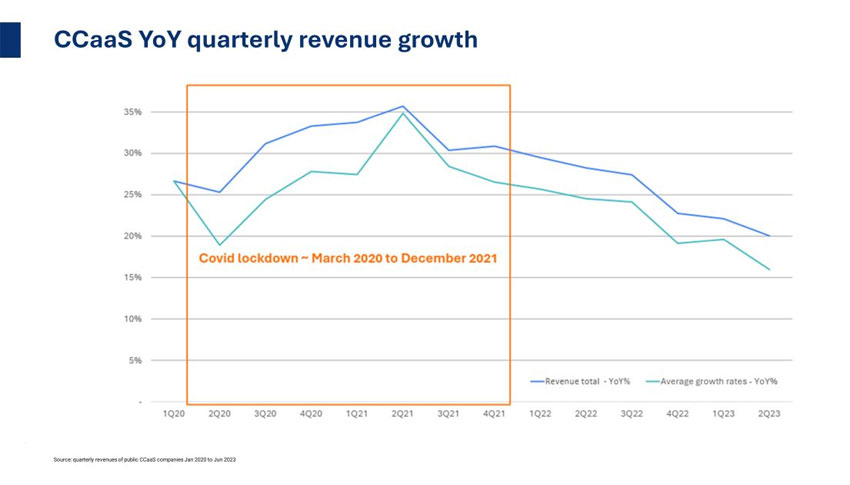
Some may have expected a lull in 2022 after a pandemic-induced rush to CCaaS.
Yet, many anticipated a bounce back at the start of 2023. Market analysts pointed to potential growth drivers, such as the evolution of cloud-based AI and prominent legacy vendors – including Genesys – slowing their legacy innovation.
The downward trend, however, has only continued as the market returns to a steadier growth rate.
Still, it remains relatively healthy, and stalwart CCaaS providers - including NICE, Genesys, and Five9 – continue to post positive earnings results.
Nevertheless, declining CCaaS growth rates are "putting pressure on all providers to show a path to profitability," according to de Kouchkovsky.
Consolidation In the CCaaS Market to Come?
Recent months have seen an uptick in M&A activity in the CCaaS space. For instance, NICE rolled up LiveVox last week, and Enghouse snapped up Lifesize in May after the latter entered bankruptcy.
de Kouchkovsky hinted that the drop in CCaaS revenue growth rates is a potential cause for such deals and noted that "we should expect more acquisitions to come."
Adding fuel to this fiery take are reports of other CCaaS vendors struggling from a tricky macroenvironment where deal cycles are extending.
Moreover, several tech giants have entered the space over the past 18 months – including Microsoft, Google, and Zoom – squeezing oxygen from the CCaaS atmosphere.
Yet, Steve Blood, VP & Analyst of the Gartner Sales & Customer Service Practice, shared a more optimistic outlook on LinkedIn.
"I can’t agree this is CCaaS consolidation, at least not yet," he said. "Leading providers are still adding capabilities to address new market adjacencies."
To this point, Lifesize ran out of money – only then did Enghouse swoop in. It was hardly a conventional act of market consolidation.