When we think of AI in the contact center, our minds often go to chatbots, predictive analytics, and automated workflows.
But Sanas is introducing a different kind of innovation – one that operates not in what is said, but in how it sounds.
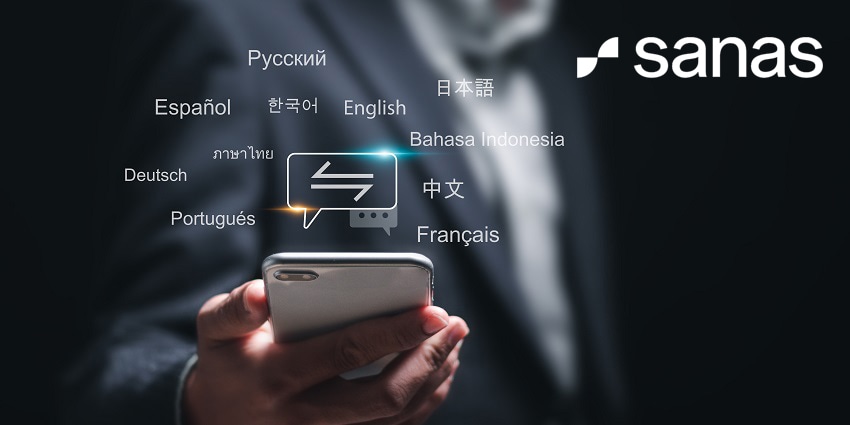
Sanas is a speech understanding technology company that enables real-time accent translation, noise cancellation, and speech enhancement – and recently announced a live language translation solution.
Their flagship accent translation capability works at the flick of a digital switch. An agent's natural speech is rendered in a different accent, while preserving their words, tone, and identity.
It's not dubbing, and it's not voice replacement; it's an adaptive layer that enhances voice communication, aiming to improve understanding, clarity, and confidence in conversations where accents, background noise, and low-fidelity audio might otherwise be a barrier.
Shawn Zhang, Co-Founder and CTO at Sanas, expanded on this, stating:
“In real time, we modulate the accent and pronunciation from one accent distribution to another depending on the listener.”
What Makes It Different?
What sets Sanas apart isn't just the underlying technology; it's the intent behind it.
Most speech-to-text or voice synthesis tools are focused on automation or replication. Sanas, by contrast, sits in the service of human-to-human conversation.
It's about making people feel heard, not just literally, but experientially.
“Where many solutions try to remove the human from the loop, Sanas keeps the agent front and center, simply adapting how their voice is heard to meet the listener's expectations or preferences," added Zhang.
That capability can have striking operational impacts for CX teams: reduced handle time, improved comprehension, and increased agent confidence.
The technology can also be used to help humanize the customer experience and service industry, as Zhang explains:
“Everyone has a unique part of their voice. Accent is a very core piece of everybody's identity. And it is because of that fact that we find it incredibly disheartening to feel that an accent might prohibit an agent from getting a job and performing in that job.”
For Sanas, This is Personal
The inspiration behind Sanas wasn't born in a boardroom; it started with a phone call from a friend.
While students at Stanford, the Sanas founders stayed in touch with a former classmate who had returned home to Nicaragua and taken a job in a local contact center.
On paper, he should have excelled. But when they asked how things were going, his answer cut deeper than expected.
“He told us he hated the job," recalled co-founder Shawn Zhang.
“Not because he wasn't good at it – he was solving technical problems, resolving customer issues, doing everything right – but callers would constantly complain about the way he sounded.
“It was his accent, not his ability, that they couldn't get past.”
That moment revealed a painful disconnect: someone with the skills and commitment to help was being undermined by nothing more than how he spoke.
From that frustration came a question: what if technology could help bridge the accent gap without asking the person to change how they naturally speak?
Rethinking the Ethics
The initial reaction many have when hearing about accent translation is one of concern: isn't this erasure? Doesn't it imply certain accents are more desirable than others?
These are important questions – and worth asking – but when you look closer, the story becomes more nuanced.
For many agents, especially in outsourced CX environments, accent bias isn't theoretical; it's lived.
Harassment, misunderstanding, and dropped calls happen not because of poor language skills, but because of bias or unfamiliarity.
Moreover, outsiders might not realize that without solutions like Sanas’, contact center agents often undergo ‘accent neutralization’ training.
Not only is this costly and time-consuming, but the process of coaching someone to speak differently than their natural intonation strips them of a core aspect of their identity.
“We want to make sure that this is something that improves both parties in the conversation, right?” says Zhang.
Rather than enforcing conformity, accent translation can be viewed through the lens of accessibility, enabling agents to speak naturally and customers to understand easily.
Zhang built on this:
“Obviously, for the listener, they're able to understand more easily, just because these are pronunciations that they're a little bit more familiar with hearing.
“For the contact center agent, they're having a much smoother experience because they don't have to repeat themselves.”