
In the time of flip phones, pay-as-you-go messaging, and standing on a chair to get a signal, SMS was the home of person-to-person (P2P) conversations.
However, over the last 15 years, messages from friends and family have slowly slipped off the channel and onto WhatsApp, Messenger, and other social media platforms.
In a bind, mobile operators experienced a sharp decline in use, and – like a Saharan road – traffic only trickled across their vast network infrastructures.
Their solution? Marketing application-to-person (A2P) messaging to businesses – and it worked.
The growth of the US SMS marketing market exemplifies this – as the following graphic from Grand View Research showcases.
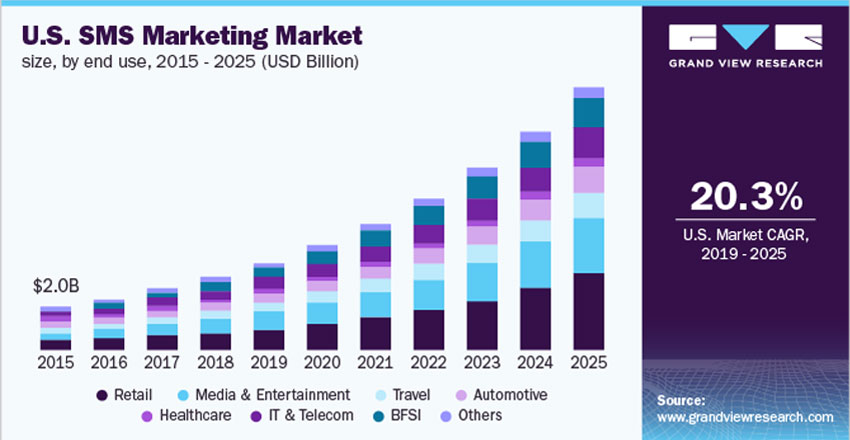
Such growth comes as brands realize several benefits of using automated SMS messages in their customer communication strategies.
As one Mitto report found, businesses that take a “mature omnichannel approach” that includes SMS have achieved the following results:
- 2x more likely to respond to customers in real-time or in less than an hour
- 3x more likely to report extreme revenue growth over the past year
- 4x more likely to deepen customer loyalty
Of course, not all enterprises have achieved these results, and limited omnichannel maturity is one likely reason. Another blocker to wider success, however, lies in the complexities of how these messages travel from a business to their end-use recipient. Things get pretty complex out there in the wild world of A2P connectivity.
Undelivered Messages: A Bigger Problem Than You Think
While optimized SMS routing is being executed every single second across the globe, there remain several reasons a business's messages could fail to funnel into customers’ phones.
Perhaps the SMS platform being utilized doesn’t provide features like invalid phone number resolution? Or, maybe a customer’s number is not allowed by its network to receive SMS (for any reason). Many businesses will be aware of such issues.
Yet, problems relating to the vast ecosystem of carrier connectivity sometimes go unnoticed – and these issues can be critical. The use of multiple aggregators and lower-quality routes in particular regions will, in turn, offer lower delivery and engagement rates.
After all, as these messages go through intermediaries, communications take longer as they hop between multiple networks – with dropouts along the way.
Those issues often slip through the cracks, and – even when the SMS provider does spot the problem – it takes longer to resolve due to the levels between the provider and intermediary.
Of course, outages will sometimes occur across any network. Nevertheless, enterprises can enhance delivery rates by working with a provider offering direct connections with trusted partner carriers.
Moreover, ensuring reliable message delivery can enhance the customer experience and streamline operations.
Look for a Provider That Establishes Direct Connections with MNOs.
Selecting an SMS API provider that lists how many direct, in-country connections and exclusivities they have with globally managed network operators (MNOs) is critical to mitigating the risk of delays and dropouts.