
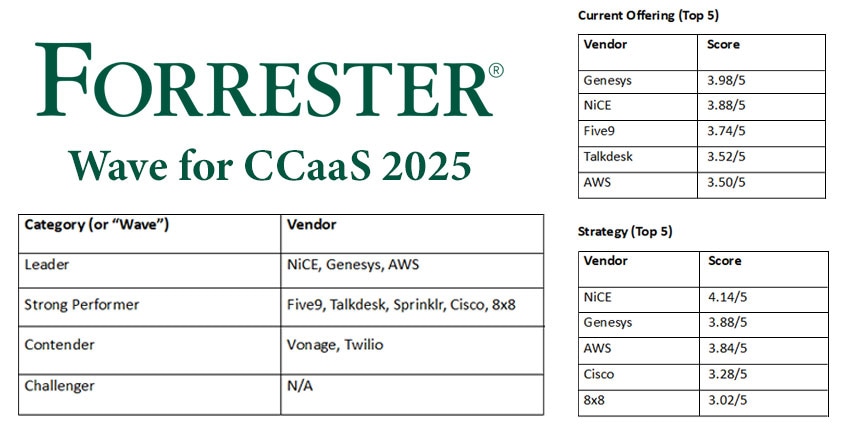
Decision tools such as the Gartner Magic Quadrant and Forrester Wave have become relied upon by IT decision makers to help clarify the muddy waters of technology purchases.
However, while the analysts who create these documents put a tremendous amount of work into them, they are still open to debate.
Earlier this year, Forrester released its Wave for contact center as a service (CCaaS). Since I’ve had some time to review and talk with the vendors and a handful of customers.
Below are some thoughts on the participating vendors and their placement in the report.
NiCE
NiCE ranked highest on "strength of strategy" and second on "strength of offering", which aligns with the Gartner Magic Quadrant. Despite that second place on the latter, NiCE's offering is the most feature-rich.
The document states: "While NiCE's breadth is unique, with leading solutions for WFO (workforce optimization) and analytics being part of the system." However, it then dings the vendor, noting that CXone Mpower "is dependent on a third-party conversational AI provider for many applications."
Nevertheless, using third parties, particularly for AI, is seemingly the right strategy, enabling NiCE to quickly pivot if a better solution presents itself.
NiCE is in the correct category and correctly placed. My criticism is more of a nitpick.
Genesys
Genesys is also a leader and ranked highest in strength of offering and second only to NiCE in strategy.
The strength of offering location is accurate, although it's the strategy that I question. The company has been close to the same spot in the Wave for years, but it's undergone some major strategy changes, such as shutting down the multi-cloud division and ending innovation on its Engage on-premise product.
While these may make sense for the business, changes this major should have moved the needle for Genesys positively or negatively, depending on whether Forrester agreed with them.
Amazon Web Services (AWS)
AWS is the third vendor in the leader section, but behind the others in both strategy and strength of offerings.
One notable point in AWS's section is that it's the only provider with above-average customer feedback. In the commentary, it states that the usage-based pricing made a significant difference to their business. It also states that Connect is complex and hard to learn. That's counter to feedback I've had from users of Connect. This was true years ago, but Amazon has improved the UI considerably.
The commentary also notes: "AWS's stated vision of being a leading provider of business applications is not differentiated, but that vision is misaligned with the broader AWS vision of having the 'Amazon' experience create unique capabilities."
One of the flaws with decision tools, such as the Wave, is that they look at things through the product lens and not at a company level. Based on this, AWS should perhaps be edging closer to those out in front.
Five9
Five9 ranked highest of the strong performers for the strength of its offering. Its strength of strategy kept it out of the Leader's section. That's somewhat of a surprise, as Five9 has always been early with innovation. Indeed, the commentary states:
Five9 has a vision to pair AI and human agents to provide a new level of frictionless customer service experiences. The company’s roadmap is heavy with AI investment, and the go-to-market strategy is balanced between direct and partner sales to help it get the broadest coverage globally.
Customer feedback was also strong, except it noted, "one stated that some of the current offerings were 'a little green' at this time." Given Five9's share, roadmap, and strength of current product, Five9 may be disappointed not to appear in the Leaders portion.
Sprinklr
Sprinklr was slightly under Five9 and Talkdesk (more on Talkdesk below) in the Strong Performers category, which is a major achievement, but also quite the surprise.
Written into the commentary, Forrester states: "The roadmap for the Sprinklr Service product is below par and will be impacted in the short run by a need to harden and mature some of its capabilities. Historically, Sprinklr has focused on direct sales and white-glove service during deployment; now it is focused on building out its partner program, which is less mature than that of other vendors in this evaluation."