

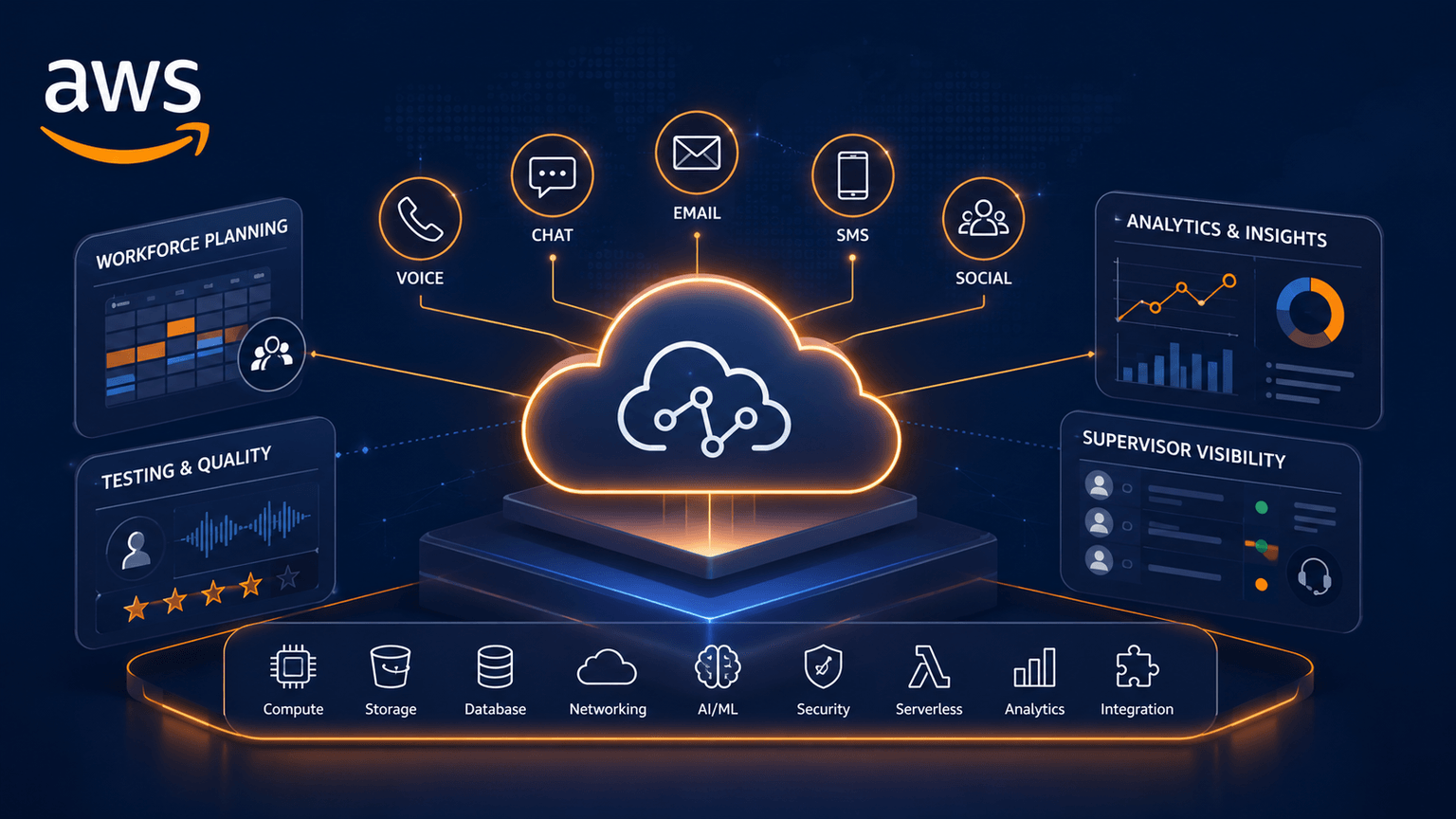
In just a handful of months, the Amazon Connect ecosystem has become one of the more interesting stories in contact center infrastructure because AWS isn’t staying politely in the background.
Amazon Connect Customer has picked up voice and chat testing, predictive insights for up to 40 million catalog items, AI manager assistance across 150+ metrics, Amazon Connect Live Sync, email analytics, and workforce planning for Tasks and Emails.
Beyond that, Zendesk’s Voice AI agents are now powered by Amazon Connect. Salesforce has added Amazon Connect to Service Cloud, and there’s a whole new MCP play in the books, too.
Increasingly, it looks like AWS is working to make its system the operating layer between customer data, AI agents, supervisors, human handoffs, and partner-built CX stacks.
For buyers, the question isn’t whether an Amazon Connect integration exists. It’s whether that connection is deep enough to survive an increasingly complicated stack.
Related Articles
- Amazon Connect Customer: Inside the AWS Rebrand
- Zendesk and AWS: Modernizing Contact Centers Together
- Human and AI Workforce Management: A Practical Guide
TL;DR: Is Amazon Connect the Infrastructure Layer Buyers Should Watch?
- It's more than a rename: Amazon Connect Customer now sits inside a four-product AWS family (Customer, Decisions, Talent, Health), with AWS explicit that AI should "work like a teammate, not a tool."
- The ecosystem is deepening, not just growing: Zendesk and Salesforce both build on Amazon Connect by choice, and a new Salesforce MCP integration lets AI agents reason, act, and remember across both systems.
- Delivery partners are maturing too: Caylent's Amazon Connect practice, built on its Pronetx acquisition, manages 1M+ daily calls and just earned AWS's Amazon Connect Customer Competency.
- The risk hasn't gone away: a branded integration doesn't prove the journey holds together end to end. Buyers still need to map who owns data, routing, and the handoff.
What Is Amazon Connect Customer?
Amazon Connect Customer is the renamed version of AWS's original contact center product, now combined with a much wider family, complete with Decisions, Talent, and even Amazon Connect Health, the HIPAA-eligible system with five purpose-built agents just for healthcare teams.
It’s more than an “Agentic CX platform”; it’s the all-in-one system for omnichannel communication, AI agents, no-code experience design, intelligent routing, and managed human and AI collaboration.
Already, positive customer stories are stacking up. For instance, AWS says Cochlear scaled quality evaluations by 22x with its system. Independent of AWS’s own materials, Constellation Research has separately sized the platform at roughly 20 million daily interactions and 12 billion minutes of AI-assisted conversation in 2025.
Plus, unlike a lot of the wider CCaaS solutions designed for larger, more complex teams, Amazon Connect operates on elastic pricing, so you only pay for the interactions and usage you need.
What Does Amazon Connect Customer Own Outright?
Before getting into who builds on top of Amazon Connect, it's worth establishing what AWS owns itself, because there's a lot in the toolkit, from analytical tools, to configuration, bot logic, agent workspace configurations, and more.
Start with Live Sync, recently unveiled at CCW in June 2026. It's the only native enterprise technology currently capable of syncing a live voice conversation with a real-time, on-screen digital interface. A customer talks to an AI agent while tapping through the options described on their phone.
Plus, when Amazon launched the current generation of Connect, VP Pasquale DeMaio confirmed that AWS is "among the few CCaaS providers to deliver first-party AI across the contact center experience, not relying on third-party integrations."
Self-service, agent assistance, conversational analytics, workforce management, quality assurance are all native, all built by AWS, all sitting inside the same product before a single third-party logo enters the picture.
AWS isn't leaning on partner logos alone. Amazon Connect already has the analyst receipts: CCaaS Leader status in the Forrester Wave for CCaaS, Customers' Choice recognition in Gartner Peer Insights, and a spot just behind NiCE on the completeness-of-vision axis of Gartner's Magic Quadrant for CCaaS. That says the base platform has weight, even before the ecosystem piles on.
The Ownership Test
Not every connection here sits at the same depth. Applying an ownership test layer by layer:
- Voice, routing, and the agent desktop are AWS's own build: this is the native core the rest of the ecosystem sits on.
- The Salesforce, Zendesk, and ServiceNow workspaces stay vendor-owned; Amazon Connect supplies the voice engine and interaction data underneath, not the interface on top.
- The Salesforce MCP link runs on an open protocol nobody exclusively owns: AWS built the connector, but the standard itself isn't AWS or Salesforce property.
- Identity verification and payment handling typically sit outside Amazon Connect entirely, in third-party tools the ecosystem doesn't yet claim.
- Bedrock and Amazon Q sit inside AWS's own stack, with Forrester and Gartner recognition (2026) as the independent backing.
- Caylent and TTEC Digital own delivery and implementation, not the underlying technology; a Competency badge proves integration skill, not product ownership.
- Beneath everything else, AWS runs the carrier and SIP-trunking layer that gets calls into Connect, even though most buyers never think to ask who controls that plumbing.
Which CX Platforms Run on Amazon Connect?
One of the great things about Amazon Connect Customer is that it doesn’t ask companies to replace their existing tech stack. It can be the native engine behind anything from Salesforce to Zendesk, ServiceNow, and Qualtrics.
Zendesk, for instance, launched Voice AI agents supporting 60+ languages, tied to the CCaaS offer powered by Amazon Connect. Those calls write recordings and AI-generated summaries directly into the Zendesk ticket's conversation log, the same record agents already work from. Salesforce contact center with Amazon Connect brings AWS voice into Service Cloud. Concretely, the voice engine writes call recordings and live transcripts directly into the Service Cloud Voice conversation record, the object Salesforce agents already work from.
Plus, that system is evolving further now, thanks to Salesforce's connection to Amazon Connect Customer via the Model Context Protocol. That replaces a fixed integration path with a four-stage reasoning loop, understand, reason, act, remember, so the agent decides which Salesforce tools to call and retains context.
ServiceNow uses Amazon Connect for CRM/ERP routing in omnichannel, AI-powered customer experience, and Qualtrics uses Connect's interaction data for analysis and workflow triggering. In practice, that means Connect routes each interaction into ServiceNow's CSM case record with omnichannel workflow triggers attached, while call transcripts and sentiment scores land in Qualtrics XM Discover as structured survey and text-analytics inputs, a flow Qualtrics chooses to ingest rather than one Amazon Connect owns or controls.
The partner layer is big enough to change the buyer conversation. Caylent, strengthened by its Pronetx acquisition, now supports more than 1 million daily calls across federal and enterprise environments.
It also picked up the AWS Amazon Connect Customer Competency, with New York Cancer and Blood Specialists highlighted for its automated chronic-care outreach work. Caylent's build sends care reminders through Connect's campaign engine and slots them straight into the clinic's existing patient-outreach schedule. There's no Caylent-owned scheduling product sitting awkwardly in the middle.
Learn more about the importance of AI integration architecture here.
CX Awards 2026 Are Open
See which contact center, CX, and automation platforms are shortlisted across every category this year.
What Changed in Amazon Connect Customer in 2026?
The 2026 changes went well beyond the name. Amazon Connect became Amazon Connect Customer within a four-product family spanning Customer, Decisions, Talent and Health. AWS also acquired NLX and launched Agentic CX Designer in preview, giving business teams a no-code route to build, test and deploy voice and digital self-service experiences in weeks.
The 2026 changes went well beyond the name. Amazon Connect became Amazon Connect Customer within a four-product family spanning Customer, Decisions, Talent and Health. AWS also acquired NLX and launched Agentic CX Designer in preview, giving business teams a no-code route to build, test and deploy voice and digital self-service experiences in weeks.
The wider release program filled several operational gaps. Native voice and chat simulation lets teams test caller profiles, queues, routing and failure paths before launch. AI-powered manager assistance can answer natural-language questions across more than 150 metrics, while eight new AI-agent measures include goal success, faithfulness and tool-selection accuracy. Those measures give buyers a better performance test than deflection alone.