

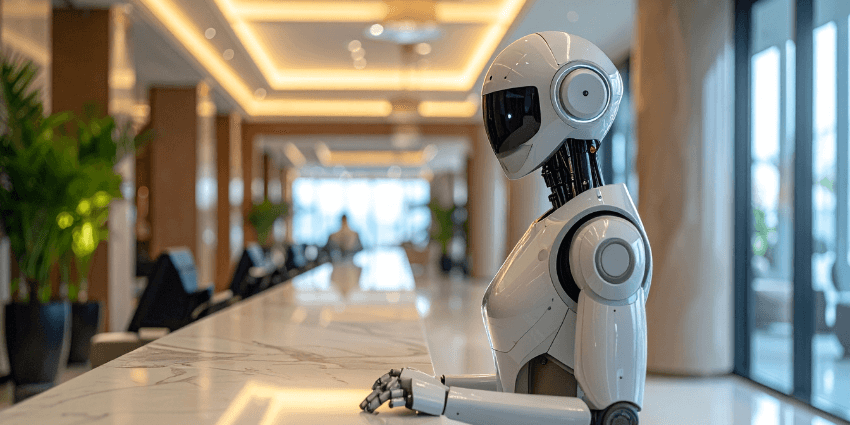
AI receptionists are becoming one of the first practical and profitable uses of AI in customer experience.
In many cases, businesses can justify these tools because the impact is measurable, the risk is limited, and the business case is clear.
By reducing missed calls for steadier revenue increase, companies can begin to build up automation across an entire contact center, but are CX Leaders giving these tools enough attention?
Daniel Keinrath, CEO & Co-Founder at fonio.ai, argues that AI receptionists are gaining credibility because the work they perform is predictable and clearly defined.
“The reason why AI receptionists are emerging as the first truly credible form of digital labour is because inbound reception, appointment booking, call routing, and after-hours coverage are structured workflows with clearly defined outcomes when properly prompted in the backend,” he explained.
“This makes the use case low-risk, and easy to justify internally - and is also a great way to diminish AI fears in some companies.
“In many verticals, the AI already resolves up to 85% of calls autonomously, forwarding only edge cases to human operators.”
AI receptionists are voice and chat systems that answer inbound calls or messages and perform basic front-desk tasks automatically.
This typically includes 24/7 call answering, caller identification, call routing, appointment handling, and answering common questions.
Many modern AI receptionists connect to business systems such as CRMs, scheduling tools, or industry platforms, allowing them to perform tasks rather than just provide relevant information.
With increased calls answered, appointments booked, this ensures higher captured demand, higher conversion rates, and reduced revenue loss from missed opportunities.
This also ensures businesses are provide consistent customer experiences and routing logic, reducing wait times and avoiding variability that occurs when customer-facing teams are overloaded.
AI Receptionists are not Experimental Automation
As AI receptionists operate in structured, measurable environments and deliver direct business outcomes, they are not experimental automation.
With clearly defined workflows, AI interactions follow predictable patterns, performing best in bounded use cases with repeatable inputs and outputs.
As technology matured, modern versions of these receptionists take on natural language processing, intent detection, and integrations with CRM and scheduling systems.
And because return on investment is measurable, many AI initiatives struggle to prove value in comparison because they’re deployed in areas where outcomes are indirect, whereas receptionists affect metrics that are already tied to revenue and service performance.
AI receptionist risk is also manageable, as escalation paths are defined, governance is made simpler compared to fully autonomous service models.
AI receptionists are not experimental because they automate a structured, high-volume function with clear financial impact, mature integrations, and defined oversight.
The Popularity of AI Receptionists
These receptionists solve numerous business problems with measurable impact, while also improving in capabilities and reliability as integrations with CRM and scheduling platforms mature.