
Artificial intelligence is no longer the technology of the future.
Today, everything we do is becoming more intelligent. With smart speakers, you can control your lights or switch on your favourite music with just a couple of words. On your phone, you have endless access to virtual assistants to help you find valuable information. Even in the business world, artificial intelligence is working to make employees more productive and efficient with quicker knowledge-base searches and automated insights.
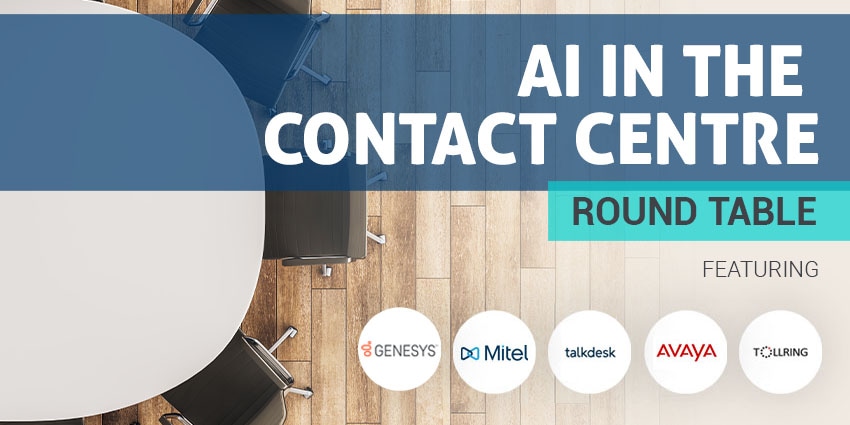
Now, artificial intelligence is on its way to the contact centre too, where it has the potential to support some of the most important conversations a business has. In the CC environment, AI can enhance customer support, drive better client experiences, and even open the door for more efficient self-service. We spoke to Avaya, Tollring, Talkdesk, Mitel and Genesys to gather their insights on how AI is affecting the contact centre.
What is the Contact Centre's Appetite for AI?
The general demand for artificial intelligence has grown rapidly in recent years. Businesses from virtually every industry are realising that intelligent solutions can enhance and improve their team's performance. Even employees are starting to feel more comfortable about the idea of working hand-in-hand with bots if it means that they can get more done, faster.
Tony Martino, the CEO of Tollring, told us:

"There's an appetite to improve customer experience here. AI is in the toolbox at the higher end of the CC market, but it needs to be quantified more than it is right now." According to Tollring, AI isn't something that's easily packaged or understood today. "A small percentage of mid to larger enterprises are asking for speech and artificial intelligence. They are looking for automation around sentiment and scoring, the ability to transcribe, keywording, etc. But the market is very small and requires a lot of consultancy."
Tollring is in the process of trying to make AI more tangible and "bite-sized" so that businesses can see clearly how the technology will help them to improve interactions with intelligence in their data. "It must be simple and have the greatest impact"
Natalie Keightley, Solutions Marketing Director at Avaya, said:
 "We have just undertaken some global research looking into this exact topic and it’s revealed that the appetite is indeed very large." Avaya has seen significant growth in the demand for artificial intelligence in their market lately, with 94 percent of business and IT leaders have said that they recognise the ability of AI to transform the performance of their contact centre.
Additionally, Avaya's studies reveal that 81 percent of respondents believe failing to adopt AI now properly will cost their company throughout the next decade.
According to Jafar Adibi, Head of AI and Data Science at Talkdesk:
 "The demand for AI is very strong in the contact centre market and, based on our success with - and demand for - Talkdesk iQ, the appetite appears to be insatiable," Adibi noted that the market could be mapped on two axes: what people want to do, and what they're capable of. While the appetite for AI is continuing to grow, contact centres that aren't cloud-native will often struggle to use AI.
According to Adibi, if the data is already available to capture, then organisations need to plan to create the right AI strategy for their needs. While everyone loves to exploit advanced AI to "keep up with the Joneses," businesses, need to do a reality check on their capabilities too.
Matt Clare, Director of Contact Center Solutions at Mitel, told us:
 "With the rise in self-service CX over the last decade, and from my talks with our customers and attendees at industry events, I think there’s no doubt the appetite is extremely high, definitely the highest it’s ever been."
According to Clare, leveraging Natural Language Processing and Understanding in AI to reduce the time required in building a virtual bot or agent is one reason for the growth in appetite. However, it's early days for AI being used in production.
"As functionality like Google’s Contact Center AI becomes generally available and companies can see that AI no longer requires hiring special, and expensive talent, I think we’ll see a much larger rise in adoption"
"This “democratisation” of AI will also drive AI technology into a broader market segment, out of the enterprise and into the SMB and midmarket."
Director of Strategic Marketing at Genesys, Brendan Dykes, told us:
 "There is a clear appetite for AI in the contact centre. Part of the appeal for AI is down to customers’ behaviour having changed dramatically in recent years. Businesses need to keep pace with their ability to serve consumers across the various digital channels they are using today."
Brendan noted that today's customers expect that brands should be able to serve them on any channel, day and night, which makes AI a must-have in the current landscape. Additionally, AI tech has further appeal to offer beyond the self-service environment because it allows companies to augment and improve the efficiency of agents. "According to recent research we carried out at Genesys, 64% of UK employees say that AI technologies are making them more efficient in the workplace."
Are End Customers at Discovery or Purchasing Stage?
Artificial Intelligence may well be one of the most exciting things in the market today, but not everyone is fully ready to adopt it. While some companies at the agile end of the market are ready to jump in and purchase the next big AI solutions, others are still in discovery mode.
According to Tollring:
"At the moment, there aren't a bunch of AI tools that people can subscribe to."
"We're focused on providing solutions to the larger SME market in a more accessible way, like using analytics to understand customer interaction. We provide that intelligence through business intelligence into customer interactions"
Tollring's Tony Martino told us that this BI is generating a lot of interest in the company's roadmap. Businesses are beginning to understand that the customer journey isn't simple. "They're keen to get involved and see what's to come. We're mainly at the discovery stage, but with a bit of purchasing."
Natalie Keightley at Avaya said:

"The vast majority of businesses have already integrated some form of AI into their contact centre and using it to some degree. However, when it comes to rolling out a more developed AI strategy to the contact centre, respondents to our survey said they are on average, only 50% of the way through implementation."
Keightley believes that companies are reaching a fork in the road when it comes to the rollout of AI. While one path will lead to failure fueled by uncertainty and misunderstanding, the other will lead to a full and effective AI rollout that transforms the contact centre and impacts essential enterprise functionality.
According to Adibi from Talkdesk:
"Since many end customers have seen AI products success stories in other fields, they are looking for real and operational AI products. So, they are at the purchasing stage. The benefits to AI are clear, numerous, and multiplying rapidly. By automating systems and simple functions with AI, adding agent assist capabilities with intelligent guidance and resolution recommendations aligned to an internal knowledge base through AI integration, and including intelligent chatbots for improved self-service; all contribute to improving customer experience through efficiency"
Adibi noted that contact centres and BPOs are hunting down sophisticated, yet simple solutions to address immediate needs, rather than just looking into the future.

Matt Clare of Mitel told us:
"It seems more like people are in the discovery and POC stage right now from my conversations with customers, prospects, and industry professionals. As the technology becomes more readily available, with quantifiable metrics to back up the ease of use, time to deploy, and benefit to the business, I think we’ll see a large uptake in terms of deployment over the next 1-2 years."
Matt also believes that smaller companies will be able to access the benefits of AI soon, as organisations realise that there are tools out there to provide easy, affordable, and rapid adoption of disruptive tech.
Brendan Dykes of Genesys said:
"According to our research, 32% of UK employers say they’re already using AI-based technologies, while 47% say they plan to implement it within the next three years. The rate at which they are deploying it versus evaluating it just depends. Early adopters are embracing elements of AI, but we haven’t reached mass adoption yet. We are seeing businesses deploy specific uses for AI, like chatbots and automation at a steady pace. However, often, these organisations are in the discovery phase for other areas of AI technology, like voice bots or predictive routing. "
Brendan told us that bots seem to be the first step on a wider journey to greater AI opportunities. Once a business has its first bot project set up, they can begin to look into more sophisticated AI tech. AI seems to be used best when it's embedded into a company's processes and orchestrated to deliver targeted outcomes. However, businesses can't achieve these outcomes if their AI tech is siloed.