
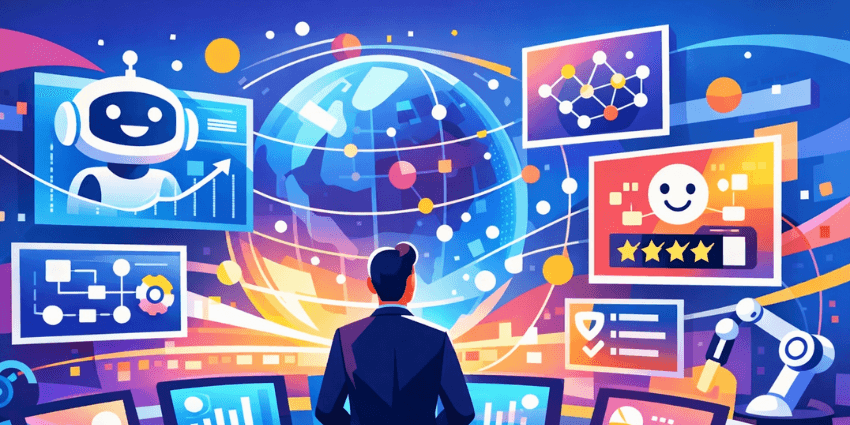
Customer experience strategy in 2026 is now defined by measurable AI impact rather than experimentation. Across contact centers and digital channels, enterprises are reporting tangible gains in efficiency, resolution speed, cost control, and customer satisfaction as AI-driven customer experience trends move from pilot to production.
The question is no longer “Should we deploy AI?” It is now: “How do we scale AI-powered CX transformation responsibly and effectively?”
For organizations, several themes are consistently shaping enterprise strategy:
- Agentic AI and autonomous workflow execution
- LLM orchestration across enterprise systems
- Real-time agent assist at scale
- AI-powered quality management and predictive analytics
Together, these trends are redefining how customer service operations are designed, measured, and optimized.
What Are the Top AI Trends in Customer Experience for 2026?
The top AI and automation trends include agentic AI systems capable of executing full workflows, orchestration layers that coordinate multiple models and data sources, real-time agent augmentation tools, AI-powered quality management platforms, and predictive AI in customer experience.
These technologies are delivering measurable improvements in operational efficiency, first-contact resolution, compliance, and customer satisfaction.
Agentic AI: From Assistance to Autonomous Execution
Agentic AI refers to systems that can reason, plan, and autonomously execute multi-step tasks to achieve defined outcomes. Rather than simply responding to a single prompt, these systems manage complete service workflows from initiation to resolution.
Adoption of generative and agentic capabilities is accelerating across contact center AI trends 2026, with enterprises increasingly moving beyond experimentation toward scaled deployment. Organizations implementing AI-driven customer experience trends report reductions in average handling time, faster resolution cycles, and measurable productivity improvements following rollout.
The defining shift is execution. Instead of merely recommending a refund policy or suggesting next-best action, agentic systems can verify eligibility, initiate transactions, update records, and notify customers without requiring manual intervention. This transition from advisory AI to operational AI represents a major inflection point in customer experience automation trends.
How Is Automation Redefining CX in 2026?
Automation is redefining CX in 2026 by shifting from task-level augmentation to end-to-end workflow ownership. Intelligent systems now orchestrate backend applications, enforce policy logic, and manage exception handling with minimal human oversight. The result is reduced operational friction, lower service costs, and greater consistency across interactions.
Autonomous agent workflows exemplify this change. By connecting CRM platforms, billing systems, identity verification tools, and knowledge bases, AI can complete complex service requests without multiple handoffs. Enterprises deploying these capabilities report improvements in first-contact resolution and measurable declines in transfer rates and resolution times. Workflow orchestration is becoming foundational infrastructure rather than optional innovation.
Why LLM Orchestration Is Essential for Enterprise-Scale AI
As organizations deploy multiple large language models across departments, orchestration becomes critical to ensure reliability, compliance, and cost control. LLM orchestration enables structured routing of tasks to models optimized for summarization, analytics, compliance monitoring, or complex reasoning.
Enterprises embedding orchestration within governance-led AI strategies are reporting stronger compliance performance and reduced operational risk. Orchestration also plays a central role in financial sustainability, directing routine tasks to lightweight models while reserving more advanced processing for high-value interactions.
Real-Time Agent Assist and Contact Center AI Trends 2026
One of the most significant CX AI & automation trends in 2026 is real-time agent assist. These solutions deliver live transcription, contextual knowledge surfacing, compliance prompts, automated summaries, and next-best-action guidance during customer conversations.
Organizations adopting real-time augmentation are reporting measurable gains across performance metrics. Improvements commonly include:
- Reduced after-call work and faster case documentation
- Shorter onboarding cycles for new agents
- Improved average handling time and interaction consistency
Rather than replacing frontline staff, these tools reinforce the hybrid human-AI model defining conversational AI. Automation manages information retrieval and administrative tasks, allowing agents to focus on empathy, negotiation, and complex problem-solving.
AI Quality Management and Predictive AI in Customer Experience
AI-powered quality management is expanding visibility across CX operations by analyzing 100 percent of interactions instead of relying on limited sampling models. This shift enables deeper insight into sentiment patterns, compliance exposure, recurring friction points, and systemic service gaps.