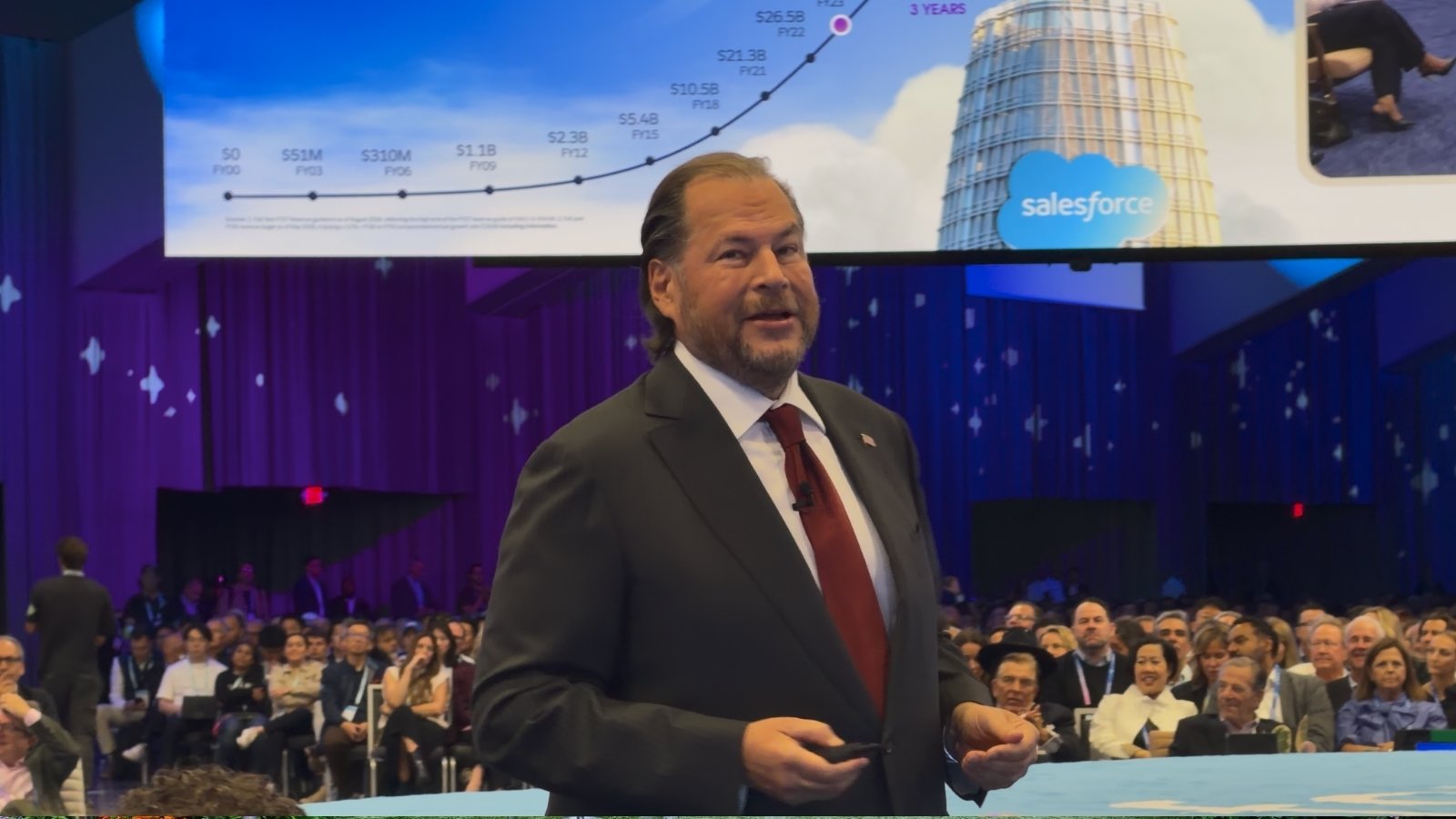
Standing in the Dreamforce keynote audience, the scale of Salesforce’s ambition was hard to miss. The company is not pitching a better chatbot or another layer of AI features for customer service. It is pitching a governed digital workforce: AI agents that understand customer context, take approved action across business systems, and recognize when the work needs to move to a human.
For CX leaders, that is an appealing vision—but the real test is far more demanding. Can it produce better resolution, cleaner handoffs, and more trustworthy customer journeys, rather than simply more automation?
This analysis builds on CX Today’s live Dreamforce coverage of Salesforce’s push to take CRM out of Salesforce. That earlier story examined the company’s effort to move customer context, business rules, and approved actions into Slack, Claude, and other AI interfaces. The keynote added the bigger strategic picture: what Salesforce expects agents, employees, contact centers, and governance teams to do with that context once it is available.
Salesforce’s keynote was not primarily about making customer service conversations more fluent. Its larger claim is that enterprise CX is shifting from a collection of applications and channels into a system of intelligent, increasingly autonomous operations.
The recurring message from Marc Benioff, Salesforce product leaders, and guest speakers from Siemens, Anthropic, NVIDIA, and Adecco was clear: models are not enough. Customer-facing AI needs trusted customer and business context, access to approved workflows, guardrails around actions, and visibility into both outcomes and risk.
That is an ambitious proposition. It also leaves CX teams with a more demanding brief for the year ahead: stop judging AI only by deflection and start judging it by whether it resolves the right problems, improves the customer journey, and knows when a human must take over.
Here are the biggest CX implications and announcements from the keynote.
1. Salesforce Wants CX to Become Action-Led, Not Answer-Led
Salesforce’s core argument is that an AI model may know a great deal about the world, but knows nothing by default about an enterprise’s customers, inventory, service history, policies, permissions, or processes.
The company’s answer is an “agentic enterprise” built on four layers: connected data; applications and business semantics; agents; and a new AI interface. In CX terms, Salesforce is arguing that a useful AI agent should not simply retrieve a knowledge-base answer. It should understand the customer’s situation, determine the permitted next step, and execute—or escalate—the work.
“Models alone cannot run the enterprise.”
— Marc Benioff
This is an important reframing for CX leaders. The strategic question is no longer, “Where can we add a chatbot?” It is, “Which customer journeys contain repeatable, governed decisions and actions that an agent can safely complete?”
What to do: Identify high-volume journeys where customers currently have to chase updates, repeat information, or wait for simple operational changes. Map the data, policy decisions, systems, and human approvals required to resolve each one end to end.
2. Customer Experience Will Increasingly Happen Outside the CRM Screen
Salesforce introduced AIforce, its umbrella for AI interfaces that bring Salesforce context and actions into Claude, Slack, Salesforce Lightning, and, through an SDK, other environments.
The company is effectively saying that CRM’s value is no longer its interface. As CX Today reported from Dreamforce, its value is the governed customer data, business rules, permissions, workflows, and audit trail underneath. Parker Harris put the point sharply in a clip replayed during the keynote:
“Why should I ever log into Salesforce again? … Maybe you never will.”
— Parker Harris, Salesforce co-founder
For CX teams, this creates an opportunity and a governance problem. A service leader could work from a dynamically generated command center that surfaces service hot spots, customer signals, and next actions. But the same model means customer context and approved actions will increasingly be available in collaboration and AI environments beyond Salesforce’s traditional UI.
Patrick Stokes said Salesforce’s product is “the trust” customers place in it to hold “your data, your workflows, your business processes, your permissions, your security rules.”
What to do: Treat AI interfaces as new CX operating surfaces. Establish which users and agent types can access which customer information, what actions can occur in each surface, and how every action is recorded in the system of record.
3. The Contact Center Is Becoming an Integrated Action Layer
Salesforce said its Contact Center as a Service (CCaaS) offering is scheduled to go live in October. The keynote pitch was straightforward: contact center, telephony, and CRM as one system.
“Contact center as a service is important because it’s your contact center. It is your telephony. It is your CRM as one system.”
— Salesforce product leader
The promise is to remove the “tool stitching” that forces agents to move between telephony, CRM, knowledge, workflow, and customer-history systems. That is a meaningful CX proposition—but buyers will need to establish precisely what is available at launch, including telephony architecture, countries and languages supported, channels, integrations, migration pathways, and operational analytics.
The bigger point is that Salesforce sees voice as part of an agentic service architecture, not merely a channel. Adecco’s Ada recruiting agent, built on Agentforce Voice, demonstrated the intended model: a caller receives a live answer about why an application is paused, provides a new certification number, has it verified, and gets the application updated during the call.
What to do: Assess service automation by resolution capability rather than containment. The benchmark is not whether an AI voice or chat agent handles a conversation; it is whether it can resolve the customer’s underlying problem safely, with a complete record and a good recovery path when it cannot.
4. Prebuilt Agents Are Salesforce’s Bid to Make Automation Operational
Salesforce acknowledged a major adoption reality: building reliable agents is difficult. Patrick Stokes described working with probabilistic systems as “a new muscle” and said Salesforce is responding with out-of-the-box, role-specific agents that business users can deploy alongside IT teams.
For CX, the relevant agents include:
- Casey — customer-support agent, already used on help.salesforce.com.
- Fin — Salesforce’s newly acquired customer agent, positioned as a high-performing service agent.
- Piper — inbound engagement and pipeline-generation agent for websites.
- Paige — IT and HR service agent.
- Agentforce Voice — voice capability supporting live agent interactions.
Salesforce said Casey has resolved five million service conversations on help.salesforce.com since launch. That is a useful scale figure, but it is not enough on its own to assess customer impact. CX leaders should ask about repeat-contact rates, customer satisfaction, complaint rates, escalation quality, and which issues remain unsuitable for automation.
What to do: Do not buy or deploy an agent based on a generic role label. Define the exact job it is allowed to do, the decision boundaries it must follow, the information it needs, the action permissions it receives, and the threshold for human takeover.
5. The New Customer Experience Standard Is Personalized Resolution at Scale
The Adecco demo provided Salesforce’s clearest illustration of its desired service model. Its Ada recruiting agent can hold a 24/7 voice conversation, recognize a candidate’s identity and application status, identify an expired certification, validate the renewal, and update the application.
The experience is meant to feel personal because it is grounded in candidate context, not because it has a human-sounding voice.
“The power of agents, it’s scale. That personalized experience that Ada just gave me as a candidate, she could give it to hundreds of thousands of candidates all at the very same time.”
— Salesforce presenter
Adecco said it has handled 2.6 million agent interactions this year. Its CEO Denis Machuel said recruiters have saved 35–40% of their time through agentic AI and that the business has placed 20,000 more people year to date, which he attributed to better conversations. Those are company-provided figures, rather than independently verified outcomes.
The sharper CX lesson is Adecco’s stated approach: start with a core workflow that matters, not an easy demonstration, and use recovered employee time to improve human-to-human interactions.
“AI had to happen with people and not to people.”
— Denis Machuel, Adecco
What to do: Measure the human dividend alongside efficiency. If automation reduces handling time, define where that time goes: complex cases, proactive outreach, relationship building, quality assurance, or journey redesign. Otherwise, the program risks becoming a cost exercise rather than a CX improvement.
6. In B2B CX, CRM Context Alone Is Not Enough
Siemens CEO Roland Busch made perhaps the keynote’s most relevant point for complex service organizations. Salesforce may be the source of truth for the customer, but Siemens’ Teamcenter platform is the source of truth for product, part, manufacturing, and service information.
The goal is to combine them so that a seller or service employee has a “virtual engineer” alongside them.
“Basically, we give a virtual engineer next to each sales rep or service rep.”
— Roland Busch, CEO, Siemens
This is the critical distinction between generic AI assistance and credible enterprise CX automation. A complex case may require customer history, contract and entitlement data, serial-number or asset data, engineering instructions, field-service availability, inventory, and compliance rules. A confident response without that context can make service worse, not better.
What to do: Build a context map for complex service journeys. Determine the authoritative systems for customer, asset, product, entitlement, policy, operational status, and knowledge. Then decide what the agent is allowed to recommend, complete, or escalate.
7. Salesforce Is Adding a CRM Reasoning Model for Complex Service Work
Salesforce introduced Koa, its first CRM reasoning model for Customer 360, built using NVIDIA Nemotron technology and trained on synthetic data, according to the company.
Koa is designed to support long-running agents carrying out multiple tasks and complex outcomes. Salesforce specifically cited determining next-best actions in a complicated customer-support case.
“Think about a service agent that’s actually figuring out the next best step to take to handle a complicated customer case… Koa can help with that.”
— Rohan Kumar, President of Platform and Engineering, Salesforce
Salesforce also emphasized model choice: customers should select a model based on the price-performance they need for a particular result, rather than adopting one universal model.
For CX, the potential value is better reasoning in action-heavy workflows—case resolution, entitlement, refunds, account changes, service dispatch, and escalation. But this is precisely where model performance must be tested against real customer outcomes, not only technical benchmarks.
What to do: Run controlled evaluations using representative, anonymized customer cases. Test correctness, policy adherence, explainability, escalation behavior, and the quality of the resulting customer experience—not simply response quality or task completion.
8. Governance, Agent Identity, and Cost Are Now CX Concerns
Salesforce’s governance announcements may be the most consequential part of the keynote for CX leaders scaling AI.
Salesforce Guardian is a new security suite, described as an evolution of Salesforce Shield and Trust capabilities. It focuses on:
- Agent identity
- Discovery of agents deemed risky or “rogue”
- Data classification
- Data lifecycle protection
- Zero-data-retention commitments
Agent Fabric, an evolution of MuleSoft’s role, is presented as a central registry and management layer for agents across providers. Salesforce demonstrated discovery and management of agents from Azure, Microsoft, AWS, Google, and Agentforce, alongside views of data lineage, skills, latency, error rates, policy violations, requests, and costs.
“Hundreds of agents, thousands of agents—who knows? Millions of agents across all your teams, platforms and enterprises. How are you going to manage them?”
— Rohan Kumar, President of Platform and Engineering, Salesforce
This matters because an AI agent’s experience quality is inseparable from its governance. A customer will not distinguish between a bad answer, an unauthorized action, a privacy failure, or an inaccessible escalation route. They will simply experience a brand that failed them.
What to do: Give CX a formal role in AI governance. Security and IT should own controls, but CX leaders should co-own customer-impact policies: approved actions, consent and disclosure, vulnerable-customer treatment, human escalation, service recovery, performance measures, and complaint handling.
What Salesforce’s Keynote Means for CX in 2027
Salesforce’s vision is not that every customer interaction becomes autonomous. It is that more customer work becomes intelligently orchestrated: agents understand context, perform approved tasks, bring people in at the right moment, and make the entire operation measurable.
That changes the job for CX leaders, practitioners, and Trailblazers.
CX leaders need to prioritize journeys over chatbots, resolution over deflection, and governed action over impressive demos. Practitioners need to become designers of agent-to-human handoffs, exception paths, and quality controls, not simply managers of knowledge content. Trailblazers need to treat data models, permissions, workflow rules, and semantic definitions as customer-experience assets—because they are what will determine whether an agent genuinely helps a customer.
The strongest line from the keynote may have come from Adecco: AI must happen with people, not to people. For enterprise CX, that means designing a system in which automation absorbs repeatable work, while employees spend more time on the moments where empathy, judgment, and accountability genuinely matter.
Read More From Dreamforce 2026
Salesforce’s keynote set out the vision. The next question is how much of it is available now, and whether enterprises can use it to improve real customer journeys without creating new governance and service-design problems.
Read Salesforce Takes CRM Out of Salesforce at Dreamforce 2026 for CX Today’s live report on AIforce, Claudeforce, Slackforce, Agentforce, and the move to make CRM context available beyond the traditional Salesforce interface.