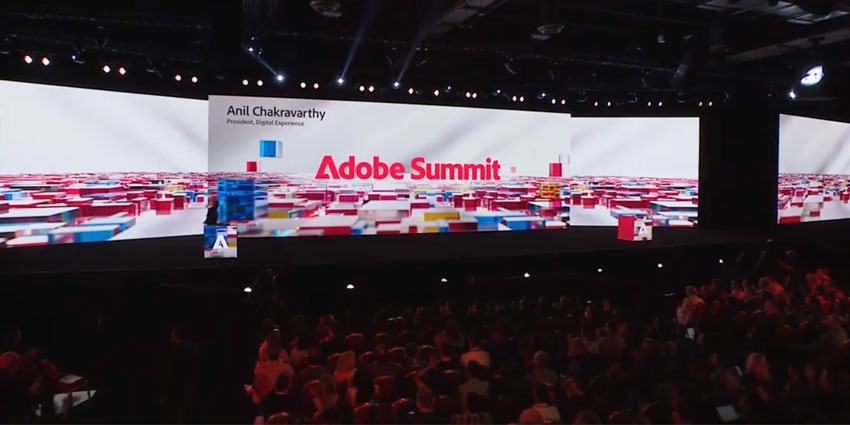
The Adobe Summit returned to Las Vegas in 2025, and – as expected – agentic AI stole the headlines.
However, while the headlines tell a familiar story, Adobe’s approach is different.
The first takeaway dives deeper, while the others explore some of the unsung stories from this year's event.
1. Adobe Wants You to Hold It Accountable for Its Definition of "Agentic AI"
At the 2025 Summit, Adobe launched an Agent Orchestrator, allowing Adobe Experience Platform (AEP) customers to create, manage, and “orchestrate” AI agents across enterprise systems.
Via the Agent Orchestrator, brands may also leverage agents from third-party ecosystems and customize pre-built AI agents – of which Adobe has already released ten.
Other brands, including Microsoft, SAP, and ServiceNow, have made similar announcements.
Yet, what made Adobe's launch unique is how it clearly defined the standards to which all Adobe agents will adhere, whether pre-packaged or built on the platform.
Indeed, during a keynote at the event, Amit Ahuja, SVP of the Adobe Experience Cloud Platform and Products, stated:
This is what we (Adobe) are holding ourselves accountable to as a definition of an agent. First, it's interactive. It interprets intent and multimodal communications. Second, it reasons. It thinks through problems, understands context, and makes decisions. It is not a rule builder. And third, it is autonomous, and it takes action. This could be via guidance or explicit action.
With this statement, Adobe not only defines its agents as interactive, able to reason, adaptive, autonomous, and capable of taking action but highlights what they are not: following a series of rules or RPA bots. For Adobe, this is different.
Why is that so significant? Well, as Liz Miller, VP & Principal Analyst at Constellation Research, stated in a LinkedIn Live session:
Definitions are important, and – right now – we do not have a good definition of agents, and we are not holding people accountable to those definitions of agents or “agentic”. We should be.
That's critical because if brands start repackaging workflow automation as AI agents, it creates confusion and may cause end-users not to realize the technology's full potential.
2. The Adobe Brand Concierge Takes Self-Service Beyond Customer Support
There are hundreds of virtual agent solutions on the market, helping businesses build a consumer-facing "bot" and deliver self-service experiences. The new Adobe Brand Concierge offers something a little bit different.
Built on AEP's Agent Orchestrator, the solution allows businesses to create, manage, and configure visually-forward self-service experiences.
Connected to critical back-end systems, Brand Concierge also delivers multi-faceted communication and contextual experiences based on customer profiles, personally guiding users from exploration to purchase and customer success.
Often, these solutions gear toward commerce and customer support. Adobe puts forward a solution for every customer-facing function.
The tech giant underlined this in a demo with Marriott Hotels. It highlighted how its concierge offered customers benefits for extending their stays, helped them book restaurant tables, suggested nearby experiences, shared loyalty point updates, and presented reminders for future stays.
"Brand Concierge is going to turn a lot of heads,” summarized Miller. “But, if I’m talking to everyone in the "CX" space – and I mean the little CX space where everyone thinks it’s about customer service – check out the demo and go and talk to your marketing team about what you might be able to do if you’re already an Adobe customer.
If you are on AEP, and this is how you already organize your content and your data, this opens up a lot more than you are going to be able to do in other solutions. This thing was impressive.
Another "impressive" feature is the ability to track brand perception alongside intent and sentiment.
Brands can also orchestrate intent-driven experiences, blending different forms of AI, modalities, and live reps to transform digital touchpoints. The demo below showcases this.
3. Adobe Serves Up Enterprise-Safe Imagery for Microsoft 365 Customers
At the Summit, Adobe strengthened its Microsoft partnership. As a result, marketing teams – which are joint customers – may now leverage Microsoft 365 Copilot to generate images that are “enterprise safe”.
Firefly supports this capability. It is only trained on Adobe Stock images that the tech giant has permission to use.