

The customer journey is becoming more complex, with customers moving between more channels than ever before. While service organisations typically want customers to begin their journeys in self-service, not all journeys can be wholly contained within it.
Gartner research found that 88% of customers that start in self-service touch multiple channels. In fact, Gartner research found that 62% of customers report that transitions between service channels are 'high effort'.
Customer service and support leaders must re-evaluate the customer journey to reduce this unnecessary effort, break down silos and create a seamless experience for the customer.
Step 1: Move from vertical channel silos to horizontal integration
When building the customer journey, many organisations fall into the trap of adding channels independently over time, without stopping to look at the bigger picture.
An example of the customer’s experience when faced with vertical silos can be found in Figure 1 below.
Figure 1. A disconnected customer journey
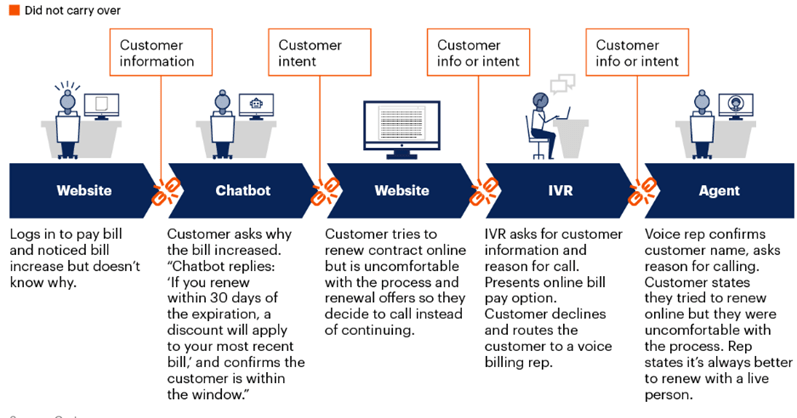
Not only does this silo effect create frustration for the customer, but it also results in a lack of alignment between teams.
In contrast, a horizontal approach enables leaders to orchestrate the customer journey more effectively and use channels simultaneously or sequentially to fulfill the customer journey.
In order to successfully adopt this approach, customer service leaders must work to break through the silos and establish a cross-functional team.
While each team are experts in their own vertical, the customer journey doesn’t stop with them – they must be part of a larger team focused on the entire customer journey.
Step 2: Develop shared priorities and performance metrics
Once established, this team must develop shared priorities that will support common performance metrics. Shared metrics, rather than individual teams working towards their own channel-specific goals, will ensure that the team’s focus moves from individual channels to overall experience.
This does not mean that individual channel priorities and metrics disappear – rather, the weighting of channel-specific priorities is lower than that of the shared metrics